S&P 500 Growth Hinges on Two AI Buyers, Morgan Stanley Warns
Hyperscaler capex will generate 25% of S&P 500 revenue growth in 2027, exposing the broader index to supply-chain bottlenecks and rising debt loads.
The S&P 500’s earnings growth has quietly become a hostage situation. Roughly a quarter of the index’s revenue expansion in 2027 will flow from just two corporate customers buying artificial intelligence hardware, according to an Oct. 15 analysis by Morgan Stanley.
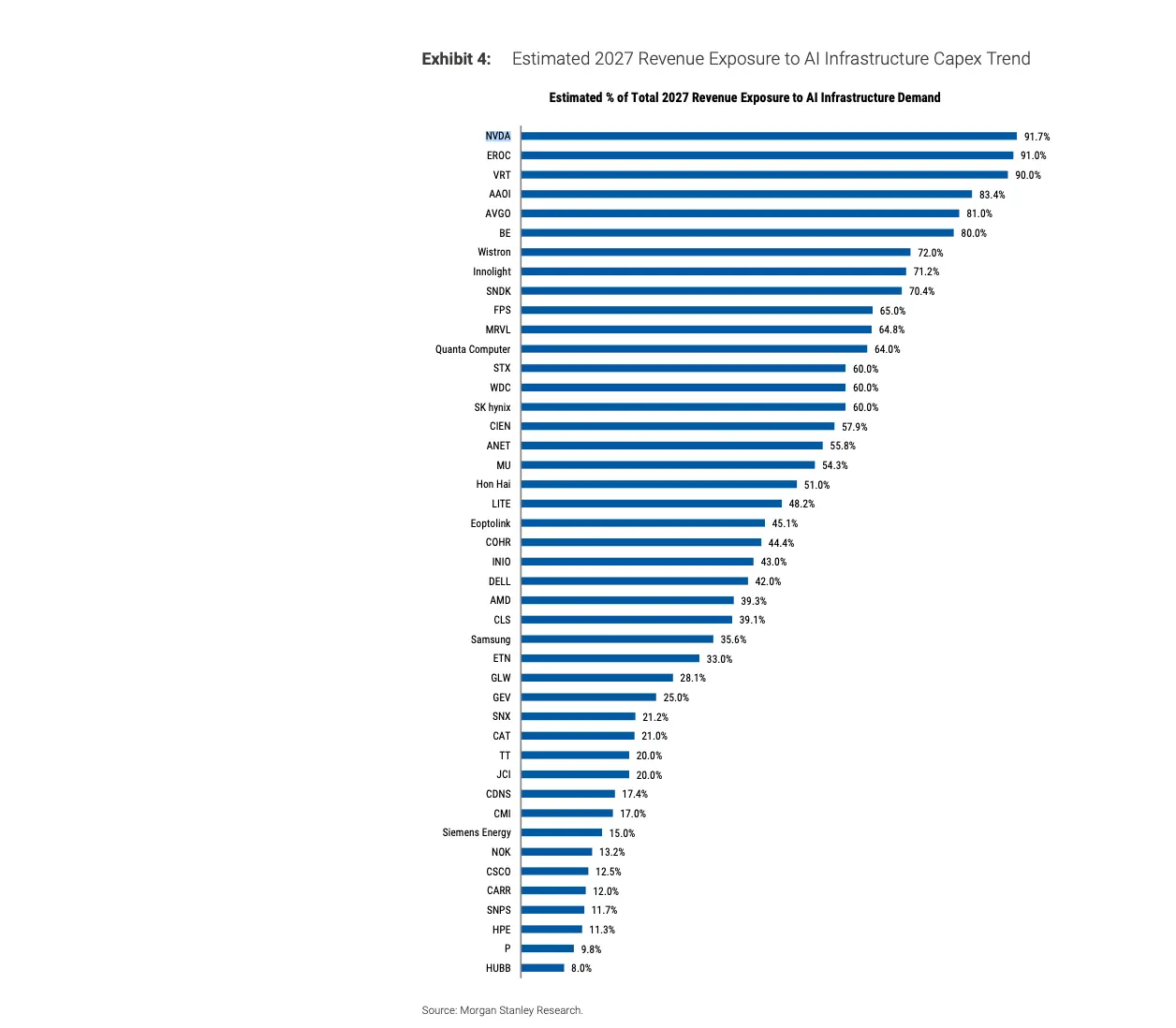
SpaceX and Amazon Web Services are projected to account for 72% of Nvidia’s hyperscaler revenue growth in 2027, the bank’s North America Insight team, led by Nicholas Lentini, wrote in a 65-page report. Together, those two entities will make up about 54% of the chipmaker’s total hyperscaler revenue that year.
That concentration creates a structural vulnerability far beyond Santa Clara, California. Nvidia captures nearly $700 billion of the estimated $1 trillion in S&P 500 revenue generated by AI infrastructure spending in 2027, Morgan Stanley calculates. The broader implication is stark: hyperscaler and neocloud customers will represent only 5% of total S&P 500 revenue that year while driving approximately 25% of the index’s top-line growth.


Wall Street indices have historically weathered sector rotations. But when a single equipment supplier funnels capital expenditures from a handful of buyers into broad market returns, the mechanics shift. A delay in one major data center buildout no longer dents a sub-sector. It drags the benchmark.
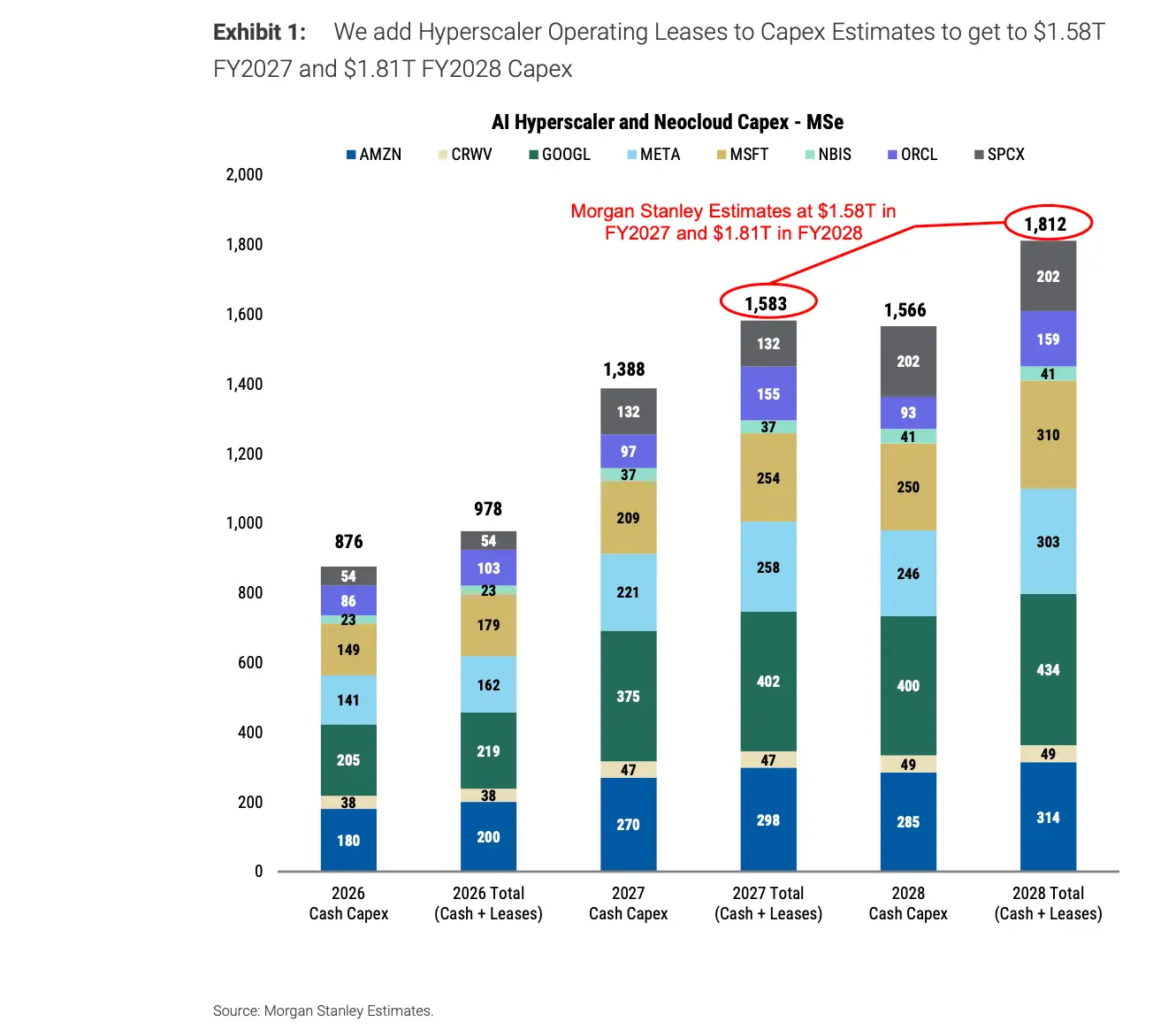
Hyperscalers and AI cloud providers plan to spend $1.58 trillion in 2027, up roughly 60% from about $980 billion this year, before climbing to $1.8 trillion in 2028, the report estimates. About $195 billion of the 2027 figure consists of data center leases. These commitments never appear as capital spending on cash flow statements, yet they lock companies into long-term financial obligations. Hyperscalers have already disclosed more than $1.1 trillion in lease commitments that have not yet begun.
Financing that trajectory requires debt markets to cooperate. Hyperscalers sold approximately $255 billion in unsecured bonds this year alone, representing about 30% of estimated 2026 spending. Morgan Stanley modeled what happens if borrowing accelerates further. For Amazon, Alphabet, Meta, and Microsoft—companies rated AA or higher—combined interest coverage ratios drop from about 31x to 12x. Oracle and SpaceX see coverage fall from 4x to 1.8x.
Not all of the headline spending figures represent new physical infrastructure. Inflation eats into the numbers. Amazon’s finance chief recently attributed most of an increase in the company’s spending plan, from $200 billion to about $220 billion, to rising memory costs rather than changes to its actual build schedule, according to the bank.
Electricity presents a harder ceiling than bond yields. Morgan Stanley’s power model projects a 32-gigawatt U.S. shortfall for data centers through 2028, leaving roughly one-third of the 97 gigawatts required without a grid connection. Companies can purchase GPUs faster than utilities can wire substations. That dynamic sustains chip revenue temporarily but risks producing hoarding and stranded inventory, the analysts noted.
When spending plateaus, the damage distributes unevenly. Volumes might hold steady while prices collapse, wiping out supplier margins first. The late-2022 memory downturn offers a recent precedent: NAND shipments fell only about 5%, but prices cratered 20% to 30%. Memory, optics, and other small-dollar components at the tail end of the supply chain face the steepest cuts in a pullback, the report states.
Morgan Stanley considers its own forecasts for SpaceX and Amazon conservative, which leaves a low bar for remaining hyperscalers. The bank’s model assumes Nvidia’s share of spending from other hyperscalers slips from 18% in 2026 to 16% in 2027, even as Nvidia expects to gain ground.
Political friction adds another variable ahead of the midterm elections. Data-center restrictions have emerged as a wedge issue. While Morgan Stanley does not expect a federal pause on construction, it identifies tax breaks as the consensus target regardless of which party controls Congress.