800W on an RTX 5090? New driver hack bypasses Nvidia BIOS lock
RTX 5090 hit 800W in developer tests, but connector melt risks and an upcoming Nvidia driver patch put the window at risk
By Anonymous
A set of three new developer tools lets GeForce RTX 30, 40 and 50 series owners load a modified VBIOS without writing to the graphics card’s flash chip, reopening a capability most enthusiasts assumed Nvidia had permanently closed. The method works by loading the custom image through the driver itself, which means it can be undone with a single driver update.
On Windows, the loader places the edited image in a registry key where the Nvidia driver already looks for a VBIOS override at device start. The GPU is then restarted and the GSP firmware boots from the custom image rather than the one stored on the card, according to the developer.


The Linux variant follows a different route, patching Nvidia’s open kernel modules so the GSP firmware starts with the custom image. Both projects build on earlier override research, which the developer credits directly.
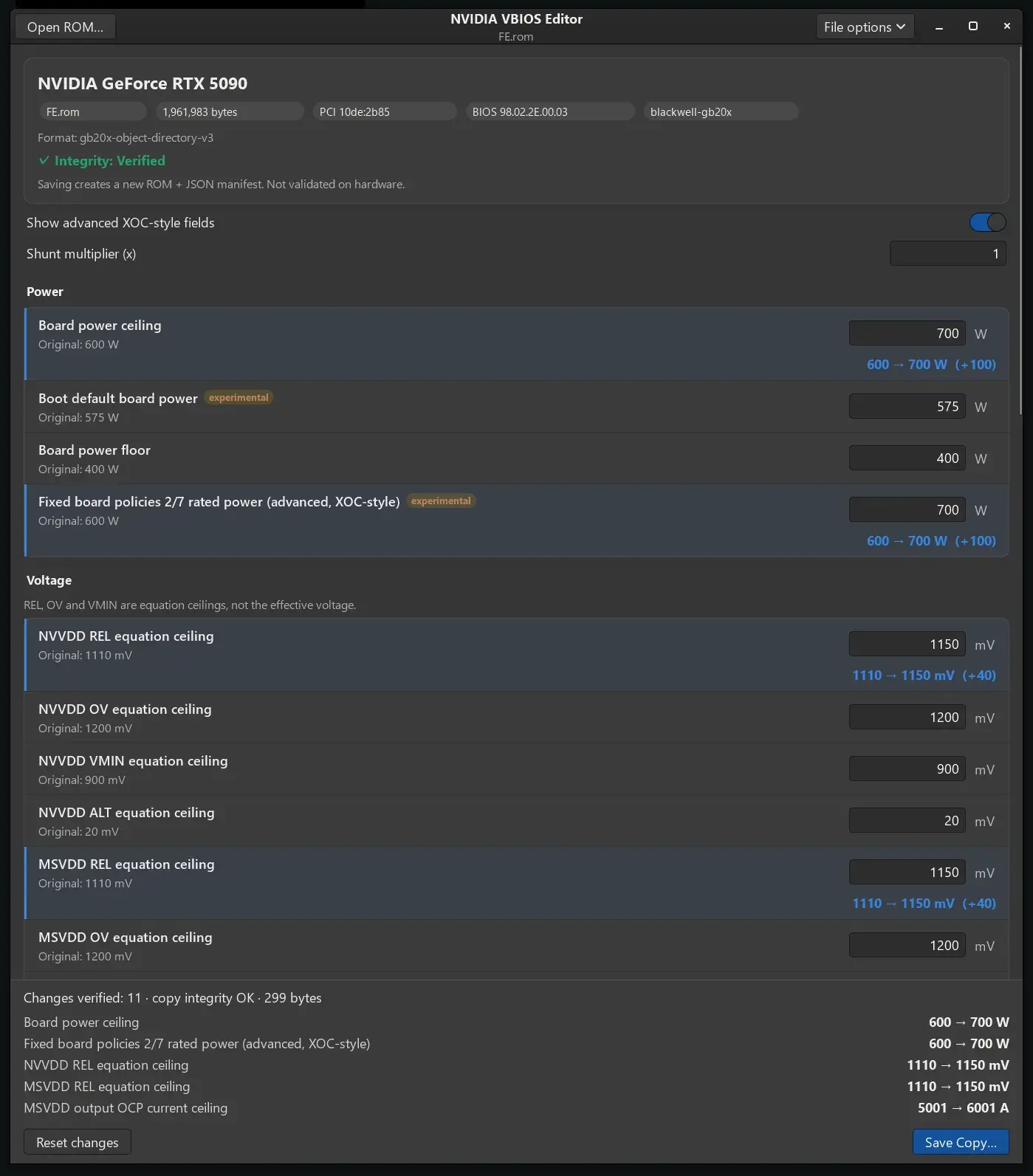
The editor exposes settings overclockers have wanted back for years: board power limits, voltage ceilings, clock offset ranges, 12V input current and output overcurrent protections, fan PWM frequency and fan channels. Blackwell cards get the full set, while Ada and Ampere images are limited to fields the developer has validated.
The numbers circulating so far are aggressive. On what appears to be an RTX 5090 Founders Edition, the board power ceiling rose from 600 W to 700 W and the NVVDD and MSVDD voltage ceilings from 1,110 mV to 1,150 mV. An RTX 4090 had its power limit raised to 671 W, confirmed by nvidia-smi, up from 550 W. In the developer’s own testing, an RTX 5090 reached 800 W, an RTX 5080 went from 360 W to 500 W, and an RTX 5060 Ti from 185 W to 300 W.
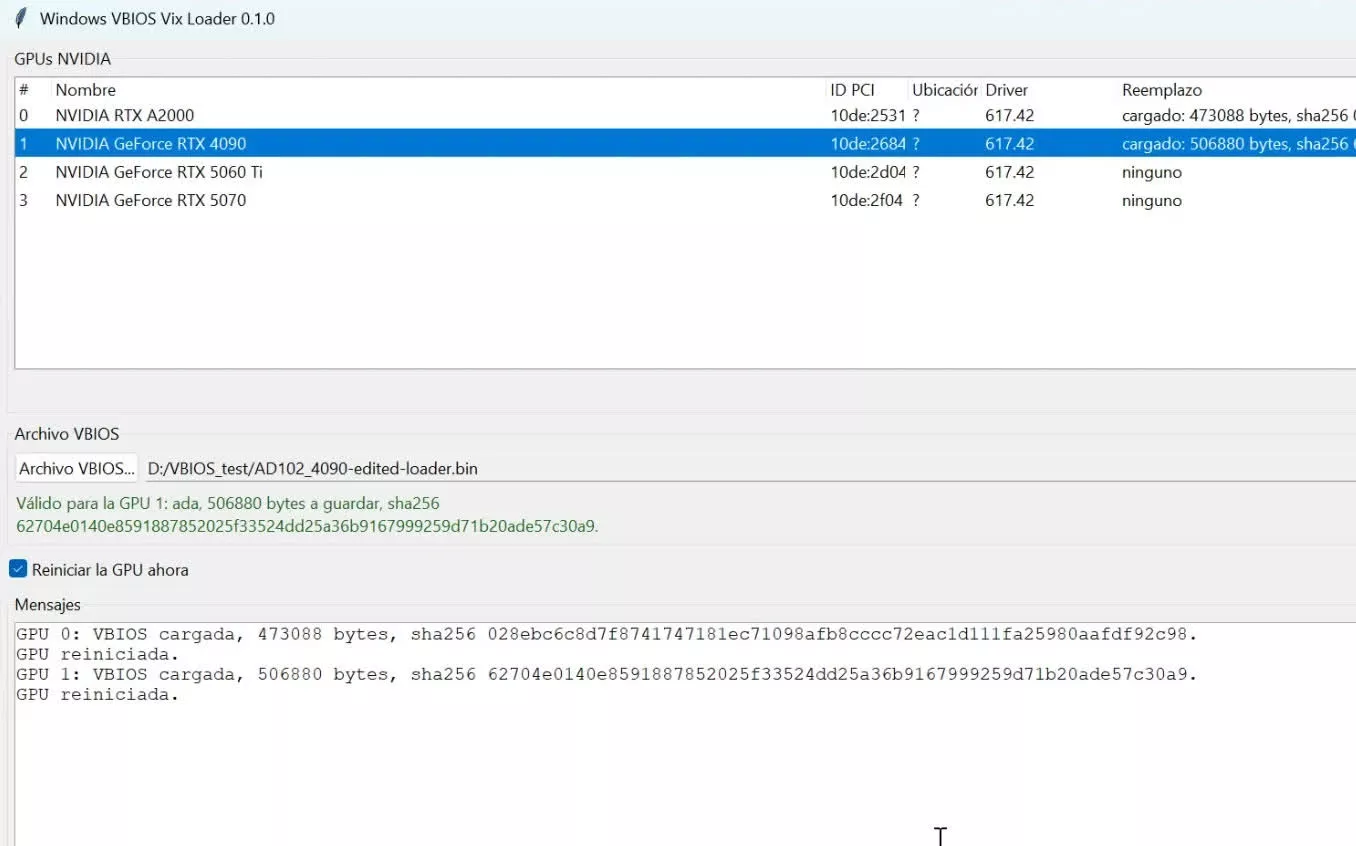
It works in both directions. On an RTX A2000, the loader dropped the card’s power floor to just 5 W, and the developer says voltages can be lowered to a hard floor of roughly 0.4 to 0.45V depending on the GPU generation. That makes the tools just as interesting for anyone who wants a cooler, quieter card with an undervolt baked in rather than applied by Afterburner at every boot.
No flashing means no bricked card from a failed write, but it doesn’t make the hardware any tougher. The 12V-2×6 connector on these cards is rated for 600 W, and there have been plenty of reports of RTX 5090 connectors melting at stock settings. Pushing 800 W through one is a big gamble, and with RTX 5090 and 5080 supply tight and warranty claims unlikely to cover a modded card, a dead GPU won’t be easy to replace. The developer advises keeping a copy of the original ROM and testing on a GPU that isn’t driving the display, and documents a Safe Mode recovery path, since Nvidia’s driver doesn’t load there.
As for how long this will last, the developer isn’t optimistic, saying that Nvidia will very likely patch the method he’s using in upcoming drivers and urging users to enjoy it while they can. Meanwhile, some enthusiasts are thrilled to see BIOS editing return, others want it purely for undervolting, and plenty are already joking about how many cards will die before Nvidia closes the gap.
What’s Next
The tools remain available for now, but the window is clearly short. For users weighing the trade-off, the question isn’t only whether the numbers are achievable—it’s whether the extra power is worth the risk on hardware that’s already under scrutiny for connector failures at much lower loads.