Teghaza 001 Was Filed as an Ordinary Mars Rock. It Is the First Piece of Mars’ Ancient Crust.
The rock spent four years filed under the commonest class of Martian meteorite. Two dating clocks, a water record written before the age was known, and a composition unlike the rest of the collection say it belongs to the Mars that actually covers the planet.
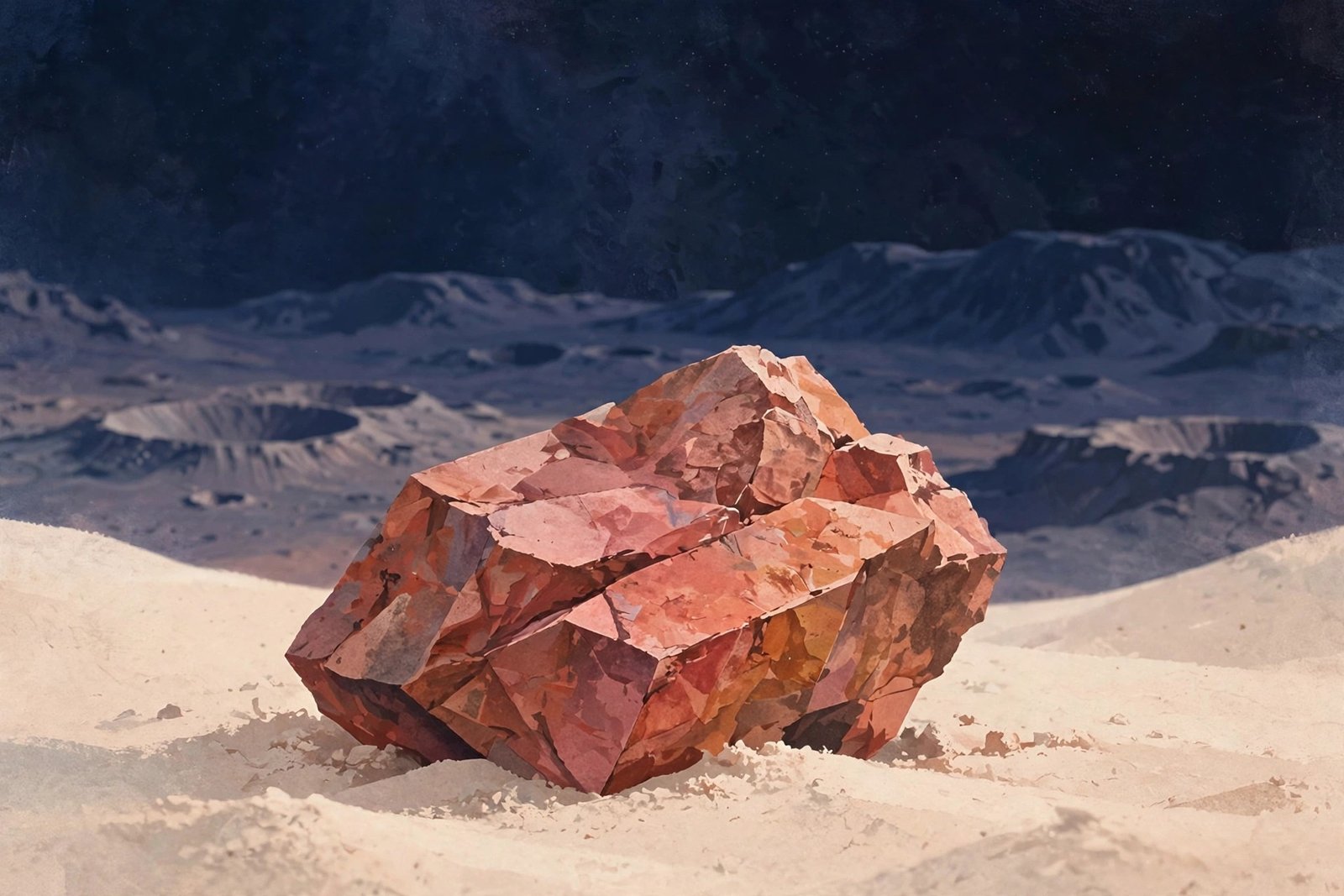
Sahrawi prospectors picked the pieces up on a salt plain in Mali in 2022, 34 kilometres from the village of Bir Chali. Eight fragments of rose-coloured rock, 798.5 grams in all, the largest about the size of a fist. A private collector bought them. A piece went to the University of New Mexico for classification, where the oxygen isotopes matched Mars. The rock was filed as a shergottite, the commonest class of Martian meteorite and one of the youngest. Teghaza 001 stayed in that file until the people who actually looked at it started finding things a shergottite should not have.
Mars formed about 4.5 billion years ago, and most of the ground a spacecraft can see from orbit is ancient terrain more than 3 billion years old. The rocks that fall to Earth tell a younger story. Nearly all of the roughly 435 known Martian meteorites are far younger than the surface they came from. The three main classes, shergottites, nakhlites and chassignites, formed 2.4 billion years ago or later. Most specimens in the collection are no more than about 2 billion years old. Only two older specimens were known before Teghaza 001. Planetary science had been describing the early planet from samples that mostly postdated it by two billion years.
Carl Agee, director and curator of the University of New Mexico’s Institute of Meteoritics, noticed the mismatch first. With Karen Ziegler, he measured the oxygen isotopes at the university’s Center for Stable Isotopes and put the rock under the electron microprobe, and the values reminded him of a different famous specimen. “I realized that this one was a little bit like Black Beauty, not exactly, but it resembled it in the oxygen isotope values,” Agee said in a University of New Mexico statement. Under the microscope he found patches rich in manganese oxide, a compound the rovers on Mars are programmed to look for as a sign of an environment where life could have taken hold. One mineral had been altered on the inside while its outer part stayed pristine. That is the reverse of how a rock weathers on Earth. The change had happened on Mars, long before any impact threw the rock into space.


Yang Liu of NASA’s Jet Propulsion Laboratory almost did not take the sample on. She had seen plenty of shergottites, and Teghaza 001 looked like one more. “It was only after we started looking closely that we realized this meteorite is really unique,” Liu said. What changed her mind was zircon. The mineral is tough enough to survive billions of years, and it is rare in shergottites. The zircons carried uranium, and the uranium decaying to lead gave an age of about 4.11 billion years. A second clock read about 4.24 billion years: rubidium decaying to strontium. A third dating method agreed. A heating event about 4.1 billion years ago may have reset those clocks, so the paper reports a minimum age. Teghaza 001 formed no later than 4.1 billion years ago, and it may be older still. No other Martian igneous rock in the collection is a single, unmixed rock type of that age. Agee put the distinction plainly in the same statement: Black Beauty is a conglomeration of many rock types, while Teghaza 001 is just one unadulterated rock type.
Francois Tissot, a geochemist at Caltech, applied an in-situ rubidium-strontium method his team had pioneered. He worked on a piece smaller than a fingernail, reading single mineral grains on its surface instead of dissolving the whole sample in acid. The traditional method destroys what it dates. Alicia Cruz-Uribe of the University of Maine worked with Tissot’s lab in the summer of 2025. She used a laser beam one-sixth the width of a human hair to drill the sample. Helium gas carried the material into a mass spectrometer. A single spot took less than a minute. The rubidium-strontium age came back the same as the uranium-lead age for the zircons, which is what made the team trust a method built for minerals other than zircon, feldspar among them. “I think we actually jumped up and down; full on dance party in the lab,” Cruz-Uribe said. The university holds 22 grams of Teghaza 001 for study. The 442-gram main mass is in Bethel, Maine, at the Maine Mineral & Gem Museum, which owns it and most of the known pieces.
The water was established before the age was. A separate paper in Science Advances in June, by some of the same authors, had already read the water bound inside apatite, a phosphate mineral in the rock. It came from two places at once. Some was water carried in the magma that rose from the mantle. The rest came from the surface and atmosphere, percolating down through the crust and mixing with that magma while the rock was still cooling underground. The water also carried a signature of loss. Its hydrogen was enriched in deuterium, the heavier form that escapes to space more slowly. That meant Mars had already been shedding water when Teghaza 001 formed, its atmosphere thinning under ultraviolet light that split water molecules apart. The deuterium-to-hydrogen ratio matched the one measured in Allan Hills 84001, the Antarctic meteorite that had been the only other intact sample of the earliest crust. Lee Saper is second author of the Science paper, now at NASA’s Ames Research Center. He told the New York Times that two matching measurements instead of one gave the team much more confidence. The October paper added the oxygen side of the same story. Teghaza 001 holds about two parts per thousand more oxygen-18 than other Martian meteorites. Neither crystallisation nor gas escaping from magma can produce a gap that big. The magma must have swallowed crust already altered by surface water, or reacted with fluids carrying the same heavy signature.
Most Martian meteorites are dark volcanic basalts. Teghaza 001 is unusually rich in silicon, with similarities to granite, which suggests the early crust was chemically more diverse than the young lava samples had implied. Liu told the New York Times that the mantle portion of the rock looked significantly different from anything measured in other Martian meteorites, more primordial and less worked over by later processes. Saper, in NASA’s release, called it the first piece of Martian crust from a part of Mars no sample had covered before. It records water and rock interacting, and possibly an imprint of the atmosphere as it lost its water. The paper describes Teghaza 001 as coming from a geochemically distinct mantle source, previously unsampled. That is evidence that the interior of Mars was more varied than the meteorites on Earth had suggested.
Allan Hills 84001 was found in Antarctica in 1984. In August 1996 it was announced as possible evidence of fossil microbes on Mars. The claim drew a statement from President Bill Clinton. Then it unravelled line by line, as each feature found an explanation that did not need life. Its age, first put at about 4.5 billion years, was later revised to about 4.1 billion, close enough to Teghaza 001 that the Science paper treats the Sahara rock as likely the older of the two. Black Beauty, Northwest Africa 7034, holds clasts older than 4.3 billion years. It holds the most water of any Martian meteorite found on Earth, about 0.6 percent by mass. But it is a breccia: hundreds of fragments of different ages stuck together. Neither gave researchers one coherent piece of early crust to read straight through. Teghaza 001 does. Its authors are careful about the one thing it does not do. Saper told Reuters the findings support the idea that early Mars had what life would need, but they do not directly answer whether there was life on Mars.
Comparing its chemistry with measurements from NASA’s Mars Reconnaissance Orbiter, the team identified 13 candidate sites in the cratered southern highlands, the most likely ground lying northwest of the Hellas impact basin, terrain no lander has touched. Arya Udry, a planetary scientist at the University of Nevada, Las Vegas, was not involved in the study. She told Scientific American that the unknown origin is exactly why Mars samples need to be brought back deliberately instead of arriving by chance. The museum in Bethel has lent an additional fragment so the work can continue at Caltech and at the University of Maine, where Cruz-Uribe has already analysed it in the MicroAnalytical Geochemistry and Isotope Characterization Laboratory.