The China Spaceplane in America’s New Photo Has Already Flown Again
A 2024 photograph published on page 53 of a 130-page threat report, a disclosure chain that runs back to a 2024 conference showing, and a fourth flight now 263 days in orbit.
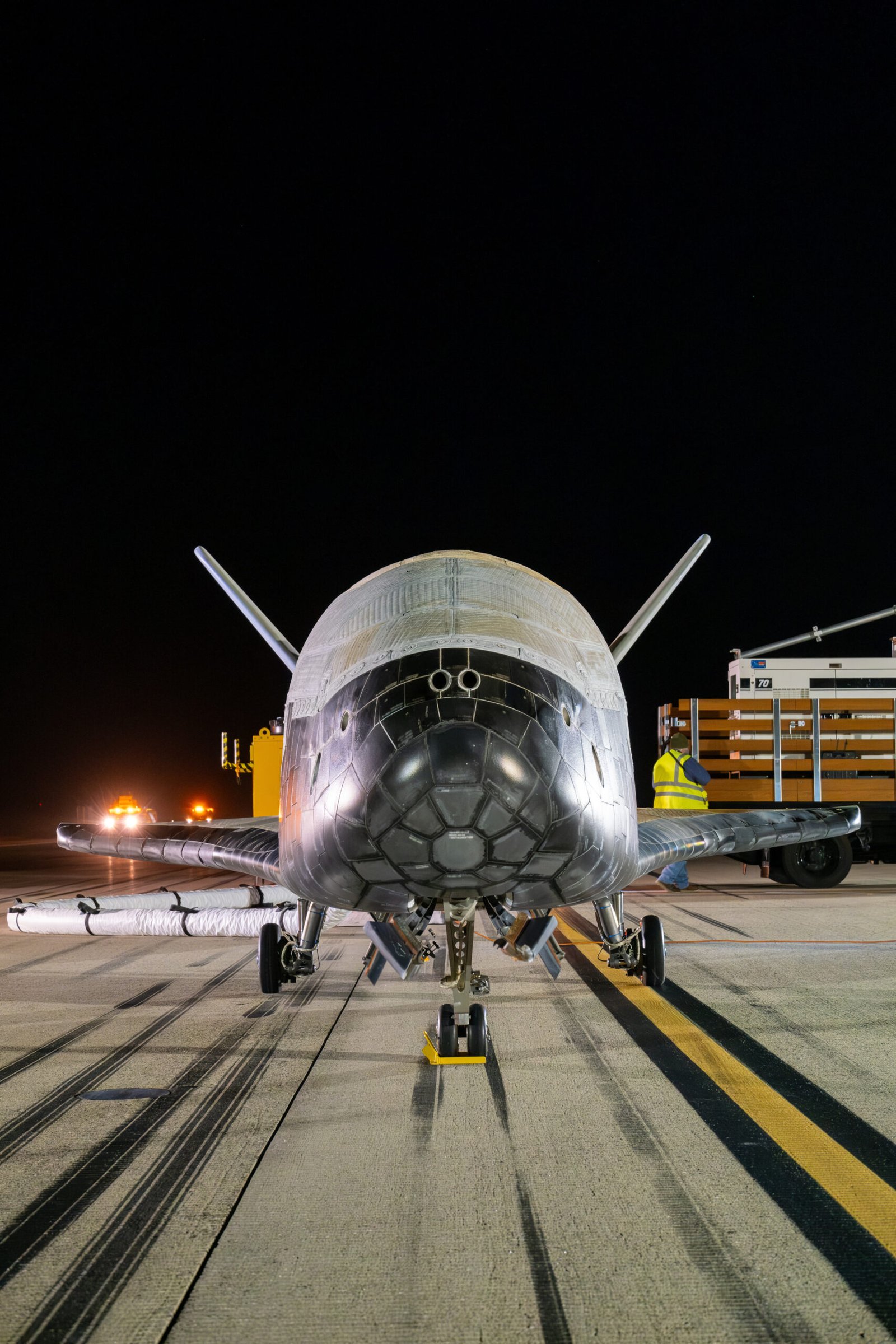
The spacecraft in the photograph has been back in orbit for 263 days. The photograph is older. It launched from the Jiuquan Satellite Launch Center on February 7, 2026, aboard a Long March 2F rocket. Tracking analysts report it is still up there, still maneuvering, still releasing and recapturing the small object it carries with it. It was taken in 2024 by a commercial imaging satellite, during the vehicle’s third flight. It reached the public only this week, on page 53 of the Defense Intelligence Agency’s new report, “Challenges to Security in Space.”
A lower-resolution version of the same image had already been shown in public once before, by U.S. Space Force Col. John Patrick at a space forum in South Korea in 2024, when the spacecraft’s identity was still uncertain. The DIA’s caption calls the craft only an unnamed Chinese “spaceplane.” The caption names no model. The agency says, in its words, that “spaceplanes can launch into orbit to place objects in space or even test them and return to earth.” The full-resolution version arrived two years later. It came inside a report the DIA describes as the third edition of its unclassified space-threat series, after editions in 2019 and 2022, with information current as of July 2026.
The first flight, on September 4, 2020, lasted two days. Open-source analysis later associated its landing with a runway near Lop Nur in northwestern China. The second flight, launched August 4, 2022, stayed up 276 days, until May 8, 2023. The third, launched December 14, 2023, stayed up 268 days and returned September 6, 2024. The fourth, launched February 7, 2026, has now run 263 days. That puts it five days short of the third flight’s stay and thirteen short of the program’s best. It passes the third flight’s mark in the first days of November and reaches the 276-day best around November 10, if it stays up that long.


On the second flight, the DIA report says, the vehicle appeared to “maneuver with a companion satellite and conduct station-keeping at around 1 km separation,” and that “at one point, the two objects appeared within 100 meters of one another. The spaceplane and satellite possibly rendezvoused before the satellite was re-released.” A commercial tracker saw the same thing. LeoLabs reported on May 8, 2023 that it had observed “multiple large maneuvers raising the object’s altitude, as well as repeated deployments, formation flying, and docking of a sub-satellite Object J (NORAD ID 54218),” including what appeared to be at least two and possibly three capture or docking operations. During the third flight, the DIA says, the craft again “released and interacted with an object.” During the fourth, astronomer Jonathan McDowell, working from U.S. Space Force tracking data, recorded a rerendezvous with its subsatellite on September 10 and a recapture on September 13. Similar operations were reportedly repeated later in the flight.
The camera that took it belongs to Maxar Technologies, now called Vantor. Its satellites photograph the Earth. This one was pointed at another satellite instead. The practice is called non-Earth imaging, and that kind of collection is now part of how the United States characterizes foreign objects in low Earth orbit. The clearest public picture of the China spaceplane exists because a commercial camera built to look down was turned sideways.
The United States flies two X-37B vehicles in rotation, and the longest completed American flight, OTV-6, spent 908 days in orbit before landing at Kennedy Space Center on November 12, 2022. China’s best of 276 days is less than a third of that, a ratio of more than three to one. Both programs now fly with a rear service module that provides power and propulsion in orbit and separates before landing. Both keep their payloads largely undisclosed. The most recent American landing the public saw was OTV-7’s at Vandenberg Space Force Base on March 7, 2025. Victoria Samson of the Secure World Foundation told Breaking Defense, “It looks a lot like the X-37B!”
The DIA report names two Chinese spaceplane lines, Shenlong and Tengyun, and does not say which one is in the photograph. Whether China operates one vehicle or several is not publicly known. Beijing’s stated purpose has not changed since the program’s second launch. Xinhua said, in translation, that the test spacecraft would carry out “reusable and in-orbit service technology verification” to provide technical support for the peaceful use of space. The DIA report does not conclude that the missions are weapons tests, and nothing in the public record establishes a military payload.
The DIA puts China’s intelligence, surveillance and reconnaissance satellite fleet at more than 510 satellites as of July 2026. That is more than triple its 2018 total. The count includes satellites owned by Chinese commercial firms, whose imagery the report says can reach the PLA under military-civil fusion. The American Enterprise Institute’s count tells a flatter story underneath that tripling. China’s operational surveillance and weather fleet grew from 141 satellites in 2018 to 541, while the United States went from 298 to 643 and is expanding faster. Senior fellow Todd Harrison notes that the number of satellites is not increasing as fast as it was. China launched 22 rockets in 2016 and 93 in 2025, according to a newsletter summary of the report. The same report carries a projection, relayed by SpaceNews, that China may field space-based directed-energy systems by the late 2020s, after earlier editions tracked ground-based lasers. The wording in the summary is “may,” not “will.”
Beijing answered the report within a day. The Global Times, in an October 27 article, called it an exercise in hyping threats, quoting analyst Song Zhongping’s argument that Washington was justifying its own space buildup, and pointed to a Chinese Foreign Ministry position paper on outer-space governance released October 23 that warned against an arms race in space. The DIA report also examines the orbital environment itself, including debris. A congressional hearing document from April 2026 put the number of objects the United States tracks at roughly 50,000, including more than 15,000 satellites.