

Marissa Roy Opens Lead Over John McKinney in Los Angeles City Attorney Race as Voters Remain Overwhelmingly Undecided
Poll reveals overwhelming voter unfamiliarity with the office and its candidates as the November general election approaches
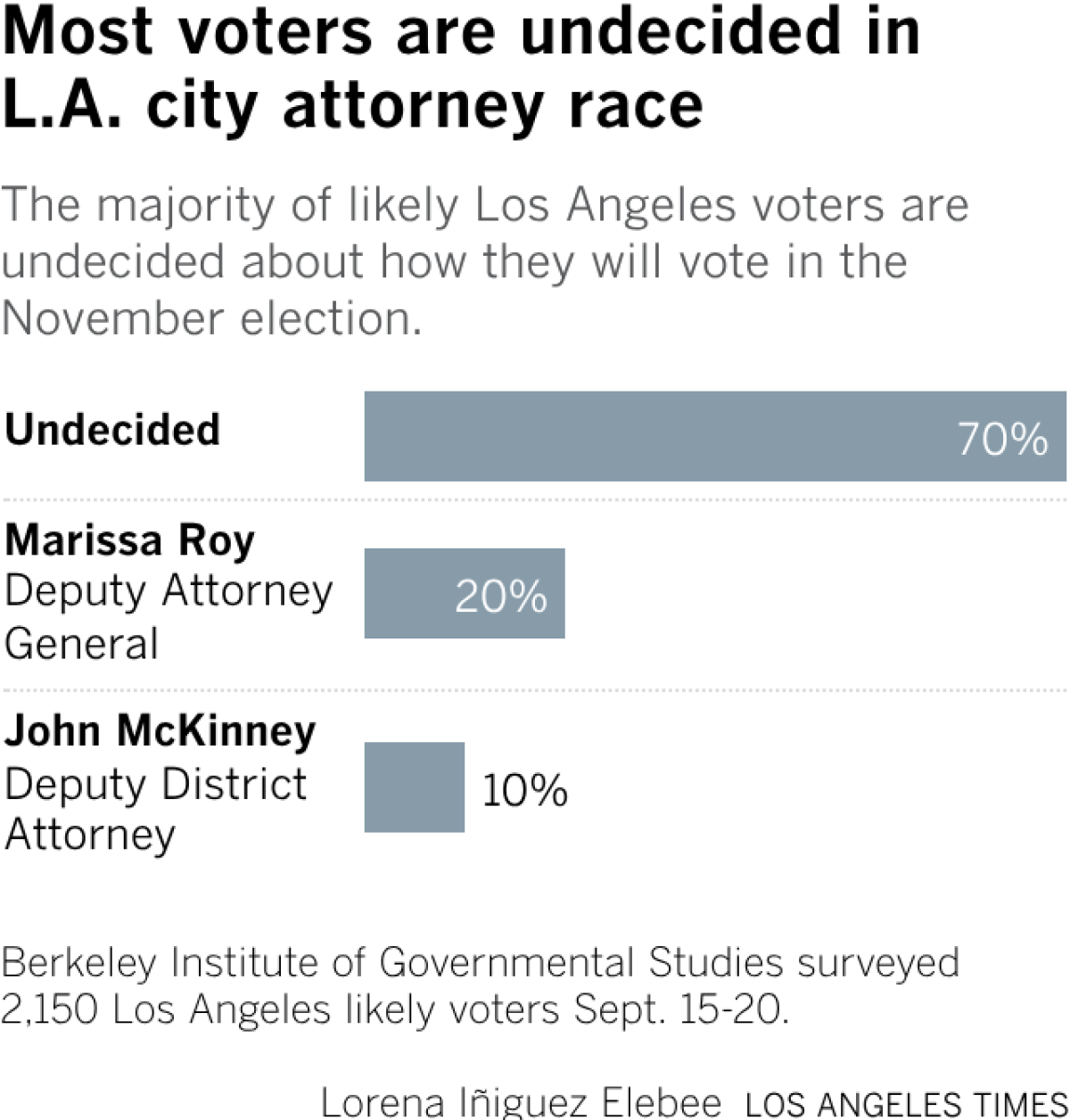
A new statewide poll suggests that Marissa Roy has emerged as the front-runner to become Los Angeles’s next city attorney, an office whose influence over municipal governance far exceeds its relatively low public profile. The UC Berkeley Institute of Governmental Studies survey, co-sponsored by The Times, puts Roy 10 percentage points ahead of rival John McKinney among likely Los Angeles voters — a margin that comes after both candidates survived a bruising June primary that claimed the political career of incumbent Hydee Feldstein Soto.
The results arrive at a moment when the city’s legal apparatus is under closer scrutiny than ever. The Office of the Los Angeles City Attorney oversees a budget approaching $200 million and handles roughly 120,000 municipal code violations each year — from zoning disputes to misdemeanor prosecutctions — while simultaneously shaping the legal architecture of city ordinances. In many American cities, the prosecutorial functions wielded by Los Angeles’s city attorney are handled by a separate district attorney’s office, making the position uniquely powerful in municipal government.
Yet the job’s outsized authority has done little to generate name recognition. Seventy percent of likely voters said they held no opinion of either Roy or McKinney, a figure that experts say is typical for down-ballot races but raises questions about how undecided voters will ultimately break in the November general election.


The polling gap between Roy and McKinney mirrors a broader pattern visible in the concurrent mayoral contest, where Councilmember Nithya Raman holds a commanding lead over Mayor Karen Bass. But analysts caution against equating the two races. While the mayor’s battle has attracted sustained national attention and fierce campaigning, the city attorney’s contest has flown largely under the radar — and that vacuum could prove decisive.
Roy, a 34-year-old California deputy attorney general, has positioned herself as a progressive pragmatist who links the city’s ballooning litigation liabilities to its deteriorating infrastructure. She points to the landmark $17-billion settlement her team secured with Meta Platforms as a demonstration of the kind of aggressive public-interest litigation a well-resourced municipal law office could pursue. The settlement, one of the largest corporate privacy resolutions in U.S. history, showcased Roy’s willingness to take on corporate giants — a pitch that resonates with the city’s influential labor unions and its network of democratic socialist political clubs.
McKinney, a 58-year-old deputy district attorney for Los Angeles County, frames his candidacy around law-and-order themes, arguing that the city attorney’s prosecutorial tools should be deployed to address street-level disorder and homelessness. He oversees more than 300 staff members at the county level and has spent decades securing high-profile criminal convictions — credentials he believes outweigh his limited experience in civil municipal litigation.
Both candidates benefited from a nationwide surge of anti-incumbent anger that swept through the June primary. Each directed their fire at a common opponent whose name recognition had eroded among disillusioned voters, rarely targeting the other directly. That dynamic, however, is expected to shift as the general election approaches and the two candidates’ ideological differences become harder to obscure.
The partisan composition of the electorate could complicate McKinney’s path. About 19% of the city’s voters identify as conservative, and polling suggests that segment leans heavily toward McKinney — roughly 30% of self-identified MAGA voters and 21% of Republicans favored him in the recent survey. But Los Angeles’s general-election electorate has trended leftward for years, and primary voters who skew older and more conservative are replaced by a younger, more progressive base in November.
Roy draws her strongest support from Democrats, at about 25%, and from the roughly 30% of voters who describe themselves as progressive or democratic socialists. Her endorsements span the city’s influential public-sector unions and the L.A. County Democratic Party, which backed her this spring. McKinney, by contrast, counts the Los Angeles Police League among his key supporters and has been championed by Los Angeles County District Attorney Nathan Hochman.
Voter priorities offer a glimpse of how the undecideds might eventually divide. Roughly a third of likely voters ranked “moving homeless people indoors” and “crime and public safety” as top concerns, while nearly as many pointed to crumbling streets, sidewalks, and streetlights as essential priorities — an issue on which Roy has explicitly built her platform.
What remains unclear is whether Roy’s polling advantage reflects durable support or the natural gravitational pull of a progressive candidate in a city whose electorate has moved steadily left. With more than two-thirds of voters still uncommitted, the final stretch of campaigning could reshape the field entirely.









