Fraunhofer Battery Simulator Quantifies Impact of Storage on German Electricity Price Volatility
Open-access tool uses real exchange data to model volatility reduction and solar revenue uplift under varying storage scenarios
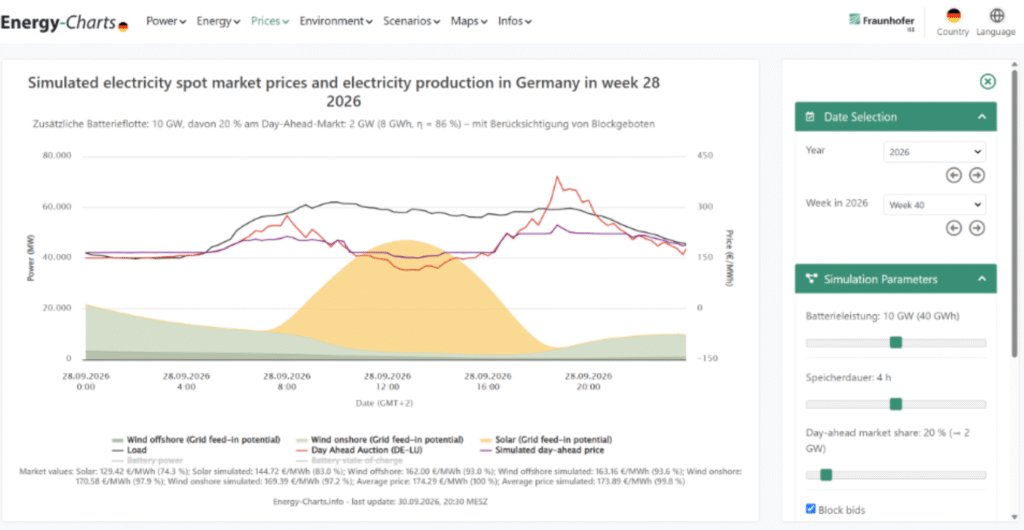
A new open-access modeling tool now allows market participants, policymakers, and researchers to calculate precisely how utility-scale battery storage alters wholesale electricity prices in Germany. Developed by the Fraunhofer Institute for Solar Energy Systems (ISE), the simulator moves beyond theoretical estimates by processing actual bid data from the European Power Exchange (EPEX) day-ahead auction to project price formation under varying storage capacities.
The tool addresses a critical gap in energy transition planning: distinguishing between price stabilization and physical generation. While batteries are frequently cited as solutions for renewable integration, their economic function differs fundamentally from power plants. The simulator demonstrates that while storage can drastically reduce price spikes and negative pricing events, it does not create energy. This distinction is vital for grid operators who must balance the arbitrage value of batteries against the need for dispatchable generation capacity during prolonged periods of low renewable output.
Users can configure hypothetical battery fleets ranging from 0 to 20 gigawatts (GW) with discharge durations between two and six hours. The model incorporates complex market mechanics often overlooked in simplified analyses, including block bids from conventional power plants and cross-border market coupling. These variables significantly influence outcomes because thermal generators cannot always adjust output instantaneously in response to battery dispatch, and neighboring grids can absorb or supply power that domestic storage cannot. Results are generated at 15-minute intervals and updated daily, providing granular visibility into charging cycles, state-of-charge dynamics, and renewable feed-in correlations.

Fraunhofer’s baseline analysis using 2025 market data illustrates the magnitude of potential volatility suppression. In a scenario adding 20 GW of two-hour storage without cross-border trading, the average daily spread between peak and quarter-hour prices contracts by 60%, dropping from €130/MWh to €53/MWh. Extreme price events show even more dramatic sensitivity. Hours exceeding €200/MWh fall from 169 to just 20 annually, while negative price occurrences decrease from 575 to 271. On January 20, 2025, the year’s most expensive trading day, the modeled fleet would have reduced the evening peak from €583/MWh to €221/MWh. Conversely, during the midday surplus on May 11, batteries would have absorbed excess generation, raising prices from -€250/MWh to -€20/MWh.
These price corrections carry direct implications for renewable asset economics. Under the same 20 GW scenario, the simulated market value of solar power increases by 35%, rising from €45.08/MWh to €61.02/MWh. This uplift occurs because batteries shift solar generation from saturated midday hours to higher-value evening periods, improving revenue certainty for photovoltaic projects. For investors, this suggests that co-locating storage with solar or accounting for system-wide storage deployment is increasingly necessary for accurate financial modeling.
However, the tool also serves as a cautionary instrument regarding storage limitations. Leonhard Gandhi, project manager for Energy Charts at Fraunhofer ISE, notes that the simulator explicitly visualizes the boundary between smoothing prices and generating electricity. The model reinforces that storage alone cannot resolve adequacy concerns during multi-day dunkelflaute events when wind and solar output remain low across wide regions. As Germany targets 80% renewable electricity by 2030, the simulator provides empirical grounding for debates over how much storage suffices versus when hydrogen-ready gas turbines or other firm capacity remains essential.
The simulator is freely available via the Energy-Charts.info platform and exports raw data for independent verification and extended research.