Steam Deck Sales Drop 82% After Valve Retires Budget Models and Raises Prices
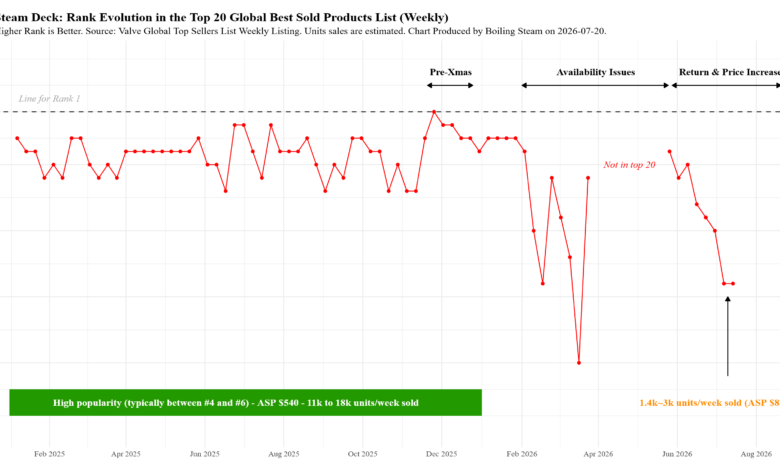
Valve’s strategy to offset rising hardware costs by pushing higher-priced handheld consoles has led to a sharp downturn in consumer demand, according to recent sales estimates. Following the retirement of its entry-level LCD models in 2026, weekly unit sales for the Steam Deck have plummeted by roughly 82%, causing estimated hardware revenue to decline by 72%.
Data compiled by gaming site Boiling Steam, which tracks product rankings on the Steam sales charts using methodologies previously applied to Steam Machines, indicates that weekly volume dropped to between 1,400 and 3,000 units. By comparison, Valve consistently moved between 11,000 and 18,000 units per week during 2025, when cheaper configurations were readily available.
The shift stems from supply-chain pressures tied to the broader artificial intelligence boom, which inflated component costs across the tech industry. In response, Valve passed hardware surcharges onto consumers by phasing out its cheaper LCD inventory and offering only premium OLED models. The price adjustment added approximately $300 to purchase costs, raising the top-tier 1TB model to roughly $1,000—a sharp departure from its previous $650 price point.
Since its initial release in early 2022, the Steam Deck established the modern handheld PC gaming market by offering an accessible price-to-performance ratio. Valve originally absorbed hardware margins to expand its digital ecosystem, but hardware price hikes have altered that value proposition.
At a $1,000 price point, the Steam Deck faces stiff competition from hardware makers using alternative hardware architectures and more powerful silicon. Consumers willing to spend four figures on portable hardware are increasingly gravitating toward competing devices such as the Asus ROG Ally X and the MSI Claw 8 EX AI+, which offer higher raw performance at comparable price tiers.
While initial sales of the OLED models briefly held steady during early stock releases, sustained high pricing appears to have cooled long-term consumer demand. Analysts note that while the hardware sector remains volatile due to ongoing supply fluctuations, Valve’s reduced volume highlights the vulnerability of enthusiast hardware when priced beyond mainstream reach.