2026 Jeep Grand Wagoneer L Review: The Best Full-Size Luxury SUV You Might Not Buy
Jeep's flagship three-row SUV simplifies its lineup for 2026, delivering peerless luxury and surprising capability at a six-figure price point.
There aren’t many six-figure SUVs left that try to be everything at once. Most modern contenders lean heavily into a single specialty. A Cadillac Escalade is primarily about pure street presence. A Lincoln Navigator majors in soft, isolating comfort. A Chevrolet Suburban is all about utilitarian hauling. Meanwhile, a Range Rover attempts to blend high-end luxury with genuine, mountain-climbing off-road capability, albeit at an eye-watering price point.
The 2026 Jeep Grand Wagoneer takes a different, far more ambitious approach. It wants to do all of those things simultaneously, wrapping three rows of genuine luxury inside a body capable of wandering miles off the pavement before comfortably cruising home on the interstate. That’s a bold promise for a vehicle measuring nearly 18 feet long and weighing almost three tons.
This model year brings a surprisingly significant shakeup to the lineup. Jeep has simplified the family, dropping the standard Wagoneer entirely while also retiring the 540 hp (403 kW) High Output Hurricane inline-six. Every Grand Wagoneer now gets the “standard” twin-turbocharged 3.0-liter Hurricane making 420 horsepower (313 kW) and 468 lb-ft (634 Nm) of torque. On paper, these changes might feel like cost-cutting. But after a week behind the wheel of our test vehicle, a 2026 Jeep Grand Wagoneer L Summit Obsidian, including taking this massive SUV somewhere most owners probably never will, we kept coming back to one question: What happens when the best full-size SUV isn’t the one you’d actually recommend?
Design and Proportions: A Tale of Two Halves
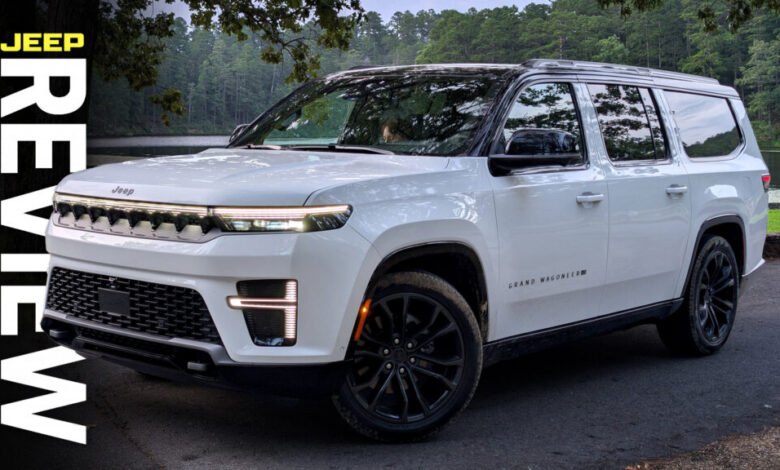
When this generation originally debuted, it always felt like Jeep had designed the front and rear ends separately before introducing them five minutes before production. The nose looked modern, while the rear resembled an overinflated suburban appliance. Fortunately, the latest facelift improves matters significantly.
The front fascia finally looks like it belongs on a flagship Jeep. Slimmer lighting, a revised grille, and cleaner surfacing give it far more identity than before. It’s recognizable from half a mile away, which is exactly what a flagship SUV should accomplish. Unfortunately, the rear remains its weakest angle. The proportions simply don’t flow. Viewed from almost any angle behind the C-pillar, it feels bloated, as though the design kept expanding after everyone else stopped drawing. If the front is athletic, the rear is… beluga whale.
Speaking of whales, white might genuinely be the worst possible color for this SUV. The Grand Wagoneer is already enormous, and painting it bright white somehow makes every dimension look another foot longer. It’s difficult not to think of marine mammals that are actually smaller than this Jeep. The average length of an adult Beluga is about 15 feet. The Grand Wagoneer L, by comparison, is 17.8 feet long (measuring 226.7 inches overall). Of course, the sheer size becomes a pleasant surprise in light of the 22-inch wheels. Usually, wheels that large either disappear beneath oversized sheetmetal or dominate the design. Somehow, Jeep nailed the proportions here; they look exactly the right size. Overall, this is the best-looking version of the current Grand Wagoneer, even if there’s still plenty of room for improvement.
Cabin Accoutrements: Craftsmanship and Quirks
Step inside, and this is where Jeep justifies much of the asking price, which starts at $97,310 and climbs to $106,890 as tested. Yes, there are cheap materials if you start hunting. The piano black plastic covering much of the center console and sections of the dashboard looks and feels out of place in a vehicle costing over $100,000. It’ll scratch, it’ll attract fingerprints, and eventually, it’ll probably look terrible.
Fortunately, that’s the exception rather than the rule. Nearly everything you actually touch feels genuinely premium. The quilted leather is excellent, and the stitching throughout the cabin feels expensive. Even the leather-wrapped start/stop button communicates that someone paid close attention to detail. Stretching across the dashboard is a beautifully textured wood trim panel, with the Grand Wagoneer script elegantly embedded into the passenger side as the cherry on top. It’s one of the classiest dashboard designs offered by an American manufacturer today.
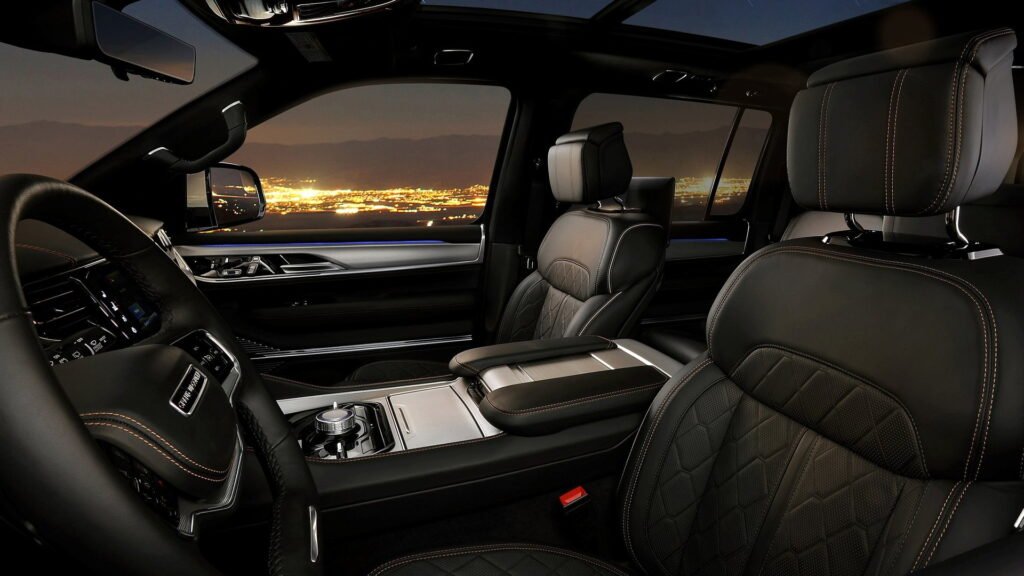
The front seats also deserve particular praise. They’re heated, ventilated, and feature massage functions that don’t merely vibrate—they actually work to reduce fatigue over long distances. That said, they’re clearly designed around someone shorter than a 6-foot-6 frame; no amount of adjustment ever allowed the upper seatback and headrest to perfectly fit taller shoulders. Thankfully, the massage system made up for much of that discomfort.
Notably, not everything here is perfect. Jeep placed an array of expensive electronic switches immediately below the cupholders. Gravity doesn’t care how expensive your SUV is; eventually, a coffee, soda, or water bottle is going to leak directly into those controls, and replacing that assembly won’t be cheap.
Thankfully, most of the other controls are excellent. The main infotainment display is responsive and intuitive, while Jeep wisely retained physical climate controls rather than burying everything inside menus. A second, lower touchscreen handles seat functions and can retract to reveal a hidden storage compartment complete with wireless charging, USB ports, and HDMI connectivity. The optional passenger display is fine, though using it feels more complicated than necessary. Watching independent content requires pairing headphones, connecting compatible apps, and hoping everything talks to each other correctly. Ironically, it’s often easier for the front passenger to watch whatever’s already playing on the rear entertainment screens.
The second row might actually be the best place to sit. Heated and ventilated captain’s chairs, abundant legroom, four additional USB ports, a household outlet, 12-volt power, and large entertainment displays make it feel genuinely first class. Then there’s the third row. Simply put, it’s outstanding. Outside of the Grand Cherokee L, it is hard to think of another three-row SUV with a third row that adults would willingly occupy for hours. The leather quality matches the rest of the cabin, and both outboard passengers get power recline, charging ports, cupholders, and dedicated storage.
Cargo space is equally impressive, with 28.4 cubic feet (804 liters) behind the third row, 70.8 cubic feet (2,005 liters) with the third row folded, and 94.2 cubic feet (2,668 liters) behind the front seats. Better still, the power-folding seats make reconfiguring the cabin effortless. Finally, the McIntosh sound system is spectacular. Not just “good for an SUV,” but genuinely one of the finest factory audio systems currently available in any mainstream luxury vehicle.
Driving Impressions: Road Manners and Trail Capability
The cabin is great, but the Grand Wagoneer separates itself from the rest of the pack where the rubber meets the road—or the dirt. Having driven the Escalade IQ, Chevrolet Suburban, and Ford Expedition, none of them move down the road quite like this. The closest comparison is actually a Range Rover.
No, it doesn’t corner like a sports car, but it shares that rare ability to make something impossibly large feel smaller than it really is. The steering is accurate without becoming nervous, while body control borders on remarkable given the sheer mass involved. Body roll barely exists, which is astonishing for a vehicle that weighs approximately 6,430 lbs (2,917 kg). Through sweeping corners, it stays composed while simultaneously delivering an exceptionally quiet ride. Wind noise is minimal, road noise barely intrudes, and rough pavement is reduced to a muted suggestion. The chassis is unquestionably the star of the show.
Power, meanwhile, is perfectly adequate. The 420-horsepower twin-turbocharged 3.0-liter Hurricane never feels slow. Passing is effortless, and towing capability remains excellent at 8,200 lbs standard or up to 9,810 lbs (4,449 kg) with Max Tow Package. However, if you’ve driven the old 540-horsepower High Output Hurricane, you will miss its extra urgency, which transformed this SUV from surprisingly quick into genuinely entertaining. Losing it feels like an unnecessary downgrade. It’s also worth noting that, at 15.4 MPG as tested, we came in well below Jeep’s EPA combined estimate of 18 MPG, so you aren’t trading that lost power for stellar fuel economy.
To test its rugged DNA, we took it off-road onto trails severe enough to force the suspension into full articulation while climbing and descending double-digit grades. At one point, the front passenger tire hung completely off the ground despite the suspension sitting at maximum ride height. The Jeep simply kept going with zero drama, no hesitation, and not a single unsettling moment. It’s easy to forget this is still, fundamentally, a Jeep. Just remember that tight forest roads weren’t designed with vehicles this wide in mind; had another vehicle appeared from the opposite direction, someone would have been backing up a very long way.
The Competitive Conundrum
Oddly, the Grand Wagoneer’s biggest competition isn’t the Cadillac Escalade, nor is it the Navigator or the Yukon Denali. The biggest threat comes from the Jeep showroom floor itself. Among full-size American luxury SUVs, the Grand Wagoneer is highly compelling—it drives better than the GM offerings, feels more cohesive than the Ford products, and delivers an interior that punches well above its weight.
But many buyers might find themselves happier with a Grand Cherokee L. It drives even better thanks to its smaller footprint, goes farther off-road, offers nearly identical interior quality, still has an excellent third row, and costs dramatically less. Alternatively, if you absolutely need the additional towing or cargo space of the larger platform, a certified pre-owned Grand Wagoneer with either the 540-hp Hurricane H.O. or even the older 392 V8 is a highly tempting route. You’ll save tens of thousands of dollars while getting a more exciting powertrain that’s still under warranty.
The Verdict
The 2026 Jeep Grand Wagoneer is unquestionably the best version of this vehicle Jeep has built. It looks better, drives brilliantly, offers one of the nicest interiors anywhere near its price point, and remains astonishingly capable once the pavement ends. As a complete package, it is currently the best full-size American luxury SUV on sale.
We do think vehicles this large are becoming increasingly difficult to justify for everyday suburban duties. They occupy more road than many drivers need, create visibility concerns for pedestrians, and demand a lot from parking infrastructure. But if you are determined to own something this big, you won’t find a more complete package. If you truly need everything the Grand Wagoneer offers, including a factory-fresh warranty, it’s the one to go with, bar none. If you don’t, Jeep’s own Grand Cherokee L, or a lightly used Grand Wagoneer with the High Output Hurricane, might actually be the smarter purchase.