The $50 Jersey Problem: Why Zohran Mamdani’s ‘Affordability’ Experiment Hit a Market Wall
A limited-run apparel drop exposes the friction between democratic socialist price caps and real-world supply constraints.
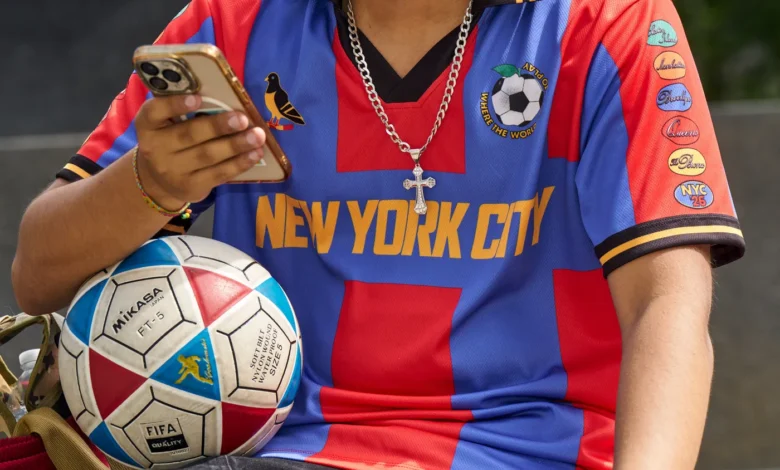
In the high-stakes theater of New York City politics, few symbols have proven as potent—or as polarizing—as a piece of polyester athletic wear. When Mayor Zohran Mamdani, the self-described democratic socialist who swept into City Hall in 2025, launched a limited run of $50 NYC-themed World Cup jerseys, it was intended as a victory lap for his “affordability” agenda. Instead, the initiative has become a textbook case study in the friction between ideological price-setting and the cold realities of market demand.
The jersey initiative was never just about apparel. It was a microcosm of the platform that propelled Mamdani to power: a sweeping promise to insulate New Yorkers from the soaring costs of urban life through rent freezes, free public transit, city-run grocery stores, and a $30 minimum wage by 2030. This populist surge wasn’t confined to the five boroughs; across the Hudson, the more moderate Mikie Sherrill secured the New Jersey governorship on a parallel affordability pitch. Together, these victories signaled a regional shift toward state intervention in the cost of living, a trend Mamdani bolstered this summer by backing successful primary challengers who have sent tremors through the Democratic Party’s mainstream.
However, the rollout of the jerseys suggests that translating a campaign slogan into functional policy is fraught with traditional economic hurdles. On June 12, the administration released 1,500 units—500 each in three colorways—produced locally by Mazzi Sports at its factory in the gentrifying Bedford-Stuyvesant neighborhood of Brooklyn. Priced at $50, the kits were a fraction of the $150-plus charged for authentic Adidas or Nike World Cup gear. “Jerseys symbolize much more than just the team you cheer for,” Mamdani told GQ. “They embody pride in your origins and identity. With this limited run, we are offering New Yorkers an affordable jersey made for New Yorkers, by New Yorkers.”
The market response was a swift validation of the product’s appeal and a simultaneous indictment of its distribution. Fans queued at the NYC City Store at One Centre Street before dawn, with lines snaking around the block and wait times exceeding three hours. The entire stock vanished in sixty minutes. What followed was an immediate arbitrage effect: within hours, the jerseys migrated to the secondary market. On platforms like StockX, eBay, and Facebook Marketplace, the $50 shirts were listed for anywhere from $400 to over $900.
Critics were quick to label the spectacle “swag socialism.” The administration attempted to pivot, moving subsequent drops online starting July 8. Yet, the digital shift only traded physical lines for virtual ones. Potential buyers reported the 500-unit daily drops selling out in “under a minute,” with many losing items in their carts due to bot activity and technical bottlenecks. As one Reddit user noted, with only 20 jerseys available per size in each drop, the odds were “extremely stacked against you.”
This outcome has reignited a century-old debate over price ceilings. When a price is artificially suppressed below the market-clearing level, the result is a chronic shortage. In this vacuum, the good is rationed not by price, but by time, luck, or the technical sophistication of scalpers. It is a phenomenon famously critiqued by Austrian School economist Ludwig von Mises, who argued in 1944 that price-fixing efforts often result in a state of affairs “even less desirable” than the original problem. While the Austrian School’s rejection of modern statistics makes it heterodox today, its insights into individual economic behavior remain a staple of critiques against the kind of price controls historically favored by the left—and occasionally flirted with by populist Republicans like Richard Nixon and Donald Trump.
Yet, the most cutting critique of Mamdani’s experiment isn’t coming from the right, but from an internal schism within the progressive movement. A rising cohort of center-left thinkers, championing an “abundance” framework popularized by Ezra Klein and Derek Thompson, argues that the true enemy of affordability is a lack of supply, not the presence of high prices. In this view, New York’s housing crisis is a product of regulatory barriers and zoning restrictions that prevent construction. Applied to the jersey drop, the abundance critique suggests the failure wasn’t the $50 price tag, but the decision to produce only 1,500 units for a city of millions.
This tension represents a fundamental fork in the road for urban governance. Mamdani’s brand of democratic socialism treats affordability as a price problem to be solved via mandates—freezing rents or capping the cost of a jersey. The abundance movement treats it as a production problem. The bottleneck is perhaps most visible in Mamdani’s proposal for city-owned supermarkets—one per borough. In a city of 8 million, five stores would serve over a million residents each, a ratio that practically guarantees the same lines and shortages seen at the NYC City Store.
The debate has already turned personal. Democratic socialists often dismiss the supply-side approach as “neoliberal” market-worship. This friction surfaced last fall when FTC Chair Lina Khan, an advisor to Mamdani’s transition, suggested mandating lower beer prices at stadiums. Economists like Matt Yglesias and Jason Furman countered that lowering the price of beer without increasing the supply of seats would simply allow teams to hike ticket prices. While defenders like Tim Wu dismissed those concerns, the jersey saga provides a real-world data point for the skeptics.
The administration has shown it can learn from these dynamics. In May, Mamdani secured 1,000 World Cup tickets for residents at $50 each, but used a lottery system and made them nontransferable to block the secondary market. While successful at preventing scalping, it remains a lottery—a system where the many are still excluded by the scarcity of the supply. As Mamdani moves from retail stunts to citywide policy, the $50 jersey remains a vivid reminder that while a politician can fix a price, they cannot so easily command the market to provide enough for everyone.