Warsh Signals a Pivot Toward Opacity by Tapping the Architect of Central Bank Secrecy
The new Fed chair signals a retreat from the transparency standards of the last decade.
Six weeks into his tenure as Federal Reserve chair, Kevin Warsh is signaling a departure from the era of radical transparency. By reportedly recruiting former Bank of England governor Mervyn King to lead a communications task force, Warsh is aligning himself with a figure known for guarding the internal mechanics of monetary policy with idiosyncratic intensity.
The irony of the appointment is sharp. In 2014, Warsh was commissioned by King’s successor, Mark Carney, to dismantle the very culture of secrecy King had cultivated at the Bank of England. In that era, Warsh argued that effective communication required the public to understand the reaction function of policymakers. Now, as head of the world’s most influential central bank, Warsh appears to be embracing the reticence he once critiqued.
At the European Central Bank’s recent Sintra conference, Warsh resisted calls for greater clarity. While ECB President Christine Lagarde attempted to define a new concept of framework guidance—explaining how a bank might react to various economic contingencies—Warsh declined to offer a similar roadmap for the Federal Open Market Committee. He asserted that market participants already understand the Fed’s reaction function “quite well.”
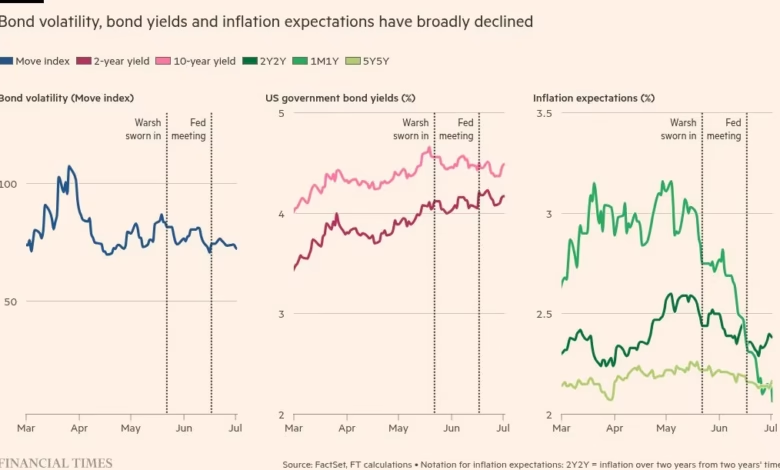
To support this claim, Warsh pointed to market stability since his arrival. He noted that bond volatility and yields have remained stable or declined, while inflation expectations have fallen. Warsh associated those moves explicitly with a market that correctly anticipates the Fed’s trajectory.
However, this interpretation ignores significant external variables. During the same period, oil prices dropped following a memorandum of understanding between the U.S. and Iran. This shift in energy costs likely did more to quell inflation expectations and stabilize bond volatility than any newfound clarity from the central bank.
The risks of a less communicative Fed are already being weighed by the academic community. According to a survey by the Kent A. Clark Center for Global Markets, 53 per cent of economists disagreed with the notion that substantially less forward guidance would improve the U.S. economy. Only 12 per cent of those surveyed supported the shift toward a more tight-lipped approach.
History suggests that Mervyn King’s influence could lead to a significant rollback of public data. During his 2003–2013 leadership of the Monetary Policy Committee, the Bank of England famously refused to release the numerical parameters of its forecasts. King frequently urged observers to “throw your rulers away” rather than try to precisely calculate the bank’s future path.
Warsh has already introduced a shorter post-meeting statement that omits the specific results of the committee’s vote, a move reminiscent of King’s preference for presenting a unified, if opaque, front. Under King, the public often had to wait weeks for minutes to reveal whether a decision had been unanimous or closely contested.
This pivot comes at a time of heightened political tension. President Donald Trump has indicated he will continue to seek the removal of Fed governor Lisa Cook, even following recent Supreme Court rulings regarding executive authority. In such a volatile environment, the decision to reduce the frequency and depth of official guidance may complicate the market’s ability to distinguish between economic strategy and political pressure.