White House Digital Assets Director Patrick Witt to Take Military Leave Amid Critical Senate Push for CLARITY Act
The executive director will undergo JAG training as the landmark cryptocurrency regulation bill faces a tight Senate deadline.
WASHINGTON — Patrick Witt, the White House’s lead official coordinating the Digital Asset Market Clarity Acttps://nile1.com/en/2026/07/14/senate-democrats-demand-crypto-profit-ban-for-trump-as-clarity-act-faces-key-deadline/” class=”auto-internal-link” title=”Senate Democrats Demand Crypto Profit Ban for Trump as Clarity Act Faces Key Deadline”>Clarity Act, will take a temporary leave of absence starting at the end of July to undergo several months of military training.
Witt, who has served as the executive director of the President’s Council of Advisors for Digital Assets since August, is scheduled to wrap up his official duties on July 24. He will then report for Judge Advocate General training with the Georgia Army National Guard, a program that will qualify him to serve as a legal officer within the Guard.
“Patrick has always been forthcoming and honest with every stakeholder that he was taking military leave later this month,” said Cody Carbone, CEO of Digital Chamber, on Tuesday.
Legislative Timeline and Key Negotiations
The timing of Witt’s departure coincides with a critical period for the CLARITY Act, which aims to establish the first comprehensive regulatory framework for the cryptocurrency market in the United States. Supporters of the bill face a narrow legislative window to secure passage in the Senate before lawmakers depart for the scheduled recess on August 8.
During his tenure, Witt has played a central role in mediating discussions between representatives from the cryptocurrency sector and the banking industry. These negotiations have focused on key elements of the market structure bill, including stablecoin yield and ongoing disputes regarding ethics provisions.
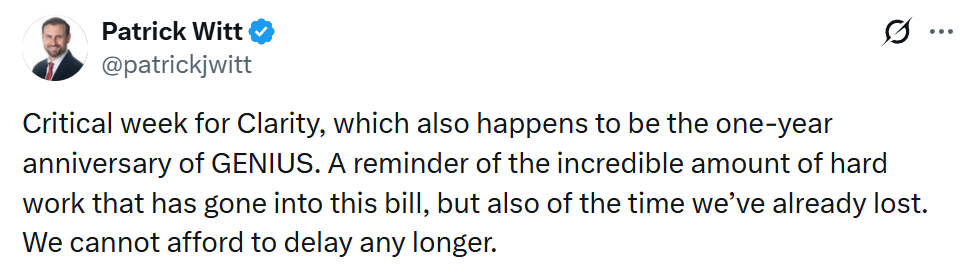
Source: Patrick Witt
While Witt is away, Harry Jung, the deputy director of the President’s Council of Advisors for Digital Assets, is expected to assume his day-to-day responsibilities. However, sources familiar with the matter indicate that Witt intends to remain active in the ongoing policy process during his training period.
Background: Legislative Recesses and Military Law
To help readers understand the context of these developments, the following established frameworks govern congressional schedules and military legal roles:
The Congressional August Recess
The United States Congress historically observes a month-long recess during August, a tradition formalized by the Legislative Reorganization Act of 1970. This period allows lawmakers to work from their home states. Because legislative activity effectively halts during this time, major bills often face intense pressure to pass before the recess begins, as the legislative calendar compresses significantly in the autumn months.
The Judge Advocate General’s Corps
The Judge Advocate General (JAG) branch is the legal arm of the United States military. Officers trained in this program perform duties related to military justice, operational law, civil law, and administrative law. National Guard JAG officers serve a dual role, providing legal counsel to state-level commanders during domestic emergencies and supporting federal military operations when called to active duty.