Gen Z Drives Resurgence in Analog Photography as Youth Reject Digital Fatigue
Younger generations turn to film, vinyl, and physical media to escape digital isolation and build real-world communities.

A growing segment of young people is turning away from digital screens and algorithmic feeds to embrace analog photography, sparking a significant global revival of film, disposable cameras, and physical media.
Once declared all but dead and relegated to niche hobbyists, analog photography—which relies on photographic film and chemical processing—is experiencing a major resurgence. In 2025, 35% of the 42 million active film camera users worldwide were reported to be between the ages of 18 and 30. This demographic shift follows a 41% rise in online searches for analog photography in 2024, a year that the photography journal PetaPixel declared as “film’s best year in decades.”
The trend is reflected in market demand. Disposable camera sales have risen steadily since 2023, while major brands have introduced new cameras and revived classic models to meet consumer interest. More than 30% of respondents to a 2024 Ilford Photo survey on film photography were in the 25-34 age group.
This movement is increasingly viewed not as a simple nostalgic trend, but as a deliberate effort by young people to establish physical connections and escape digital fatigue. By 2023, 51% of American teenagers reported spending at least four hours a day on social media, a lifestyle that researchers have linked to increased feelings of isolation and detachment, particularly following the COVID-19 lockdowns.
Rotem Rozental, a lecturer in critical studies at the University of Southern California’s Roski School of Art and Design and executive director of the Los Angeles Center of Photography, observes that students are actively seeking physical alternatives to digital platforms. “This year, for the first time, some of my students discussed images they’d printed and the physical photography albums they’d put together of their friends and family,” Rozental noted, adding that students are also sending postcards, writing letters, and hanging physical photographs on their walls.
New York Knicks forward OG Anunoby snaps a photo with a disposable film camera during the team’s victory rally on June 18, 2026, after winning the NBA Finals. Craig T. Fruchtman/Getty Images
The Search for a ‘Third Place’
The physical nature of analog photography has helped foster real-world communities, acting as what sociologists call a “third place.” Coined by sociologist Ray Oldenburg in his 1989 book “The Great Good Place,” a third place is a space separate from home (the first place) and work (the second place) that allows for social interaction, creative exchange, and community engagement.
In April 2026, the inaugural AnalogCon took place in Los Angeles. Organized by the Los Angeles Center of Photography, the two-day festival featured exhibitions, panels, demonstrations, and guided photography tours around Little Tokyo, serving as a physical hub for analog enthusiasts.
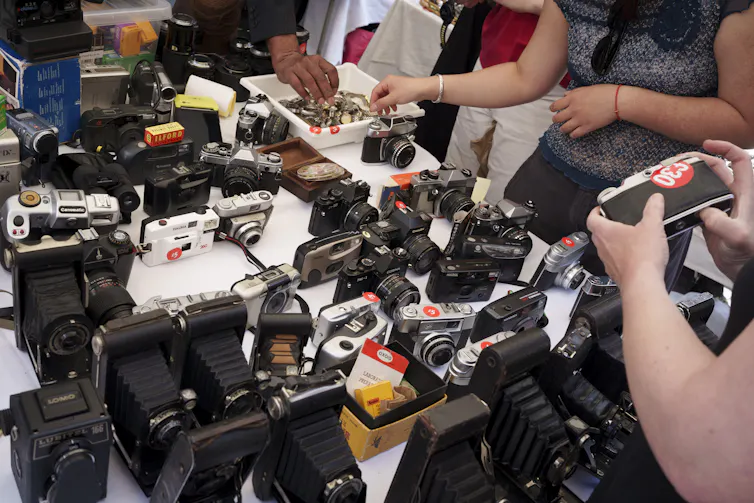
Customers peruse vintage film cameras at a stall on Brick Lane in London’s East End on June 14, 2026. Richard Baker/In Pictures via Getty Images
This interest in physical media extends beyond photography. While music streaming represents 82% of music industry revenues, vinyl record sales crossed the $1 billion threshold in the U.S. in 2025, with nearly 60% of Gen Z purchasing records. Similarly, physical video formats are seeing a localized resurgence, with California stores like Be Kind Video and Videotheque reporting demand for VHS, DVD, and Blu-ray rentals.
Background: The Rise, Fall, and Chemistry of Film
To understand the significance of the current film revival, it is helpful to look at the transition from analog to digital imaging that occurred at the turn of the 21st century. For over a hundred years, consumer and professional photography relied entirely on chemical processes. However, the rapid commercialization of digital sensors in the late 1990s and early 2000s led to a swift decline in film production.
Industry giants struggled to adapt to the digital shift. Eastman Kodak Company, which had dominated the global photographic market for a century, filed for Chapter 11 bankruptcy protection in 2012. Polaroid, famous for its instant film, stopped manufacturing its signature instant film products in 2008, though the brand and chemistry were later kept alive by independent enthusiasts under new ownership.
Unlike digital photography, which records light electronically onto a silicon sensor, analog photography is a chemical process. Film consists of a plastic base coated with an emulsion containing light-sensitive silver halide crystals. When the camera shutter opens, light strikes these crystals, creating a latent image. Developing the film requires a series of chemical baths—typically a developer to make the image visible, a stop bath to halt the development process, and a fixer to make the image permanent and insensitive to light.