Why College Costs Feel Unaffordable: Historical Data Reveals Stagnant Wages, Not Tuition Spikes, Drive the Crisis
Historical data shows tuition growth has slowed since 1990, but stagnant family incomes have pushed higher education costs to 43% of median earnings.
For millions of Americans, a college degree has increasingly come to feel like an unaffordable luxury. However, new historical research reveals that the primary driver of this financial strain is not an unprecedented acceleration in tuition rates, but rather a decades-long stagnation in family wages.
According to a comprehensive data analysis of college tuition trends from 1840 to 2020, tuition growth has actually slowed significantly since 1990 compared to the preceding decades. The study, conducted by Thomas Adam, a professor of political science at the University of Arkansas, shows that the era of extraordinarily high tuition growth occurred between 1920 and 1990, after which the rate of increase began to decelerate.
The findings, published in the academic journal History of Universities, are based on a newly compiled database tracking tuition fees in 10-year increments across 667 public and private institutions. This sample represents approximately 64% of all U.S. colleges and universities established before 1920.
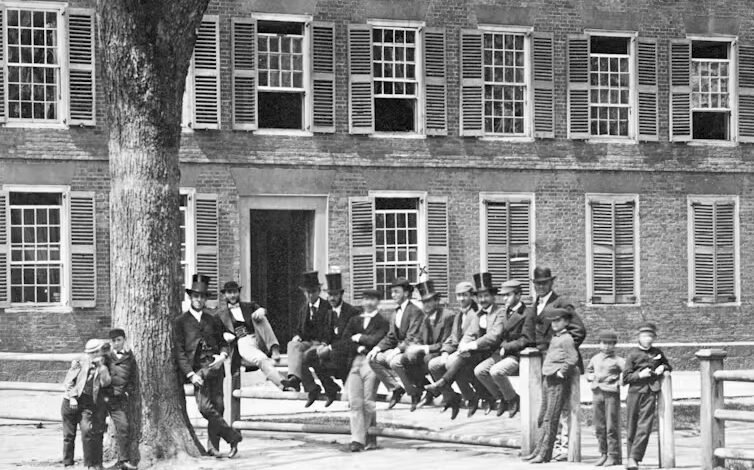
Yale University’s class of 1870 poses for a photograph on the school’s campus in New Haven, Conn. Bettmann/Contributor via Getty Images
The Historical Shift in College Funding
The research highlights a dramatic shift in how American higher education has been financed over the last two centuries. Between 1840 and 1910, tuition rates remained essentially flat when adjusted for inflation, fluctuating between $41 and $59 annually—the equivalent of $1,586 to $2,194 today. During this period, students rarely paid their own bills; instead, local communities or future employers, such as churches seeking ministers, covered the costs.
Furthermore, tuition-free education was relatively common. By 1910, approximately 20% of universities—including 100 public and 19 private institutions—charged no tuition at all. Among these tuition-free schools were Stanford University, Howard University, and Oregon State University.
This model shifted in the early 20th century as student demographics changed. Rather than training low-income students for roles as ministers or teachers, colleges increasingly enrolled wealthy students preparing for lucrative careers in law and medicine. Prominent donors, including John D. Rockefeller Jr., argued that these affluent families should pay for their children’s education, convincing administrators that students attended college largely for social reasons and future earning potential.
This realization sparked a competitive race among college administrators to raise fees. Unadjusted tuition grew by 150% to 190% every decade from the 1920s to the 1950s. The upward trajectory accelerated through the 1960s and 1970s, peaking in the 1980s with a record 241% increase over the decade, which saw average tuition jump from $2,686 to $6,467.
Growth began to cool in the 1990s, dropping to 180% over the decade, and fell further to 142% by the 2010s—marking the lowest growth rate since the 1910s.
Stagnant Income and the Rise of Student Debt
The core of the modern affordability crisis lies in the decoupling of tuition costs and household earnings. Prior to 1980, tuition increases moved in tandem with median family income. On average, American families spent about 14% of their median family income on college tuition.
After 1980, however, growth in the real median family income slowed dramatically. While tuition grew by 241% during the 1980s, family incomes rose by only 153%. Consequently, the share of median family income required to cover college tuition surged from 14% in 1980 to 43% in 2020.
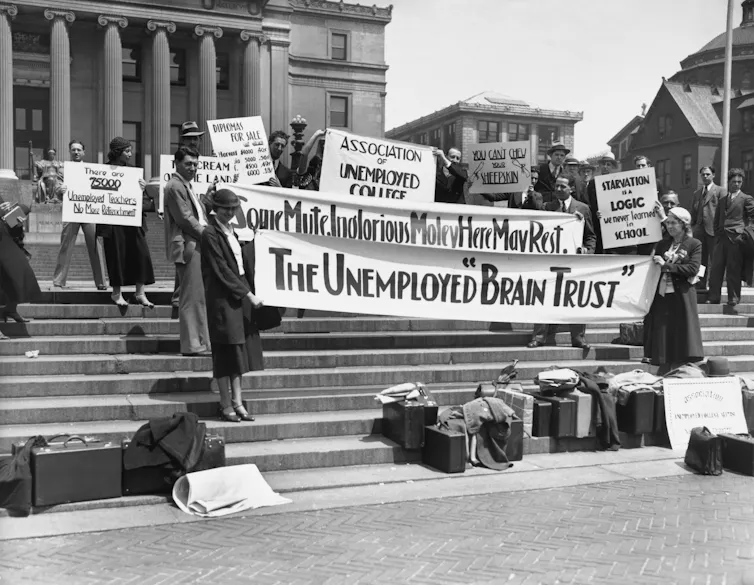 Columbia University alumni in New York City prepare to protest unemployment rates of college graduates in 1931. UPI/Bettmann Archive/Getty Images
This widening gap has forced a growing number of students to rely on loans. In 2025, more than half of all undergraduate students took out student loans, compared to approximately 25% in 1995 and 1996. Cumulative student loan debt has ballooned from roughly $500 billion in 2006 to nearly $1.8 trillion in 2024. This mounting student loan debt has broader socioeconomic consequences, often delaying major life milestones such as purchasing homes or vehicles, marrying, or having children. In 2024, total student loan debt accounted for 7.1% of borrowers’ annual income, up from 4.6% in 2006.
Background: The Morrill Land-Grant Acts and Public Subsidies
To understand why so many early American universities, such as Oregon State University, were originally able to offer tuition-free or low-cost education, it is helpful to examine the historical legal frameworks of U.S. higher education.
A key driver of low-cost public higher education in the 19th century was the Morrill Land-Grant Acts of 1862 and 1890. Under these federal laws, the U.S. government granted federally controlled public lands to states. The states sold this land to fund the establishment and endowment of colleges focused on agriculture and the mechanic arts. The explicit mission of these “land-grant universities” was to make practical, professional education accessible to the working classes, often leading states to heavily subsidize or entirely waive tuition fees for in-state residents.
As state funding priorities shifted over the late 20th century, public universities increasingly relied on student tuition to cover operating budgets, aligning their financial models more closely with private institutions and contributing to the modern cost burden borne by families today.