US Fails to Translate $32 Trillion Economy Into Basic Human Rights, Study Finds
A 25-year analysis reveals the United States consistently underperforms in health, food security, and fair wages compared to other wealthy nations.
The United States is significantly underperforming in providing basic economic and social rights to its citizens relative to its immense national wealth, according to a 25-year trend analysis by human rights scholars.
Despite possessing a US$32 trillion economy, the U.S. has consistently failed to meet the benchmarks achieved by other wealthy nations in healthcare, food security, education, and fair wages. The findings, compiled by researchers Stephen Bagwell of the University of Missouri-St. Louis and Susan Randolph of the University of Connecticut, utilize data from the Human Rights Measurement Initiative, a nonprofit organization that tracks human rights commitments across more than 200 countries and territories.
The study measures a nation’s performance against its capacity, using per capita gross domestic product (GDP) as a benchmark. This methodology holds wealthier nations to a higher standard, calculating whether a country is doing all it can with the resources it possesses. A score of 100% indicates a country is maximizing its current resources, while lower scores reflect policy failures rather than a lack of financial capacity.
Stagnant Health Outcomes and Insurance Losses
The U.S. ranks below its peer nations in health, scoring approximately 80% of what is resource-feasible. In comparison, Iceland scores 97%, Australia 93%, Canada 90%, Japan 88%, and Mexico 86%. Even less industrialized nations with a fraction of the U.S. per capita GDP, such as Turkey and Hungary, guarantee better health outcomes relative to their resources.
U.S. health scores have remained largely flat for a quarter of a century. The score rose from 79% in 2000 to a peak of 82% in 2012, a rise attributed to expanded insurance coverage following the Affordable Care Act rollout. However, the score receded to 80% by 2023, driven primarily by the disruptions of the COVID-19 pandemic.
Further declines are projected. The Congressional Budget Office estimated that 11.8 million Americans would lose access to government-subsidized health insurance due to changes in the tax and spending legislation signed into law by President Donald Trump in the summer of 2025. That figure is projected to reach 17 million people by 2034.
Rising Hunger Amid Economic Growth
In food security, the U.S. achieves only 81% of its potential, ranking 30th out of 37 peer nations with available data. The researchers estimate that if the U.S. allocated its resources efficiently, approximately 14.8 million more women and 9.1 million more men would have reliable access to healthy food.
Between 2015 and 2023, the U.S. food score fell from 81.9% to 81.1%, indicating that Americans became hungrier even as national wealth grew. While the score peaked in 2020, subsequent declines were driven by persistent inflation, rising housing costs, and legislative changes to the Supplemental Nutrition and Assistance Program.
An estimated 3.4 million people lost access to food assistance between September 2025 and June 2026 due to cuts in the 2025 legislative package. The impact has been highly localized; in Arizona, enrollment in the program fell by approximately half as of April 2026, with more than 400,000 residents losing benefits since July 2025. Those who remained enrolled received significantly reduced benefits.
Dignified Work and the Wage Gap
The widest gap between U.S. wealth and human outcomes is in the category of dignified work and fair income. When measured against a bar set at half of what a typical American household earns, the U.S. scores just 27% of what its wealth makes possible—the lowest score among member nations of the Organization for Economic Cooperation and Development.
While the U.S. ranks 10th in job creation with a score of 75%, it lags behind leaders like South Korea and Mexico. Adjusting for economic growth, the U.S. score for work and pay fell from 62% in 2000 to 51% today. This downward trajectory reflects the growth in economic inequality, as wealth gains have skewed heavily toward the richest Americans.
The researchers note that policy adjustments, such as increasing the federal minimum wage, could enable 46 million people to earn enough to cross the fair pay threshold, while 5 million people could escape extreme poverty, defined as surviving on less than $4.20 per day.
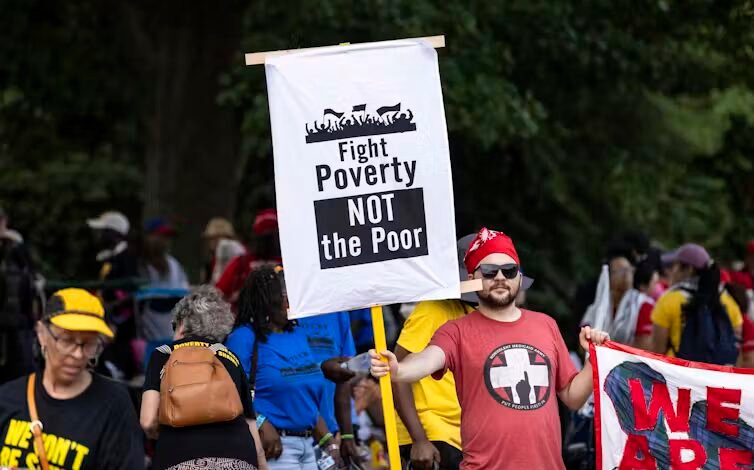
The Poor People’s Campaign holds a rally advocating for living wages, voting rights and other policies that would help poor and low-wage Americans in 2024 in Washington. Samuel Corum/Getty Images
Education Disparities
The U.S. ranks 20th among 38 OECD countries with an overall education score of 76%. While the country rates highly on educational access at 90.7%, it averages only 61.3% on educational quality, measured by student test scores in reading, math, and science.
Background and Institutional Context
To understand these findings, it is helpful to examine the international frameworks and institutions referenced in the study:
- The Universal Declaration of Human Rights: Adopted by the United Nations General Assembly in 1948, this milestone document outlines fundamental human rights to be universally protected. While the U.S. co-authored and voted in favor of the declaration, it has not ratified all subsequent binding covenants, such as the International Covenant on Economic, Social and Cultural Rights.
- The Organization for Economic Cooperation and Development (OECD): Founded in 1961, the OECD is an international coalition of 38 industrialized, high-income countries committed to democracy and market-economy principles. It serves as a platform to compare policy experiences and coordinate domestic and international policies.
- The Congressional Budget Office (CBO): Established in 1974, this nonpartisan agency provides the U.S. Congress with objective, nonpartisan analyses of budgetary and economic issues to support the legislative budget process.