How the American Summer Camp Became a Battleground for National Identity and Citizenship
How a $70 billion industry evolved from 19th-century urban refuges into modern battlegrounds over inclusion and national values.
While summer camps are widely celebrated in popular culture as nostalgic rites of passage, they have historically functioned as deliberate training grounds for American citizenship. Today, as the nation approaches its 250th anniversary, these outdoor spaces find themselves at the center of modern debates over identity, inclusion, and cultural values.
From Urban Refuge to National Ritual
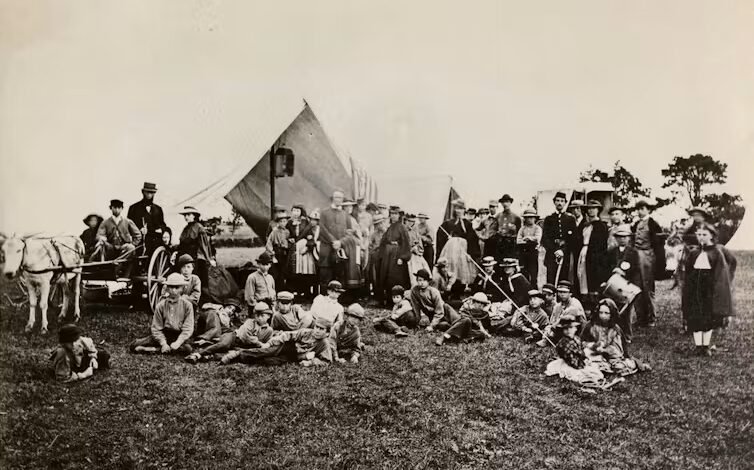
The origins of the American summer camp date back to the mid-19th century. Educator and outdoorsman Frederick W. Gunn founded The Gunnery Camp in Washington, Connecticut, in 1861. At this inaugural organized camp, boys were encouraged to march, hunt, forage, and live outdoors like soldiers.
Campers at The Gunnery Camp, which was founded in Connecticut in 1861. Letters from Charley Goodyear/Wikimedia Commons
Other organizations quickly established their own programs. The Young Women’s Christian Association (YWCA) hosted its first summer camp in New Jersey in 1874, followed by the YMCA, the Boys Club, and the federal youth development program 4-H.
During the late 19th century, rapid urbanization drew families into crowded cities. Camps offered children a vital refuge from the intense heat, odors, and noise of urban summers. This period also saw the rise of Muscular Christianity, a movement championed by figures like President Theodore Roosevelt that emphasized physical discipline, character-building, and rugged outdoor experience as pillars of faith and citizenship.
The movement expanded rapidly in the early 20th century with the founding of the Boy Scouts of America in 1910 and the Girl Scouts of the USA in 1912. Although camp participation declined during World War II, it surged to new heights during the 1950s, 1960s, and 1970s.
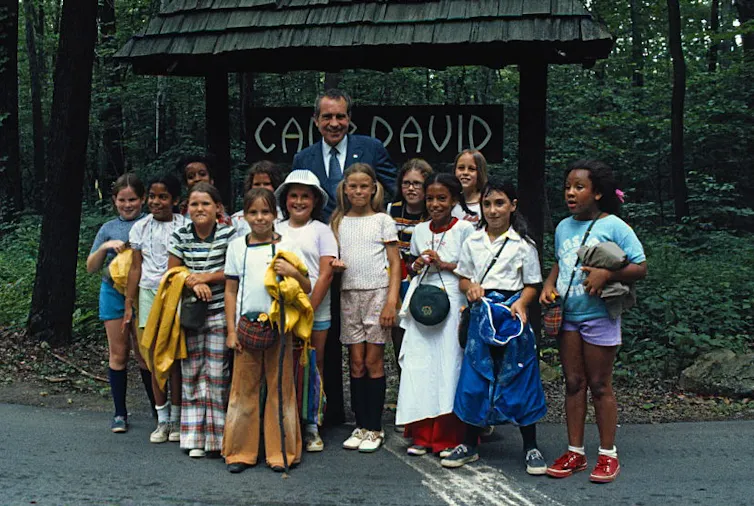
U.S. president Richard Nixon poses with a group of Girl Scouts from a nearby summer camp in 1973. Bettmann/Getty Images
In recent decades, however, youth organization membership has decreased due to competition from year-round sports, high costs, and institutional scandals.
Economic Impact and Character Development
Despite shifting participation rates, summer camps remain a major economic and cultural force. According to a Gallup poll, approximately 30 million American youth attended summer enrichment programs—including day camps, summer schools, and sleepaway camps—in 2024. The American Camp Association reports that the youth camp industry contributes $70 billion annually to the U.S. economy.
Beyond recreation, camps continue to utilize nationalistic rituals like flag ceremonies, the Pledge of Allegiance, and patriotic songs to teach cooperation, leadership, and self-reliance.
At Canyon Camp, a Scouting America camp in Northwest Illinois, participants can earn merit badges in “American Heritage” and “Citizenship in the Nation.” During the summer of 2026, campers can also earn a special America 250 challenge patch by completing civic tasks, such as delivering a speech on “one right I won’t take for granted.”
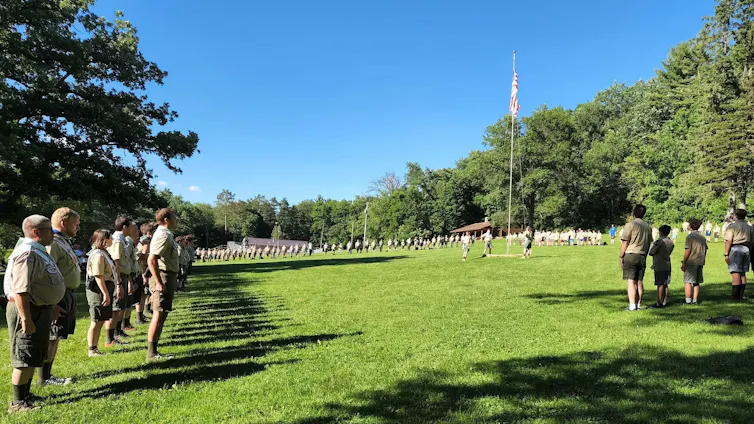
Scouts, leaders and staff stand at attention for a flag-lowering ceremony at Canyon Camp in Stockton, Ill. Canyon Camp
The Struggle for Inclusion
Historically, summer camps were not neutral spaces. Early camps primarily served white, Protestant, middle- and upper-class boys from the Northeast. Over time, marginalized groups established their own spaces. Jewish communities founded camps in upstate New York at the turn of the 20th century to assist with assimilation and civic participation.
During the Jim Crow era of racial segregation, Black communities established refuges like Camp Atwater in Massachusetts to foster racial pride and leadership. Interracial camps also began to emerge mid-century; in 1943, photographer Gordon Parks documented Black and white children living and playing together at Camp Nathan Hale and Camp Gaylord White in New York.
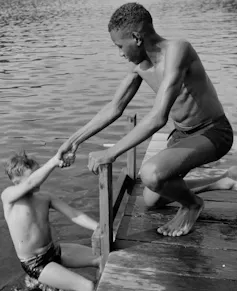
A boy gets a helping hand from a fellow camper on the lake at Camp Nathan Hale in 1943. Gordon Parks/Heritage Images via Getty Images
Desegregation, however, faced significant resistance. When the American Camping Association adopted a nondiscriminatory, interracial policy in 1965, 125 members resigned in protest, and some Southern 4-H programs resisted desegregating their camps.
A demographic divide persists today. The 2024 Gallup poll indicated that Black, Asian, and low-income children remain less likely to attend camps, with 32% of parents citing cost as the primary barrier.
The Modern Culture Wars
Today, the values taught at summer camps have become contested political terrain. This friction was highlighted when Defense Secretary Pete Hegseth demanded that Scouting America eliminate its diversity, equity, and inclusion (DEI) practices and focus on developing “boys into men.” This demand came despite the organization welcoming young women and girls since 2019.
As researchers Seth T. Kannarr and Derek H. Alderman of the University of Tennessee note, these debates reflect deeper, ongoing struggles over how American citizenship is defined and who is included in the national vision.
Background and Historical Context
The Rise of Muscular Christianity
The concept of Muscular Christianity originated in mid-19th-century England before gaining widespread traction in the United States. The movement sought to counter what critics viewed as the over-intellectualization and secularization of modern life by promoting physical strength, athletic discipline, and outdoor survival as spiritual and civic virtues. President Theodore Roosevelt became one of its most prominent American advocates, championing the “strenuous life” as essential for national vitality and leadership.
The Jim Crow Era and Segregated Leisure
The Jim Crow era refers to the period from the late 1870s to the mid-1960s characterized by state and local laws that enforced racial segregation in the United States. These laws systematically marginalized Black Americans, limiting their access to public facilities, schools, and recreational spaces. In response, Black communities established independent institutions, including churches, businesses, and summer camps, to foster leadership, self-reliance, and community resilience in a hostile social climate.