Bessent’s $4B Treasury Intervention Triggers Wall Street Skepticism Over $40T Debt Load
Treasury doubles long-term debt buybacks to $4B per operation as Wall Street assesses market impacts
U.S. Treasury Secretary Scott Bessent announced plans to “at least double” government repurchases of long-dated bonds, including 10-, 20-, and 30-year Treasuries. “The current maximum size of $2 billion per operation will be at least $4 billion per operation,” Bessent said. The expanded purchasing program is set to launch on September 9, with total annual expenditures potentially reaching $128 billion, according to estimates by The Wall Street Journal.
The buyback strategy aims to push bond prices higher and drive down corresponding yields. Because yields on long-dated Treasuries serve as foundational benchmarks for financial products like mortgages, automobile loans, and commercial debt, lower yields are designed to reduce borrowing costs across the broader economy.
The immediate market reaction proved effective, as the 30-year Treasury yield dropped from above 5.3% to 5.19% before nudging upward to 5.218% early today—marking a significant single-day shift for debt markets.
Long-term Treasury yields serve as the anchor for global credit markets, where even a fraction of a percentage point shift directly impacts corporate debt refinancing costs and benchmark 30-year mortgage rates. Managing these long-end yields is critical when sovereign debt issuance reaches historic highs.
Despite the initial yield drop, sentiment across Wall Street remained distinctly skeptical.
“While increasing liquidity buy-back operations by $2 billion might seem like rearranging deckchairs on the Titanic given the U.S. national debt of $40 trillion, yesterday’s intervention by the U.S. Treasury has been warmly greeted by investors around the world,” ING’s Chris Turner stated in a note to clients this morning.
Analysts led by Guneet Dhingra at BNP Paribas expressed doubt about the long-term impact: “Despite a series of efforts to thwart bond vigilantes, we believe these measures will struggle to offset either declining Fed credibility or rising rate expectations. … bond vigilantes continue to have the upper hand. The boost to buybacks is also happening in a world of challenged Fed credibility. We do not believe buybacks will be enough to offset a continued loss in Fed credibility.”
Deutsche Bank strategist Henry Allen and his team noted the signaling effect in an email update: “Admittedly, the increase in buybacks isn’t a particularly big amount relative to the number of outstanding Treasuries. But it offers a signal that officials are willing to support the long end.”
Ed Yardeni, the economist who coined the term “bond vigilantes,” observed that “Bessent is signaling that he will do whatever it takes to keep a lid on bond yields. His message to the Bond Vigilantes: ‘You folks aren’t the only players in the bond market.'”
Equity investors across the U.S. and Asia responded positively to the Treasury’s cash injection promise. The S&P 500 posted gains yesterday, while futures traded sideways ahead of this morning’s bell. Supporting the benchmark index near record highs, retail investors executed $6.9 billion in net equity purchases over the latest weekly tracking period monitored by Arun Jain and his J.P. Morgan team.
Asian equities advanced sharply today, looking past threats from President Trump to enact tougher economic measures on Iran that drove an immediate morning spike in crude prices.
S&P 500 futures held steady early today following yesterday’s 0.21% gain. European equity indicators showed mixed movements, with the Stoxx 600 dipping 0.08% in morning action while the U.K. FTSE 100 gained 0.19% before midday. Asian benchmarks closed higher: South Korea’s KOSPI surged 5.89%, Japan’s Nikkei 225 advanced 1.36%, India’s Nifty 50 added 0.64%, and China’s CSI 300 ticked up 0.09%. Brent crude climbed to $94 per barrel from $91 yesterday, and Bitcoin advanced to $71.6K.
In current economic conditions, millennials and Gen Z prioritize debt-free partners over relationships, citing significant lifestyle divides according to reporting by Catherina Gioino.
Corporate expenditure on artificial intelligence is reaching trillions, yet leadership teams lack clarity on ultimate accountability, notes Amanda Gerut.
Examining the structural vulnerabilities and fiscal liabilities associated with OpenAI security breaches.
Despite massive volumes of AI-generated digital assets entering commercial channels, buyers continue favoring human-created alternatives, reports Sasha Rogelberg.
A private philanthropist donated $9,161 to each public school teacher in an affluent San Francisco suburb to offset severe compensation gaps, writes Sydney Lake.
Meta confronts potential $1.4 trillion regulatory risks capable of altering core operations across the tech sector, according to Tatiana Sataua.
Venezuela’s incoming petroleum chief is framing the South American state as a developing energy destination open to foreign and American capital, rather than a decaying producer.
Speaking to an industry audience in Houston on Wednesday, Paula Henao—appointed hydrocarbons minister in March following the U.S.-led removal of Nicolás Maduro—emphasized that the nation offers opportunities beyond traditional heavy crude, reported Jordan Blum. Henao highlighted over 916 exploration prospects available to international investors, covering untapped oil fields and natural gas reserves.
“It’s an entire world waiting to be discovered, just waiting for us to reach these agreements so we can develop these new areas,” Henao told attendees gathered at the Post Oak Hotel in Houston.
President Trump declared a sweeping crackdown on Iran, promising an “ECONOMIC D-DAY” that enforces secondary sanctions against any nation conducting business with Tehran. “This will be Economic Warfare and Isolation on an unprecedented scale,” Trump posted on Truth Social. “ANY country that allows its financial institutions, businesses, airports, or government entities to provide any type of lifeline to Iran will itself face TREMENDOUS Economic Consequences. Oil smuggling, swap lines, cash transfers, exchange houses, ship registries, front companies — It all needs to stop NOW.”
Iranian Foreign Minister Seyed Abbas Araghchi dismissed the threats, stating: “The so-called ‘Economic D-Day’ is a diversion from America’s own crisis: unprecedented debt & surging interest costs.”
Trump’s announcement followed a decision by the United Arab Emirates to cut all commercial ties with Iran after sustaining Iranian missile strikes, a move expected to contract Iran’s economy by 5% this year. While fresh sanctions will apply financial pressure, former Central Bank of Iran economic adviser Mehrdad Sepahvand urged caution when evaluating the system’s stability, telling CNBC: “We should be a little bit cautious about the view that the Iranian economy is simply on the verge of collapse.”
Approximately 15 to 20 oil tankers are moving through the Strait of Hormuz nightly under a covert U.S. naval operation that guides dark-transponder ships through southern Omani sea lanes to evade Iranian strikes, according to Axios. The figure exceeds earlier estimates of just six vessels daily, with an estimated 10 million barrels of oil per day successfully transiting the waterway.
The Strait of Hormuz represents the world’s most critical maritime oil chokepoint, through which roughly 20% of global petroleum consumption normally flows. Escorting 10 million barrels daily effectively restores half of the narrow waterway’s typical daily volume amid active military threats.
Reporting by The New York Times indicated a lower volume of 5 million barrels per day in July, while U.S. Central Command confirmed that over 1,000 vessels have completed guarded transits supported by warships, rotary aircraft, fighter jets, and air defense systems.
Despite naval escorts, Iranian strikes have damaged or hit at least 15 commercial vessels since the conflict began.
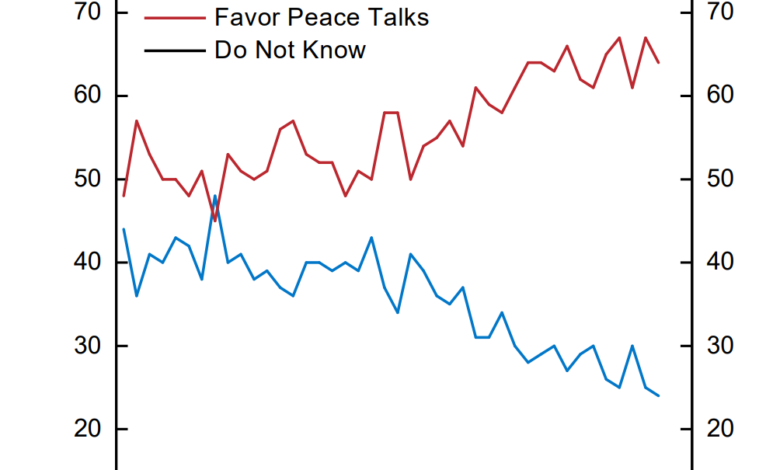
Public support in Russia for the war in Ukraine continues to erode, with polling data from Alpine Macro showing 65% of citizens now favor peace negotiations. The shift comes as Russian military casualties approach an estimated 1.4 million, including approximately 450,000 deaths.
Alpine Macro Chief Geopolitical Strategist Dan Alamariu signaled that fighting could intensify, noting: “The Kremlin may be preparing a large-scale upcoming offensive. It has stepped up missile and drone strikes as Ukrainian interceptor stocks run dry.”
Ukrainian intelligence assessments indicate Moscow could mobilize between 300,000 and 500,000 additional troops following Russia’s September elections.
Disruptive integration of artificial intelligence could drive baseline U.S. unemployment up by a full percentage point to over 5%, according to research from Oxford Economics analysts Adam Slater and Daniel Moseley. The analysts outlined three potential paths for the labor force: “An AI Breakthrough scenario with large productivity gains and positive labour market outcomes, an AI Disruption scenario with fast productivity rises but serious dislocation of labour markets, and an AI Disappointment scenario with weaker productivity gains and moderately worse labour market outcomes.”
While labor economists continue evaluating whether AI is primarily eliminating or generating roles, empirical data highlights selective job contraction. Goldman Sachs researchers Sarah Dong and Joseph Briggs analyzed Indeed job postings across sectors heavily exposed to automation, determining that heavily AI-reliant firms are slowing recruitment: “Industries with greater exposure to AI automation are associated with slower job openings growth since the second half of 2022, with a more negative relationship in Germany, Australia, and the U.S.”
A survey by Goldman Sachs analyst Ronnie Walker revealed that 65% of S&P 500 corporations cited artificial intelligence during recent quarterly calls—a modest decline from prior highs. Executive language has transitioned from “generative AI” toward “AI-enabled” workflows, though concrete financial metrics remain rare: “Only a small share of management teams have quantified the impact of AI on specific use cases (11%) or earnings (2%),” Walker noted.
Exactly 50% of bond investors, voters, and finance or economics graduates anticipate a U.S. fiscal debt crisis occurring within the next decade, according to an NBER study surveying 2,233 respondents across all three demographics.
Major morning developments across leading publications include:
– Major American law firms face industry pushback over aggressive first-year associate hiring practices (Financial Times).
– Digital currencies rally following presidential calls for Congress to enact the Clarity Act (CNBC).
– Historical internal complaints regarding executive conduct emerged prior to the removal of L3Harris’s CEO (Wall Street Journal).
– Prince Harry and Meghan Markle prepare to return their primary residence to the United Kingdom later this month (BBC).
– Chinese judicial authorities sentence Evergrande’s founder to life imprisonment following the property developer’s collapse (New York Times).
– Total U.S. national debt surpasses $40 trillion following substantial expansion under successive administrations (New York Post).
Historic freight train ambushes linked to 19th-century outlaws have reemerged in modernized form, with cargo theft expanding fourfold compared to pre-2020 levels. As pandemic lockdowns disrupted traditional narcotics channels, organized groups redirected operations toward rail choke points in major transit hubs such as Chicago, Los Angeles, and Memphis to capitalize on heightened consumer product demand, Bloomberg reported.
Organized freight theft netted over $200 million across 75,000 separate incidents on U.S. rail networks in 2025, according to trade data representing major carriers including CSX, BNSF Railway Co., and Union Pacific Corp. Court documents highlight high-value targets, such as a Phoenix federal filing detailing the theft of 1,985 unreleased Nike sneakers valued at over $440,000 from a BNSF shipment, alongside CSX reporting over $900,000 in stolen tires since early 2023. In response, rail operators and federal authorities are deploying expanded surveillance systems and private security details to secure vulnerable urban freight bottlenecks.