Goldman Sachs CEO David Solomon Warns Interns AI Cannot Replace Human Judgment
The chief executive tells incoming recruits to challenge automated models and adopt long-term patience in career planning.
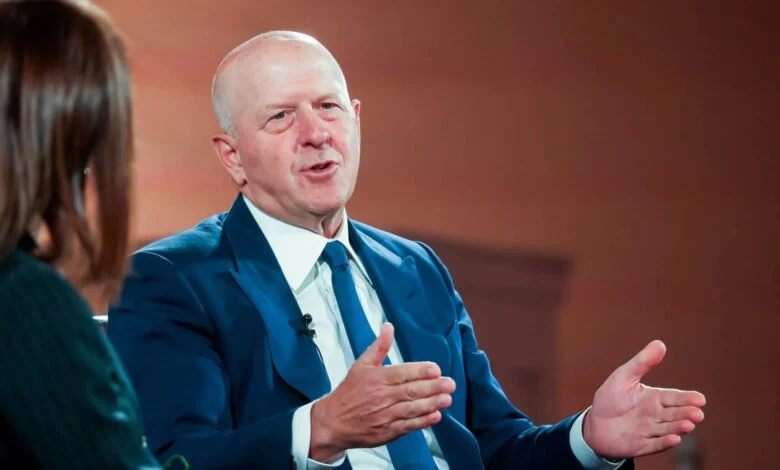
Goldman Sachs Group Inc. Chief Executive Officer David Solomon cautioned the bank’s incoming intern class that Artificial Intelligence cannot replace human judgment in financial dealmaking, urging recruits to challenge AI outputs rather than accepting them as authoritative.
Addressing recruits at a town hall for the firm’s summer intern program—where the acceptance rate remained below 1% for a third consecutive year—Solomon framed AI tools as analytical accelerators that lack the human intuition required for complex advisory work.
The address comes as Goldman Sachs posted record second-quarter financial results, reporting net revenues of $20.34 billion and earnings per share of $20.98, representing a 92% increase from the prior year.
While Solomon noted that AI models can now draft roughly 95% of an S-1 initial public offering filing in minutes—a process that previously required a six-person team several weeks—he emphasized that automated tools cannot evaluate whether financial structures make sense.
“The technology has no ability to do what we do as human beings—to think about whether something makes sense,” Solomon told the group. “There is a form of intelligence which is analyzing data, but there’s also a form of intelligence which is taking life experience and using it to think about or infer things that data wouldn’t.”
Solomon instructed the interns to use AI to test their own assumptions rather than accept automated findings. “Ask questions, challenge the conventional wisdom,” he said. “You have the ability to pick any topic and, in a much shorter period of time, get much smarter on it. But you have to challenge what the models give you.”
He described his own practice of using AI models as an analytical sparring partner. “Go to one of these models and ask them to verify it for you. Is this going on? What are the implications? What would it take to change it?”
Despite rapid technical progress across Wall Street workflows, Solomon stressed that client relationships remain anchored in human interaction. “Across our business, a lot of the relationship is about clients wanting to talk to someone, be heard, be understood, and have an emotional connection. That’s not going away.”
Internal research by Goldman Sachs indicates that AI technology could automate up to 25% of current U.S. working hours over the next decade, with significant impact on white-collar sectors including banking, law, and accounting. In a May New York Times guest essay, Solomon acknowledged the shift, writing, “Will A.I. disrupt the labor market? Absolutely.” However, he maintained that automation will elevate remaining job responsibilities rather than replace human labor entirely.
Solomon has also voiced caution regarding the broader economic return on enterprise AI spending. At Italian Tech Week in Turin last October, he observed that “It’s not different this time,” arguing that a substantial portion of current capital investment in AI will fail to generate expected returns.
Beyond technology, Solomon outlined a structured approach to decision-making derived from his late father, Jerry Solomon. “I have an old habit that, when I make big decisions—of taking out a piece of paper, drawing a line down the middle, and putting things on both sides of the line,” Solomon told the interns. “Even when I quickly put things on the left side that are overwhelmingly obvious, I force myself to think more deeply about what things I might not be thinking about, that should force me to consider the other way.”
“My dad had an incredible way of never telling me what to do, but always forcing me to really wrestle with things and think through issues,” he said. “If I was running down the road to turn left, he had a great ability to get me to pause and really think about why left was a better choice than right. He never said right was better—even when he thought so—he wanted me to spend more time thinking about right before I went left.”
Solomon noted that forcing opposition into decision-making provides clarity. “That gives you more confidence when you ultimately make the decision,” he said. “So go slow, force yourself to look at the other side, and you’ll know when you have big decisions.”
Applying the same principle to career management, Solomon pointed to his own path, which included nearly a decade at Bear Stearns before joining Goldman Sachs in 1999, having been turned down by the firm earlier in his career. “Some of the most important decisions I made were saying no to things where the grass looked greener in the short term,” he said. “I stayed in places longer and that therefore opened up bigger opportunities than I would have imagined.”
“Being patient and taking more time can open up a broader range of opportunities,” Solomon told the recruits. “Try not to be in a hurry and enjoy the ride.”