Computer Science Enrollment Plunges as Universities Pivot to Interdisciplinary AI
Undergraduate computer science enrollment fell 8.4% in spring 2026 as universities embed AI into non-technical majors.
Undergraduate enrollment in computer and information sciences at four-year U.S. higher education institutions fell 8.4% in spring 2026 compared with a year earlier, marking an accelerating downturn for a field long regarded as higher education’s safest career path.
The contraction follows a 3.6% year-over-year drop in fall 2025, when graduate enrollment in computer science programs also fell 14%, according to data from the National Student Clearinghouse Research Center. The multi-quarter decline signals a fundamental shift in student enrollment as universities reallocate technical instruction across broader academic disciplines.
To adapt to changing student demand and prepare graduates for an AI-altered labor market, major public universities are expanding artificial intelligence education beyond dedicated computing departments. The University of Florida now offers more than 200 AI-related courses across all 16 of its colleges, enrolling 14,000 students annually—with 71% of its spring 2026 graduating class completing at least one AI course. Meanwhile, Ohio State University introduced an AI fluency initiative last year to ensure all students, starting with the class of 2029, achieve field-specific AI literacy prior to graduation.
Liberal arts institutions are adopting similar strategies. Colby College in Waterville, Maine, established the Davis Institute for Artificial Intelligence in 2021 with a $30 million gift, creating the first cross-disciplinary AI institute at a liberal arts college to combine technical training with ethical frameworks across all degree programs.
“The vision is really around an interdisciplinary approach to AI,” said David Watts, director of Colby’s Davis Institute for Artificial Intelligence. “A lot of the challenges around AI go a lot further than the AI itself.”
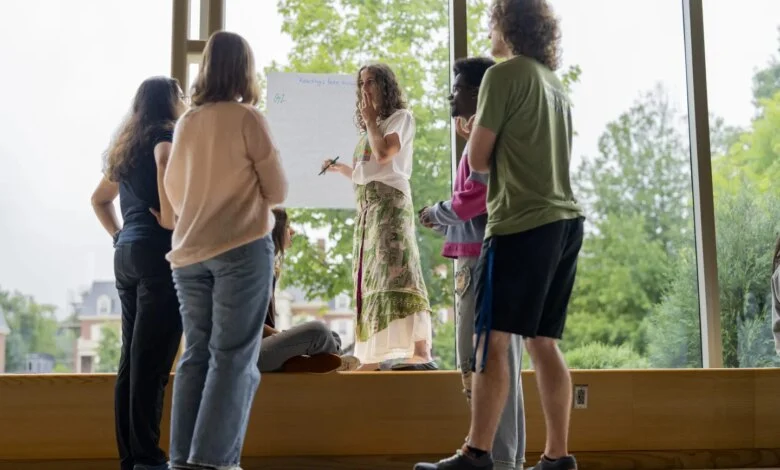
Watts, a computer science graduate from Carleton College in Northfield, Minn., spent two decades at IBM before joining Colby last year. He noted that even senior software engineers at major technology companies often struggled to adapt as technologies evolved. This summer, the Davis Institute partnered with Colby’s Halloran Lab for Entrepreneurship to run an eight-week Interdisciplinary Summer Bridges program. The cohort drew 30 students across 23 majors—requiring no previous programming experience—to study AI fundamentals, analyze ethical implications, and develop real-world software applications.
Student teams created projects including a no-code AI tool designed to eliminate legacy biases in automated hiring systems and an AI-assisted legal citation verification tool for law students and legal professionals. In the final week, students pitched their projects to a panel of judges that included Kathryn Guarini, a former IBM chief information officer who now teaches at the Yale School of Management.
The shift reflects growing recognition that non-computer science majors can acquire technical AI skills applicable to their own fields—such as psychology students developing behavioral health tools—without becoming full software engineers.
“The more you collaborate and bring additional fields to bear, the better you can tackle different perspectives,” he said.
Although core engineering skills remain necessary to build models and detect AI errors, academic leaders emphasize that technical education can no longer be limited to computer science departments alone.
“I’m not an advocate to say that computer science is no longer needed,” Watts said. “It’s just that the nature of how you apply that knowledge is changing.”