NASA Satellite Data Slashes Solar Storm Forecast Margin to 30 Minutes
Initial proof-of-concept tests show NASA's four-satellite PUNCH mission dramatically improves prediction precision for geomagnetic disruptions.
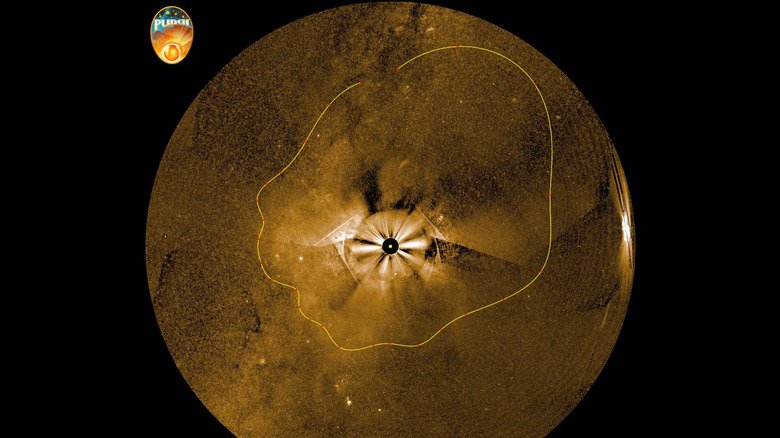
Data from NASA‘s newly deployed Polarimeter to Unify the Corona and Heliosphere (PUNCH) satellite constellation has demonstrated the ability to predict the arrival time of solar storms on Earth to within 30 minutes, replacing existing forecasting methods that carry a five-hour margin of error.
In initial proof-of-concept testing detailed in a manuscript submitted to the journal Space Weather, researchers used PUNCH’s continuous imaging of a coronal mass ejection recorded on May 31, 2025. By analyzing the initial 12 hours of the solar explosion’s trajectory, a computer model calculated the speed and geometry of the cloud to project its arrival at Earth eight hours later, matching actual impact within half an hour.
“We thought PUNCH would be good at this, but it’s a stunning result,” said Craig DeForest, principal investigator for the PUNCH mission at the Southwest Research Institute in Boulder, Colorado. “To put it in perspective, this could be the space weather equivalent of going from a steam engine to a modern internal combustion engine.”
The jump in accuracy stems from continuous tracking capabilities. Traditional space weather observation tools could monitor only roughly one-fifth of a coronal mass ejection’s transit from the sun to Earth. PUNCH, which comprises four microsatellites launched into orbit in March 2025, captures images every four minutes, tracking solar material across the entire interplanetary gap.
Coronal mass ejections unleash massive bursts of solar plasma that trigger geomagnetic storms in Earth’s magnetic field and atmosphere. These space weather events can cause radio blackouts, disrupt high-frequency aviation communications, degrade GPS satellite navigation, threaten orbiting spacecraft, and destabilize ground power grids or internet connections. For power grid operators and satellite constellations, narrowing prediction uncertainty from five hours to 30 minutes allows precise timing for protective actions, such as adjusting transformer loads or placing satellites into safe modes.
While the four microsatellites monitor the sun 24/7, PUNCH is not yet being used to officially predict solar storms. Researchers believe that with improved computational models and refined data from the mission, solar storm forecasts can be made even further in advance.