DJI Pocket 4P Introduces Dual-Lens Optical Zoom in Compact Gimbal Battle
Compact gimbal camera adds a dedicated 60mm telephoto lens to challenge market competitor Insta360.
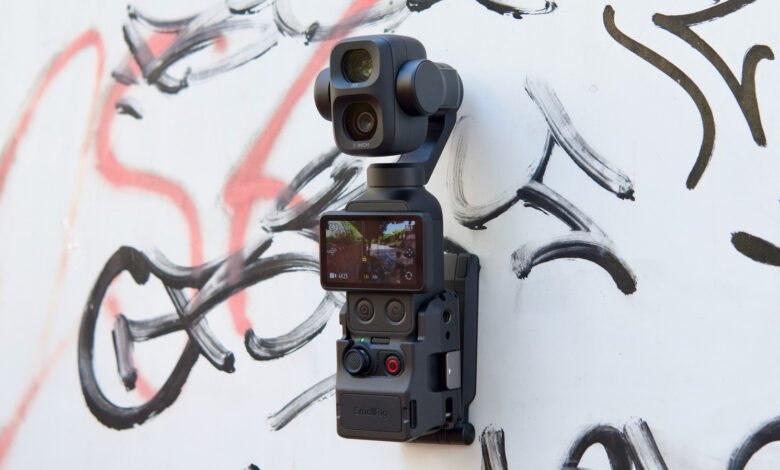
The battle for handheld video supremacy has entered a new phase as camera manufacturers integrate multi-lens architectures into compact gimbal systems. DJI‘s Pocket 4P marks a significant hardware evolution for the lineup, adopting a dual-camera layout designed to deliver dedicated optical zoom capabilities.
Replacing the standard 2x in-sensor crop found on the previous Pocket 4 model, the new device pairs a traditional 20mm wide-angle primary lens with a 60mm medium telephoto lens. The secondary optic delivers a true 3x optical magnification. In standard photography focal standards, 60mm offers natural facial proportions and subject isolation, reducing the perspective distortion common to ultra-wide vlogging cameras.
The secondary lens features a smaller aperture, creating a shallower depth of field that isolates subjects against blurred backgrounds. Subject tracking remains active while zoomed, allowing solo videographers to maintain framing automatically via ActiveTrack. The optical reach enables precise framing adjustments prior to recording, simplifying setup times for macro and top-down product videography.
Beyond the 3x physical limit of the secondary lens, the camera relies on advanced sensor cropping and digital enlargement algorithms. Image fidelity remains stable through 6x hybrid zoom, while extended digital zoom reaches up to 12x. While digital artifacting and noise become visible at maximum magnification, performance remains competitive with dedicated hardware like the Insta360 Luna Ultra.
Hardware transition challenges remain inherent to compact multi-camera setups. When crossing the 3x threshold, the system physically switches between optical assemblies. This shift introduces brief fluctuations in exposure, color cast, and spatial perspective due to physical lens displacement. Although DJI reduced these optical jump effects through recent firmware patches, slight parallax remains observable—a trait shared by Insta360’s competing hardware.
Control ergonomics reveal distinct design choices between competing platforms. On the Pocket 4P, magnification is managed via the physical joystick or a dedicated multi-function zoom button. A single tap toggles between 1x and 3x optical focal lengths, a double tap jumps to 6x, and a continuous hold executes a smooth motorized focal transition. However, the physical joystick can inadvertently remain locked to camera pan movements during live recording.
Software interface restrictions present additional operational differences. When rotated into portrait orientation for vertical content capture, the Pocket 4P removes the visual zoom controls from its touchscreen interface. In contrast, the Insta360 Luna Ultra utilizes a dedicated hardware thumb slider that maintains step-wise and smooth zoom adjustment regardless of screen orientation.