How Anthropic’s Memory Import Tool Breaks OpenAI’s Lock-In on Chatbot Context
Users migrating to Claude can now port their personalized ChatGPT context and preferences using a prompt extraction pipeline.
As artificial intelligence providers compete for high-value power users, the barrier to switching platforms has shifted from raw feature capability to data portability. To counter OpenAI‘s user-retention advantages, Anthropic introduced a dedicated memory import system within Claude designed to extract and ingest saved user context from competing services, including ChatGPT and Google Gemini.
Personalized context—which includes stored user preferences, project details, coding habits, and communication styles—has traditionally served as a key mechanism for platform lock-in. When OpenAI enabled persistent memory across ChatGPT conversations, users accumulated months of tailored context, making platform migration inherently costly in terms of manual setup time.
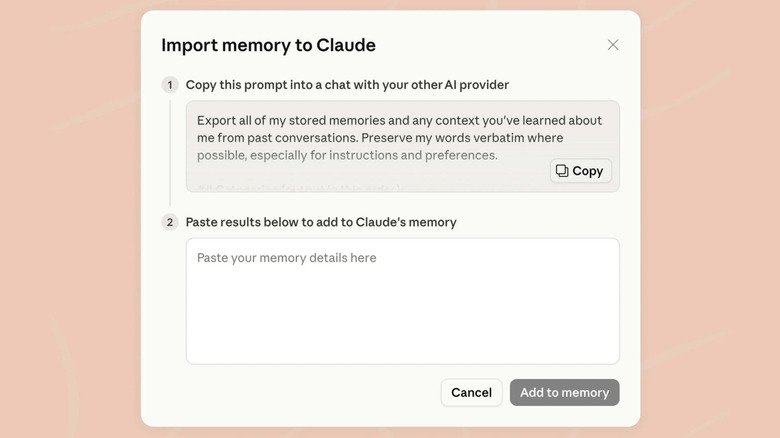
Anthropic’s memory migration feature operates by using structured prompt engineering to export data across platform boundaries. Rather than relying on direct API integrations between rival tech firms, Claude generates a standardized extraction prompt that users execute inside their existing ChatGPT or Gemini sessions. This prompt instructs the source AI to aggregate its stored memories into a standardized text summary that can be copied back into Claude’s memory settings.
To execute the transfer, users navigate to Claude’s settings menu under the Memory or Capabilities section and initiate the import workflow. After copying the provided extraction string, users paste it into ChatGPT, where memory must be active under personalization settings. Utilizing advanced reasoning models—such as ChatGPT’s Thinking mode, accessible via keyboard shortcuts like Shift-Ctrl-M—allows the source system to assemble a more coherent profile summary before export.
This migration pathway reflects broader shifts in AI adoption. A growing segment of developers and analysts have gravitated toward Anthropic’s AI architecture due to its specialized performance in complex software engineering tasks, while others have sought alternatives following controversies surrounding OpenAI’s strategic partnerships with government institutions such as the U.S. Department of Defense.
The same context transfer logic applies to Google Gemini users, who must activate memory features under Personal Intelligence settings before running the extraction string. Once the exported text block is submitted to Claude, Anthropic’s background systems spend up to 24 hours indexing and integrating the context into the user’s account vector store.
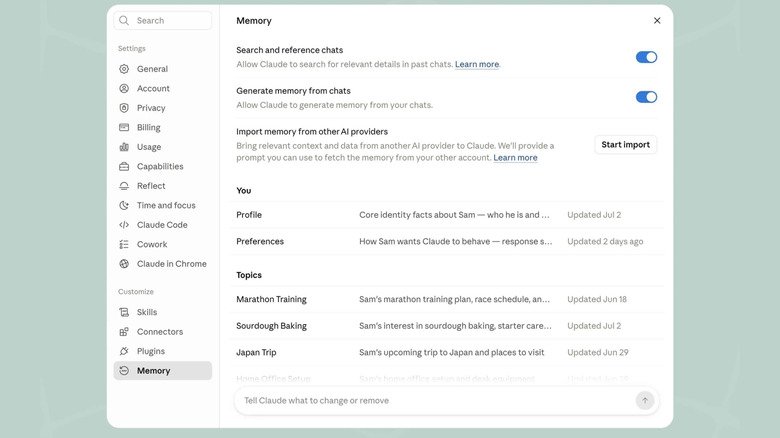
Following the indexing window, users can review, edit, or purge individual memory items within Claude’s settings menu to ensure historical context aligns with their current workflow requirements.