Treasury Yield Surge Breaches Scott Bessent’s Rate Targets as Bond Market Selloff Accelerates
10-Year Yields Threaten 4.5% Red Line as Divisia M4 Money Growth Hits 6.7%

A relentless selloff in U.S. Treasuries has driven yields past informal target thresholds set by Treasury Secretary Scott Bessent, driven by accelerating money supply growth and renewed inflation expectations that Johns Hopkins economist Steve Hanke warned represent a “deadly cocktail” for government debt.
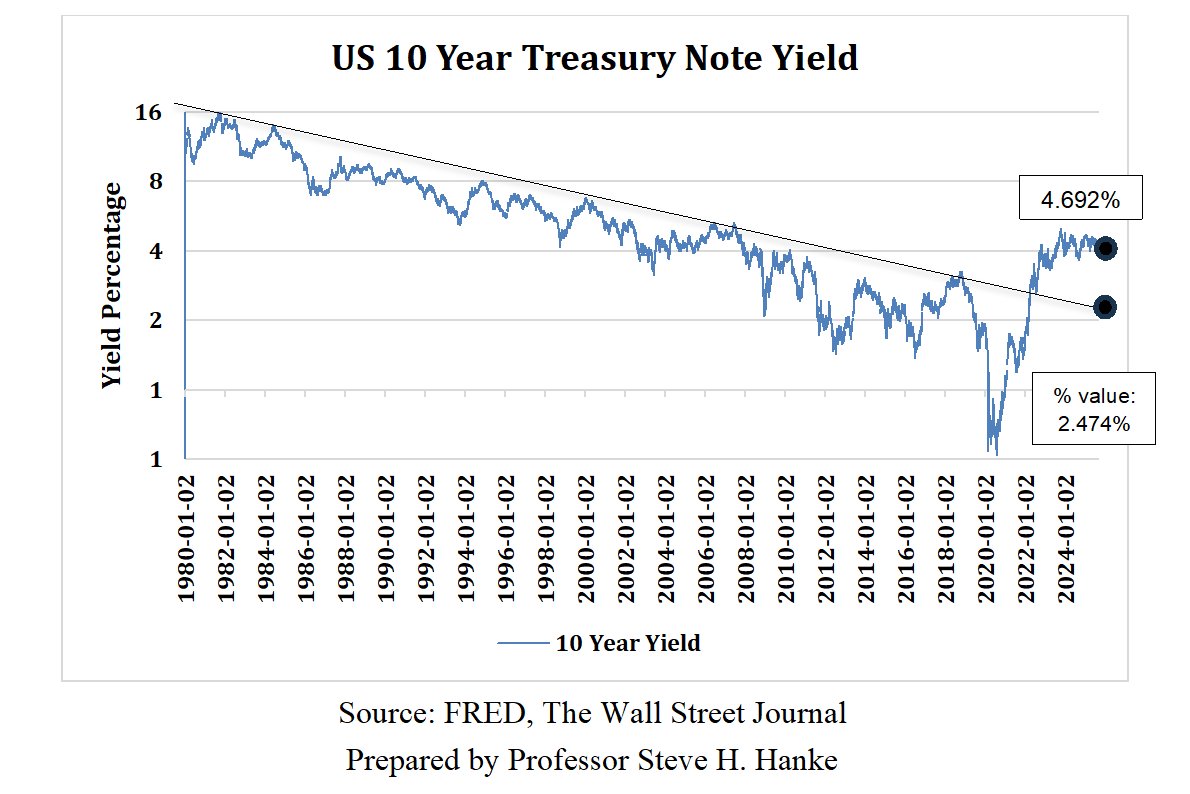
Hanke, a professor of applied economics at Johns Hopkins and special counselor at the Center for Financial Stability, said the primary driver of the spike in yields is monetary expansion. Money growth measured by Divisia M4—the broadest indicator tracked by the Center for Financial Stability—accelerated to 6.7% year-over-year, eclipsing Hanke’s calculated “Golden Growth Rate” of roughly 6% needed to maintain the Federal Reserve’s 2% inflation target. He noted that faster money growth fuels long-term inflation expectations, which directly dictate bond yields, warning that the 10-year Treasury yield could rise an additional 50 basis points.
Bessent has said he wants the 10-year yield to carry a “3 handle”—meaning below 4%—and multiple reports describe a widely understood marker around 4.5% on the 10-year and 5% on the 30-year as his effective red line. Hanke called it a “red line” for the Treasury Secretary, adding that it was a consensus view. “It’s reading the tea leaves,” he said, calling it a “commonly understood red line, not unique to Hanke.”
The upward movement in yields reflects growing pressure from bond investors selling debt to counter fiscal and monetary conditions, a dynamic Hanke noted began intensifying when inflation peaked at 9.1% in June 2021. Reporting from Bloomberg and Reuters highlights that Bessent remains focused on capping the 10-year yield because of its benchmark role in setting consumer borrowing costs and 30-year mortgage rates. According to official foreign holding reports from the U.S. Department of the Treasury, foreign official holdings represent a crucial pillar of federal debt absorption, making yield spikes particularly sensitive to overseas capital flows.
Wall Street strategists say the breach is rattling the Treasury Secretary directly—and the most concrete evidence is an extraordinary policy action on July 31, the same day the 30-year yield hit 5.27%. The U.S. joined Japan in a coordinated yen-buying operation, the first joint currency intervention between the two countries since 1998. The explicit concern was that a falling yen would push Tokyo to sell a portion of its $1.114 trillion in U.S. Treasury holdings to defend its currency — a dump that would send yields even higher. Bessent’s notepad from a Camp David cabinet meeting visibly listed “Buy Japanese Yen (JPY) $5–10 bil.”
The joint currency intervention underscored how fiscal authorities are being forced to take direct steps to insulate Treasuries from external liquidations. Hanke emphasized that long-term Treasury yields act as a natural governor on the broader financial system, asserting that continued yield increases will independently tighten financial conditions without requiring explicit rate adjustments by the Federal Reserve.