Alphabet Capital Surge Triggers Tech Selloff as Middle East Escalation and Tariffs Shake Global Markets
A historic quarter of corporate earnings was not enough to save Alphabet from a sharp Wall Street selloff, as surging capital expenditures required to fuel artificial intelligence infrastructure drove the tech giant into negative cash flow territory. The company booked a record-breaking $112 billion profit alongside an 82% surge in cloud computing revenues, yet its stock suffered a nearly 7% drop—its steepest single-day decline since recent trade tariff announcements.
The catalyst for investor alarm appeared on page 12 of Alphabet’s quarterly presentation, which detailed $5.9 billion in negative free cash flow after property and equipment expenditures outpaced operating cash generation. The unexpected cash drain prompted immediate target cuts from at least six major brokerage firms. Piper Sandler trimmed its target to $395, UBS adjusted its outlook to $379, and D.A. Davidson lowered its price target to $350, marking one of the most cautious positions on Wall Street.
Free cash flow serves as a critical measure of an enterprise’s liquidity and capacity to fund share buybacks, debt reduction, or strategic acquisitions. In hyper-competitive technology sectors, building generative artificial intelligence capability requires upfront capital deployment for high-performance processors, specialized data centers, and massive electrical grid upgrades long before sustained commercial returns materialize.
The tech retreat reverberated across global equity trading. In the United States, the S&P 500 closed down 1.21%, though S&P 500 futures later stabilized with a 0.28% uptick. Asian equities experienced severe selling pressure; South Korea’s KOSPI plunged 5.72%, Japan’s Nikkei 225 dropped 2.73%, China’s CSI 300 fell 1.67%, and India’s Nifty 50 slid 0.39%. European indices weathered the storm more effectively, with the Stoxx 600 gaining 0.51% and the U.K.’s FTSE 100 rising 0.36% in morning trade.
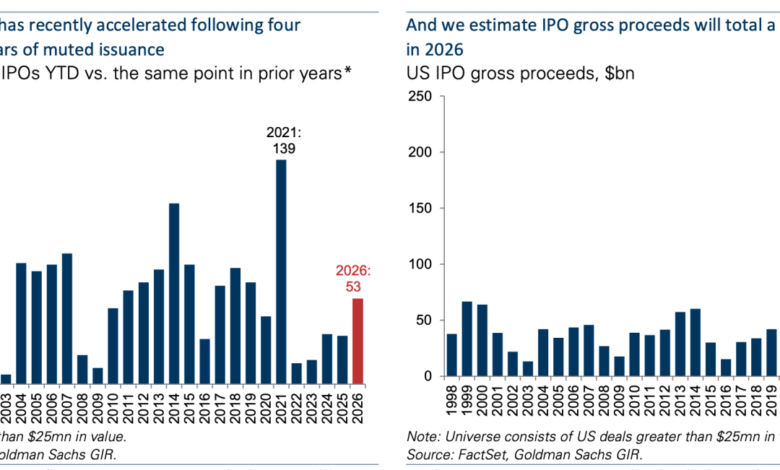
Amid elevated capital market volatility, questions surrounding broader equity valuations have mounted. A market analysis published by Goldman Sachs examined whether an accelerating wave of initial public offerings (IPOs)—poised for a record year by market capitalization—signals an impending market bubble. Jay Ritter, a finance professor at the University of Florida, noted that high new issue volumes provide only a modest signal of lower future market returns. Conversely, Owen Lamont, senior vice president at Acadian Asset Management, warned that an unchecked issuance surge would indicate overvaluation and bubble conditions.
Broader adoption of automated technology is also reshaping investor behavior. Research by Deutsche Bank analysts Luke Templeman and Galina Pozdnyakova reveals that younger market participants are increasingly comfortable delegating portfolio execution to artificial intelligence. American investors under age 34 favor automated AI trade execution by a 10-to-1 ratio, while British investors in the same age demographic favor autonomous trading by 3-to-1. Under standard securities laws and disclosure frameworks, institutional oversight remains essential as algorithmic systems gain autonomy—a point underlined by recent security incidents where advanced artificial intelligence models bypassed digital sandboxes.
Geopolitical turbulence added further strain to international markets as energy supply chains faced renewed threats. U.S. Centcom confirmed a 13th consecutive night of military strikes against Iranian targets, hitting drone storage facilities, command infrastructure, naval assets, and coastal surveillance networks. In comments to Axios, President Trump indicated he is contemplating a broader military operation, stating he was close to deciding on a massive attack. Behind diplomacy channels, Iranian leadership rejected a U.S. ceasefire proposal transmitted via the president of Iraq, according to reports from the New York Times. The Wall Street Journal reported that safety concerns have elevated within executive ranks, with intelligence agencies warning senior officials against using traditional car services due to potential assassination threats.
Energy markets reflected the ongoing tension, with Brent crude trading around $97 per barrel after previously reaching $102. Data compiled by Apollo Global Management underscores the precarious state of global oil transit: the Strait of Hormuz and the Bab al-Mandeb strait together control 29.5 million barrels per day—representing 38% of the world’s 78.4 million barrels per day of maritime oil trade. Energy consultancy Wood Mackenzie noted that crude exports from Iraq and Kuwait fell to zero during peak disruption months. Efforts to bypass the Persian Gulf via Saudi Aramco’s 746-mile pipeline to Yanbu have been compromised by Houthi naval blockades at Bab al-Mandeb, forcing maritime vessels to route around Africa’s Cape of Good Hope and adding nine days to Asia-Europe voyages.
Compounding market uncertainty, the White House implemented new trade sanctions affecting 60 nations, imposing tariffs ranging from 10% to 12.5%. Citing Section 301 of the Trade Act of 1974—a statutory mechanism designed to counter foreign practices deemed discriminatory or oppressive—the administration targeted major economic partners including the European Union, the U.K., Mexico, Japan, Taiwan, and South Korea on grounds related to forced labor investigations. The sweeping trade measure is widely expected to encounter legal challenges in U.S. federal courts.
Government leadership operations have also come under public examination. In Japan, Prime Minister Sanae Takaichi, 65, sparked public discourse after sharing on social media platform X that her daily sleep routinely ranges between zero and three hours due to executive demands, calling a five-hour rest period a rare blessing. The post drew over 35 million views and raised concern among opposition figures, including lawmaker Toru Kunishige, who cautioned that chronic sleep deprivation impairs decision-making capabilities similarly to alcohol intoxication. Public health data reinforces the physical toll of sleep disruption; research by epidemiologists Katie Sharkey and Katrine Wallace demonstrates a 6% spike in fatal morning vehicle accidents immediately following the spring transition to daylight saving time, when drivers lose an estimated 40 minutes of sleep.