Tech Giants Shift to Asset-Heavy AI Model Triggers $400 Billion Debt Surge and Off-Balance-Sheet Strain
Massive corporate borrowing and hidden liabilities test fixed-income investor appetite amid rising U.S. sovereign debt.
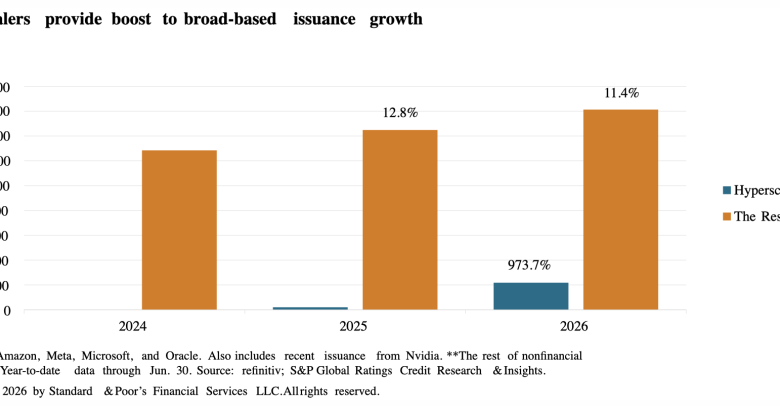
Major technology corporations are executing a fundamental financial shift, moving away from software-driven, asset-light business models to fund massive physical infrastructure projects required for artificial intelligence. This capital spending expansion is fueling a record borrowing spree that is beginning to strain bond markets while pushing off-balance-sheet commitments to unprecedented levels.
Data compiled by S&P Global Ratings indicates that technology hyperscalers and key hardware suppliers such as Nvidia issued $225 billion in corporate bonds during the first half of 2026. That marks a 973.7% jump compared to the same period in previous years, placing the sector on pace to reach $400 billion in total debt issuance by the end of the year.
However, fixed-income markets are exhibiting signs of fatigue. S&P noted that hyperscalers are being required to pay higher yield premiums over benchmark U.S. Treasuries to attract institutional buyers. Credit investors, who traditionally viewed large technology firms as low-leverage cash powerhouses, are growing cautious as capital expenditure guidance continues to climb—highlighted by Amazon‘s recent upward adjustments to its spending plans.
This corporate borrowing expansion collides with heavy issuance from the U.S. Treasury, where the federal budget deficit is projected to approach $2 trillion this fiscal year. Because the Federal Reserve is no longer absorbing large volumes of government debt through quantitative easing, private fixed-income investors must finance both record sovereign deficits and corporate AI expansion simultaneously. According to Capital Economics, combined corporate and government bond issuance as a share of gross domestic product could surpass any year on record outside the pandemic if current pace continues.
Joseph Brusuelas, chief economist at RSM, observed that while overall market demand for sovereign and corporate debt remains functional today, high federal deficits will eventually push borrowing costs upward, causing capital flows to tighten for all market participants.
Parallel to public bond markets, an even larger volume of unrecorded liabilities is financing data centers and processing hardware. A study by Nikkei revealed that off-balance-sheet debt among major U.S. technology leaders expanded eightfold over four years to $1.65 trillion, eclipsing the $1.35 trillion in visible debt carried on their primary balance sheets.
These off-balance-sheet commitments consist of long-term purchase agreements for graphics processing units and operational leases for third-party facilities. Although fully compliant with accounting standards and disclosed within financial footnotes, these commitments convert into mandatory debt and rent payments once facilities go operational.
Credit rating agency Moody’s placed off-balance-sheet technology liabilities at $1.2 trillion, with more than $820 billion tied directly to data centers under construction. Moody’s emphasized that moving from asset-light software and cloud intellectual property to hardware-intensive infrastructure requires capital raising on an unprecedented scale. While rating agencies note that hyperscalers maintain high credit ratings and strong balance sheets, these mounting commitments lock in substantial long-term financial obligations.