Optical Stealth Drone Exploits Limits of Human Perception
Northwestern University researchers develop the counter-rotating Phantom Twist UAV to achieve a ten-fold reduction in visual detection.
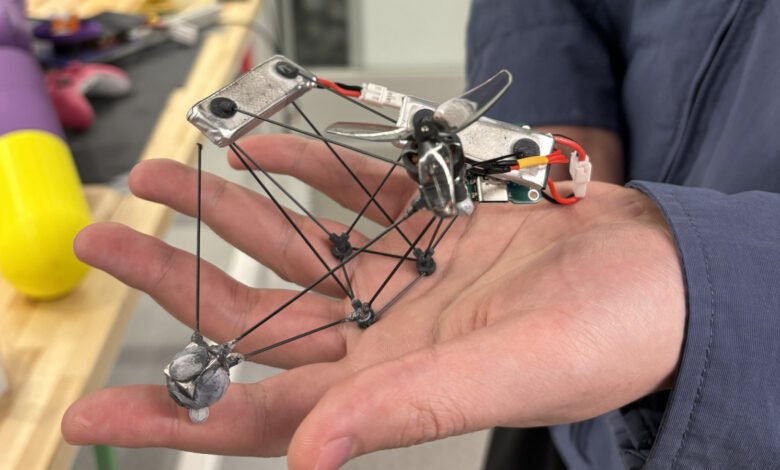
Drones operating at low altitudes may soon bypass visual detection not through active camouflage panels, but by exploiting fundamental limits in human visual perception. Engineers at Northwestern University have designed an experimental craft named the Phantom Twist, which spins rapidly to dissolve into a translucent blur during flight.
Unveiled at the Robotics: Science and Systems conference in Sydney, Australia, the platform achieves a ten-fold reduction in visual visibility compared to standard commercial quadcopters. Rather than altering surface coloration or matching background lighting, the aircraft targets temporal visual integration—the physiological lag in how the human brain processes motion. By rotating at speeds reaching 25 revolutions per second, the drone forces an observer’s vision to blend its solid components into the surrounding background, producing a faint, barely discernible distortion.
Standard multi-rotor aerial vehicles rely on stationary bodies paired with localized spinning blades, creating static focal points that human eyes easily track. To remove these visual anchors, researchers at Northwestern’s McCormick School of Engineering designed a counter-rotating architecture where the main airframe and propeller spin in opposite directions. The drone’s structural components—including its battery, wiring harness, control circuits, and counterweights—are separated across vertical planes to maximize open space between moving elements.
The low-visibility UAV emerged from an automated design process at Northwestern’s Center for Robotics and Biosystems, funded in part by the National Science Foundation. Researchers utilized artificial intelligence to screen 20,000 potential physical structures. The system sifted these down to 500 candidate models, evaluating flight performance across simulated landscape environments using visual perception algorithms modeled on human sight.
Michael Rubenstein, an associate professor of computer science and mechanical engineering who headed the project alongside computer vision specialist Emma Alexander, noted that physical construction began only after automated modeling validated the stealth criteria. Alexander explained that the optical effect relies on visual integration periods similar to camera shutter speeds, where rapid motion averages opaque structural elements into ambient background illumination.
Unlike traditional military stealth designs focused on minimizing radar cross-sections or heat signatures, micro-UAVs face detection primarily through visual observation and acoustic noise at close range. The prototype Phantom Twist remains partially detectable due to mechanical whirring during high-speed rotation, while its support rods and wiring harness can still be seen under specific lighting conditions.
The research team plans to refine the platform by incorporating transparent structural materials and quieter motor configurations. While initial intended uses focus on ecological monitoring—allowing low-altitude surveillance of sensitive wildlife habitats without disturbing animal behaviors—the underlying mechanics highlight ongoing technical efforts to lower the operational signature of small autonomous aircraft.