CFTC and Michigan Court Clash Over Kalshi, Putting Prediction Market in ‘Impossible Position’
Federal regulator orders platform to ignore state court mandate to unwind contracts, fueling jurisdictional battle.
The regulatory landscape for prediction markets in the United States has devolved into a high-stakes jurisdictional turf war. On Tuesday, the Commodity Futures Trading Commission (CFTC) ordered Kalshi to ignore a Michigan state court directive to cancel and unwind executed trades, leaving the federally regulated prediction market platform caught in a legal crossfire.
The conflict stems from a June 29 ruling by Ingham County Circuit Court Judge Rosemarie Aquilina. The judge ordered Kalshi to immediately cease offering sports betting contracts to Michigan users while a state-level lawsuit plays out. The lawsuit questions whether Kalshi’s event contracts violate Michigan’s strict sports betting laws.
However, the federal commodities regulator stepped in on Tuesday with a conflicting directive, ordering Kalshi to defy the state court’s order to cancel executed trades and to continue its operations. The move has thrust the platform into a regulatory limbo, forcing it to choose between state-level compliance and federal mandates.
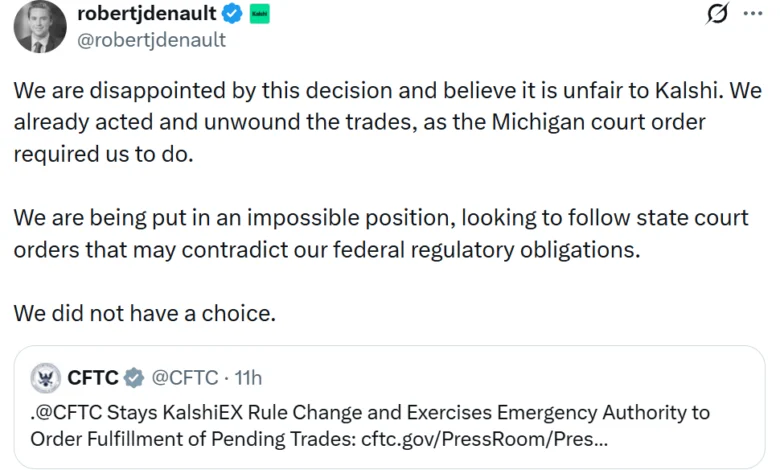
“We are disappointed by this decision and believe it is unfair to Kalshi,” said Robert DeNault, the company’s head of enforcement and legal counsel, in a statement posted to X.
“We already acted and unwound the trades, as the Michigan court order required us to do,” DeNault continued. “We are being put in an impossible position, looking to follow state court orders that may contradict our federal regulatory obligations. We did not have a choice.”
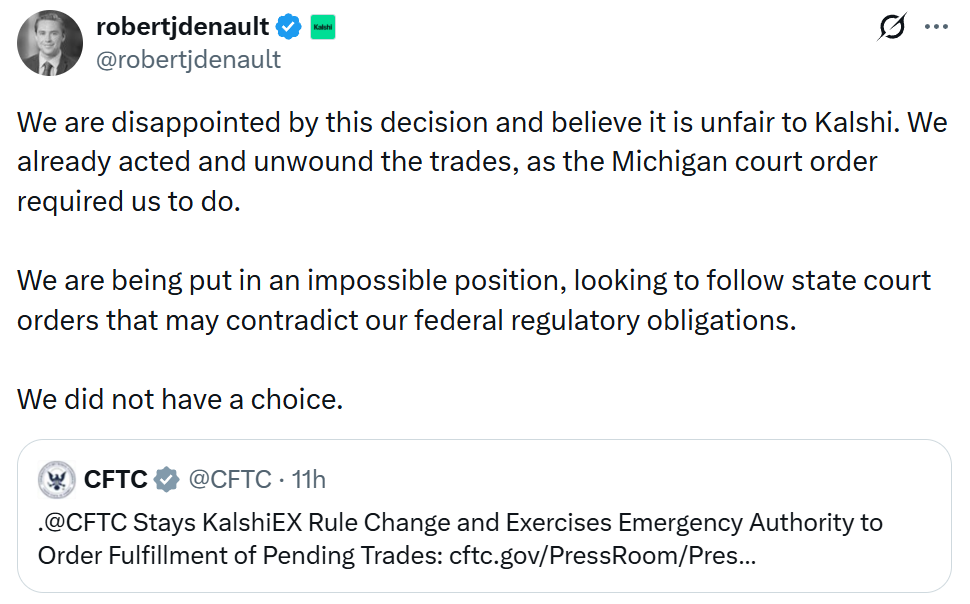
Source: Robert DeNault
A Clash of Jurisdictions
This standoff highlights a deep, unresolved regulatory divide between the CFTC and nearly two dozen state regulators over who holds ultimate authority over prediction markets. While the CFTC regulates these platforms as financial exchanges offering event-based derivatives, state authorities often view them through the lens of gambling and sports wagering laws.
According to the CFTC, Michigan’s intervention represents the first time a state has attempted to interfere with executed derivatives transactions. From the federal regulator’s perspective, allowing a state court to retroactively cancel settled financial contracts poses a systemic risk to market integrity.
“Canceling trades that have already been executed is an unprecedented step that risks a cascading effect on the entire marketplace and undermines the certainty in contracting that is a necessary component of a functioning market,” CFTC Chair Michael Selig said during an appearance on Fox Business on Friday.
Selig made it clear that the federal government would not back down in asserting its supremacy over derivatives trading. “The Commission will not allow states or state courts to bully registered entities into violating the Commodity Exchange Act and CFTC regulations,” he added.
The Broader Battle Over Event Contracts
Prediction markets allow participants to buy and sell contracts based on the outcomes of future events, ranging from political elections and economic indicators to weather patterns and sports. Under federal law, the CFTC oversees these platforms as designated contract markets, ensuring they comply with strict rules regarding market manipulation, customer protection, and financial integrity.
However, as prediction markets have surged in popularity, they have increasingly run afoul of state-level gaming commissions. State regulators argue that contracts tied to sports or elections are essentially unregulated wagers that bypass state tax and licensing frameworks.
The CFTC is actively fighting to protect its regulatory domain. “We’ve sued nine states now, and we’ll continue to sue any state that attempts to impose criminal or civil fines against CFTC-registered exchanges,” Selig stated on Fox Business, emphasizing the critical importance of maintaining federal oversight.
For Kalshi, navigating this dual-track regulatory system is proving to be a legal minefield. A Kalshi spokesperson told Reuters that the company is currently reviewing the CFTC’s order and considering its next steps.
The outcome of this dispute could set a major precedent for the entire digital asset and prediction market industry, determining whether federal registration shields exchanges from state-level prosecution or if platforms must navigate a patchwork of 50 different state regulatory regimes.