Primate Labs Launches Geekbench 7 with Next-Generation AI Workloads and Expanded GPU Support
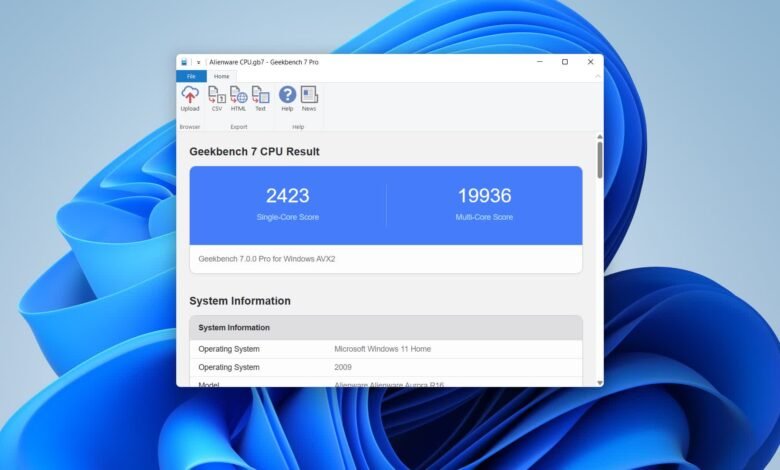
Primate Labs has released Geekbench 7, marking a comprehensive overhaul of its flagship cross-platform benchmarking suite. The updated software introduces modernized workloads tailored for contemporary computing tasks, ranging from local artificial intelligence processing to next-generation media compression and realistic multi-core application scaling.
Available across Android, iOS, macOS, Windows, and Linux, the new benchmark addresses significant shifts in consumer software usage since previous iterations. The update comes at a time when hardware manufacturers are increasingly relying on heterogeneous processor architectures—combining high-performance and power-efficiency cores—which require more nuanced testing methodologies to measure true real-world capabilities.
Central to the CPU benchmark overhaul is the addition of practical media processing routines. Geekbench 7 incorporates screen-share video encoding using the AV1 codec, standardized by the Alliance for Open Media to lower bandwidth consumption during digital collaboration. Audio compression tests now employ the Opus codec commonly used in streaming and messaging software, while video playback evaluations include live subtitle generation powered by OpenAI’s Whisper speech recognition model. Gaming performance metrics have also been refreshed through the integration of the Jolt Physics engine, alongside upgraded photo handling workloads that support modern formats like JPEG XL and RAW DNG files.
The multi-core evaluation framework has undergone structural changes to prevent synthetic inflation of performance scores. Rather than forcing all CPU cores to execute every test simultaneously, Geekbench 7 restricts multi-threaded execution strictly to workloads that naturally run across multiple threads in commercial applications. Web browsing tests utilizing HTML5, for instance, remain constrained to single-threaded routines to reflect actual browser engine behavior.
On the graphics front, the GPU Benchmark expands its scope to emphasize machine learning inference and complex image synthesis. New compute workloads evaluate real-time facial tracking, virtual background blurring for video conferencing, and neural network-driven image upscaling. Additionally, the graphics suite adds advanced rendering tests, including path tracing, fluid simulation, and LUT-based color grading for video production.
In response to long-standing industry demand, Primate Labs has added native support for NVIDIA’s proprietary CUDA API alongside existing frameworks such as OpenCL, Vulkan, and Metal. CUDA remains the dominant computing platform for professional deep learning, hardware acceleration, and high-performance scientific computing, making its inclusion critical for evaluating modern workstation graphics cards.
To account for advancing memory bandwidth and system capabilities, Primate Labs expanded the underlying datasets used across all tests. The PDF processing module now incorporates technical documents and academic papers alongside standard maps, while file compression routines utilize broader mixtures of source code and text files. The suite retains its hardware diagnostic tools, including system stress testing, battery endurance tracking, and centralized cloud synchronization via the public Geekbench Browser database.