The $130 Billion Backlash: How the AI Data Center Boom Is Forcing a New Deal for American Towns
Faced with soaring grid costs and public pushback, tech giants are signing massive community benefit agreements to keep their AI ambitions online.
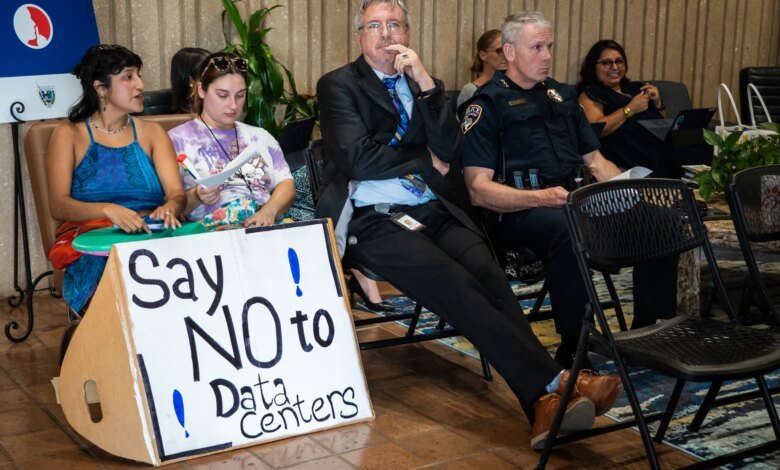
The unprecedented expansion of artificial intelligence data centers is triggering a fundamental shift in how local governments and utility companies negotiate with Big Tech. As communities push back against soaring energy costs and secretive zoning deals, a new model of “community contracts” is emerging to ensure tech giants pay their way.
This shift comes amid mounting friction. According to data from the research group Data Center Watch, at least 75 data center projects valued at approximately $130 billion were delayed or blocked across the United States in the first quarter of 2026 alone. The backlash highlights a growing public resistance to the massive resource demands of AI infrastructure. In Festus, Missouri, for instance, voters unseated half of the city council in early 2026 following the quiet approval of a $6 billion data center project.
Beyond local zoning disputes, the sheer power demand of these facilities threatens to strain regional electric grids and drive up consumer utility bills. PJM Interconnection, which coordinates electricity transmission across 13 states and Washington, D.C., faces severe cost pressures. PJM’s independent market monitor, Joe Bowring, recently linked projected data center demand to an estimated $23 billion in increased electricity costs for consumers across the Mid-Atlantic and Midwest through 2028. Bowring has argued that massive energy consumers should finance their own generation rather than relying on existing infrastructure funded by everyday ratepayers.
This grid strain has caught the attention of federal regulators. The Federal Energy Regulatory Commission (FERC) ordered all six regional grid operators to revise or justify their connection rules for large-scale energy users, aiming to clarify who bears the cost of grid upgrades. Additionally, major artificial intelligence developers signed a White House-backed pledge committing to source or fund the electricity required for their new facilities.
Where negotiations are transparent, however, some municipalities are leveraging the tech boom to secure historic financial commitments. In Hobart, Indiana—a town of 30,000 with an annual tax levy of $25 million—negotiations with Amazon Web Services (AWS) yielded roughly $200 million in community commitments. The funds will support public parks, youth initiatives, and public safety without requiring local income tax hikes, alongside an AWS commitment to recruit from local high schools.
Similar windfalls are appearing elsewhere. In LaPorte, Indiana, a Microsoft project is projected to generate $1 billion in tax revenue over 30 years, with 15% earmarked for local schools. Jasper County, Indiana, approved a community benefit package yielding $98 million upfront and $23 million annually for a decade. Meanwhile, Henrico County, Virginia, established a $60 million housing trust—funded entirely by data center revenues—to assist middle-income workers like teachers and nurses who do not qualify for traditional housing aid.
Utility companies are also restructuring their business models to protect residential ratepayers. AEP Ohio now requires large-scale consumers to pay for the capacity they reserve, regardless of actual usage. Northern Indiana Public Service Company (NIPSCO) established a dedicated entity allowing data centers to finance their own power generation. NIPSCO has secured agreements with Amazon and Alphabet expected to return $1.4 billion to existing utility customers.