Kazakhstan to Exchange Electricity Quotas for Crypto Assets Under New Mining Law
New government rules require large-scale miners to contribute to a state-backed digital asset reserve in exchange for energy quotas.
Kazakhstan is overhauling its relationship with the cryptocurrency industry by introducing a framework that trades guaranteed energy access for a direct stake in mined digital assets. Under a newly approved government resolution, large-scale data centers designated as “strategic” will receive electricity at regulated tariffs in exchange for transferring a portion of their production to a state-backed reserve.
The policy, formalized through Government Resolution No. 638, marks a significant shift in how the Central Asian nation leverages its status as a global mining powerhouse. By linking energy security to the growth of national digital reserves, the government aims to stabilize its power grid while building a sovereign crypto portfolio. The new regulations are scheduled to take effect on August 1, 2026.
To qualify for this strategic status, mining operations must meet rigorous industrial benchmarks. Applicants are required to operate data centers with a minimum capacity of 150 megawatts (MW)—a threshold that targets only the largest industrial players. Furthermore, the hardware used must meet high efficiency standards, with each unit required to deliver at least 150 terahashes per second (TH/s). This technical requirement effectively mandates the use of latest-generation hardware, such as the most advanced machines produced by industry leaders like Bitmain or MicroBT.
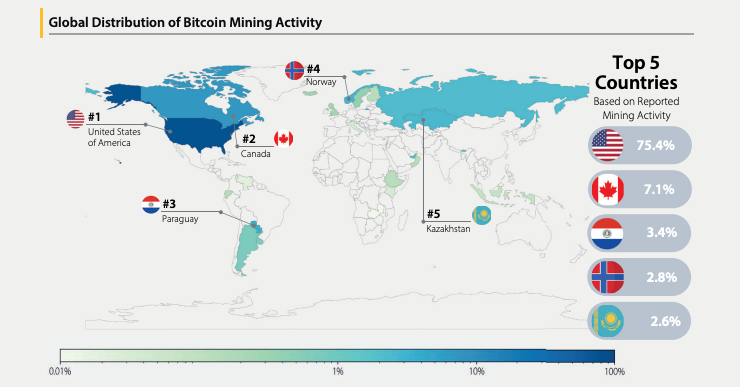
Kazakhstan ranked fifth globally by Bitcoin mining activity. Source: Cambridge Centre for Alternative Finance.
Beyond hardware, the framework demands a high level of operational maturity. Companies must maintain qualified technical staff, on-site repair facilities, and redundant internet connections through multiple service providers. They must also demonstrate full compliance with tax obligations and other mandatory state payments. This move follows years of tension between the state and the mining sector, which saw Kazakhstan grapple with energy shortages following the 2021 migration of miners from China.
The assets collected from these strategic miners will be funneled into a reserve mechanism managed by Astana Hub, the country’s primary technology and innovation cluster. While the official resolution does not specify the exact percentage of crypto assets to be surrendered, industry reports suggest the transfer rate could be as high as 10%. This mechanism aligns with the broader goals of the Alem Crypto Fund, a state-backed vehicle launched in late 2025 to manage long-term digital asset reserves.
Kazakhstan’s evolution from a passive host for mining rigs to an active participant in the digital economy is further evidenced by its recent infrastructure developments. In April 2025, the Cambridge Centre for Alternative Finance ranked Kazakhstan fifth globally in Bitcoin mining activity. To capitalize on this, the country has integrated crypto into its domestic financial system, recently launching services that allow citizens to make retail payments via QR codes through partnerships between local banks and Binance Kazakhstan.
The strategic mining framework represents a formalization of the “energy-for-equity” model, ensuring that the state benefits directly from the computational power hosted within its borders. It also provides a predictable regulatory environment for miners who can meet the high entry barriers, offering them protected access to the national grid in a region where energy reliability has historically been a point of contention.