Grayscale Challenges Four-Year Cycle Theory, Signaling Bitcoin Floor Is In if Fed Pauses Rates
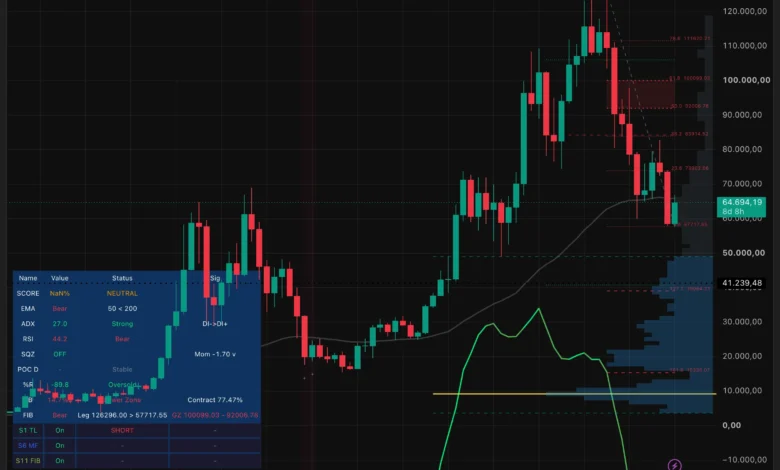
Bitcoin may have already established its cyclical bottom following a drop to $57,717 earlier this month, provided central bank monetary tightening remains on pause, according to a research note released Wednesday by digital asset manager Grayscale.
The report directly challenges the cryptocurrency industry’s long-held “four-year cycle” narrative. That traditional framework, built around the mathematical reduction of bitcoin mining rewards known as the halving, projects market bottoms approximately 12 months after a bull peak and 30 months after a halving event. Under those historical metrics—which typically involve average peak-to-trough drawdowns of 80%—the digital asset would be expected to slide further toward $50,000 by September or October.
However, Grayscale head of research Zach Pandl argues that the asset class has outgrown retail-driven halving patterns. Instead, Bitcoin now trades as a mature macroeconomic asset sensitive to real interest rates and sovereign policy shifts, displaying trading characteristics comparable to gold or growth equities. Real interest rates—the return on government bonds adjusted for inflation—increase the opportunity cost of holding non-yielding assets, explaining why previous crypto bear markets matched periods of tightening economic policy.
Market data reflects a steady shift in institutional participation since the U.S. launch of spot exchange-traded funds, which bridged traditional brokerage accounts with digital asset spot markets. Spot Bitcoin ETFs recently recorded nearly $1 billion in net capital inflows across seven consecutive trading sessions, lifting prices back above $65,000 despite persistent monthly pressure.
The digital currency remains down roughly 49% from its peak near $126,000 recorded in October 2025. Much of that decline stemmed from aggressive recalibrations of central bank expectations, particularly after market concern surrounding monetary policy leadership—such as the nomination of Kevin Warsh to head the Federal Reserve—muted sovereign currency debasement hedges.

With the Federal Reserve scheduled to deliver its next interest rate assessment on July 29, macro traders are evaluating whether interest rate pauses could confirm a durable market floor. Industry peers have expressed mixed views; while exchange-traded product provider 21Shares noted earlier this summer that price action continues to echo historical patterns, analytics firm CryptoQuant previously identified a realized-price floor near $55,000.
Beyond central bank policy, institutional attention is fixed on legislative momentum in Washington. The Clarity Act faces an August 7 deadline in the U.S. Senate. The legislation seeks to establish a clear regulatory boundary for digital assets, assigning authority over investment contracts to the Securities and Exchange Commission while designating spot commodity markets and derivatives under the oversight of the Commodity Futures Trading Commission. Market participants view regulatory clarity as a potential catalyst capable of solidifying the current market recovery.