EU Regulators Approve 14 New Crypto Firms Under MiCA as Traditional Banks Deepen Digital Asset Push
ESMA's latest register update brings the total number of licensed CASPs to 294, highlighting a growing institutional embrace of the EU's landmark regulatory framework.
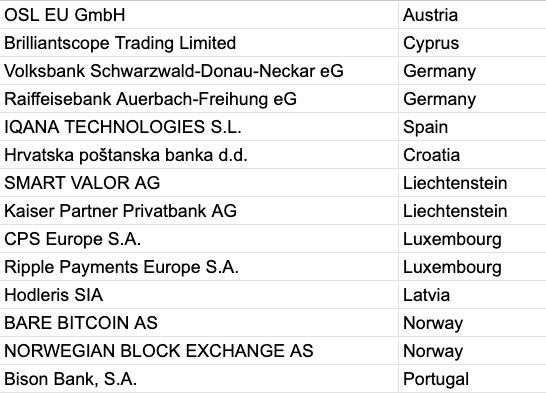
The European Union’s landmark Markets in Crypto-Assets (MiCA) framework continues to reshape the digital asset landscape across the continent. In its second post-deadline update, the European Securities and Markets Authority (ESMA) updated its interim register on Thursday, adding 14 new crypto companies to the system. This latest cohort brings the total number of licensed crypto-asset service providers (CASPs) to 294, signaling a steady, albeit more measured, pace of licensing following an initial regulatory rush.
Among the high-profile additions to the register is Ripple Payments Europe, the European payments arm of the prominent blockchain enterprise Ripple. The inclusion of Ripple’s European division underscores how global crypto firms are leveraging MiCA’s standardized licensing to solidify their foothold in the European Economic Area (EEA). Joining Ripple are several notable financial institutions, including Portugal-based Bison Bank and Croatia’s state-owned bank, Hrvatska poštanska banka (HPB).
This latest expansion follows ESMA’s initial major post-deadline update on July 3, when the regulator added 37 CASPs immediately after the expiration of MiCA’s transitional phase. The drop from 37 to 14 new entries suggests that national competent authorities are adopting a more meticulous, long-term approach to vetting applicants now that the initial wave of transition-period registrations has been processed.
A defining trend of this update is the accelerating convergence of traditional finance (TradFi) and digital assets. European banks are increasingly utilizing the MiCA framework to offer regulated crypto services, viewing regulatory clarity as a green light to enter the space. Alongside Bison Bank and HPB, the register welcomed two German cooperative banks: Volksbank Schwarzwald-Donau-Neckar and Raiffeisenbank Auerbach-Freihung. Additionally, Liechtenstein-based Kaiser Partner Privatbank secured its spot on the register, further expanding the presence of private banking institutions catering to high-net-worth clients seeking regulated digital asset exposure.
These new additions join an already impressive roster of traditional financial heavyweights on the MiCA register. Established institutions such as Spain’s BBVA and CaixaBank, Germany’s Commerzbank, France’s CACEIS Bank, and Standard Chartered Luxembourg have already established their regulated crypto footprints under the framework. For these legacy institutions, MiCA’s “passporting” rights—which allow a firm licensed in one EU member state to operate across all 27 nations—offer an unprecedented opportunity to scale digital asset offerings efficiently.
While the CASP registry continues to grow, other segments of the MiCA framework remain static. ESMA reported no new changes to its registries for electronic money tokens (EMTs) and asset-referenced tokens (ARTs). Under MiCA’s classification system, electronic money tokens are stablecoins designed to maintain a stable value against a single official fiat currency (such as the Euro or US Dollar), whereas asset-referenced tokens are pegged to multiple assets, fiat baskets, or commodities. Currently, the EMT register stands at 21 unique issuers, while the ART register has yet to list any approved issuers, reflecting the stringent regulatory hurdles and compliance standards imposed on stablecoin operators.
Alongside its licensing updates, ESMA continues to actively police the European market to protect consumers from unregulated actors. The regulator added two new entities to its non-compliant register: Reversal Investment Group and Kortex. These additions were triggered by enforcement actions taken by Italy’s securities regulator, the Commissione Nazionale per le Società e la Borsa (CONSOB). With these new entries, the total number of flagged, non-compliant entities has risen to 164, a list that notably includes the major global crypto exchange MEXC. This dual focus on licensing compliant players while blacklisting unauthorized operators underscores Europe’s commitment to creating a highly secure and transparent digital asset ecosystem.