South Korean Crypto Exchanges Face 89% Volume Drop as Retail Investors Pivot to Booming Stock Market
Trading volumes across major won-based platforms collapsed by nearly 90% as the KOSPI benchmark doubled.
South Korea’s once-boisterous retail cryptocurrency market is facing a severe liquidity slowdown, with trading volumes across the country’s major digital asset exchanges plunging by nearly 90% year-over-year.
Data analyzing trading activity on the nation’s five licensed won-fiat exchanges—Upbit, Bithumb, Coinone, Korbit, and Gopax—reveals that combined average daily trading volumes plummeted to approximately $305 million. This represents a staggering 89% decline from the $2.82 billion recorded during the same period in the previous year. Even on an unweighted basis, which treats each platform equally regardless of market share, the exchanges suffered an average volume drop of roughly 77% according to historical market data compiled by CoinGecko.
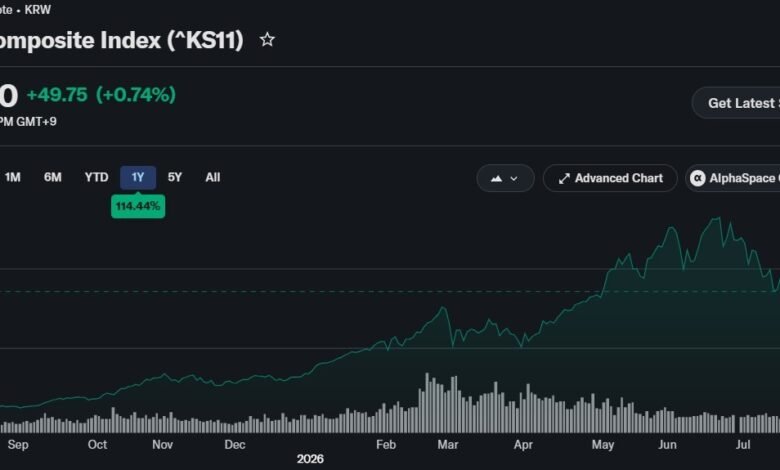
This capital flight from digital assets coincides with a massive bull run in the traditional financial sector. South Korea’s benchmark stock index, the Korea Composite Stock Price Index (KOSPI), surged by 114.44% over the same 12-month period. The stark contrast suggests that local retail investors, historically known for their high-risk appetite, are migrating en masse back to equities.
The sharp decline in trading activity has put immediate financial pressure on smaller domestic platforms. Because South Korean exchanges operate under a fee-dependent business model, the prolonged volume slump has severely eroded transaction fee revenues. To cope with the cash squeeze, some platforms have resorted to liquidating their own cryptocurrency reserves. Korbit, one of the country’s oldest exchanges, recently sold 15 Bitcoin (BTC) and 60 Ether (ETH) to raise approximately 1.6 billion won (around $1.15 million) in capital.
South Korea has long been regarded as one of the world’s most intense retail crypto markets. The region is famous for the “Kimchi Premium,” a phenomenon where capital controls and overwhelming domestic demand cause cryptocurrencies to trade at significantly higher prices on local exchanges compared to international platforms. However, strict regulatory frameworks have gradually altered the market’s dynamics.
The implementation of stringent regulatory measures, including mandatory real-name bank account verifications and the comprehensive Virtual Asset User Protection Act, has raised compliance costs and squeezed smaller operators. The dominant player, Upbit, continues to command the lion’s share of the domestic market, leaving smaller competitors highly vulnerable during prolonged market downturns.
Industry analysts suggest the current slump reflects deeper structural changes rather than a simple temporary downturn. A report by Tiger Research points to growing retail investor fatigue, driven by recycled project narratives and blockchain ventures that failed to deliver on their promises. With the KOSPI offering highly competitive returns, retail traders have found more viable alternatives for their capital.
Despite the retail retreat, the market is undergoing a fundamental transition as institutional players begin to establish a presence. South Korean banks and major financial conglomerates are quietly positioning themselves to offer sophisticated digital asset services. These institutions are exploring won-denominated stablecoins, tokenized real-world assets (RWAs), and direct exchange investments. While institutional participation is still in its early stages, analysts believe this shift could eventually replace volatile retail speculation with more stable, long-term capital.