Hyundai and Kia Patent a Clever Bumper-Mounted Wind Turbine to Charge Cars
How active aerodynamics and micro-turbines could harvest free energy for hybrids and gas-powered cars.
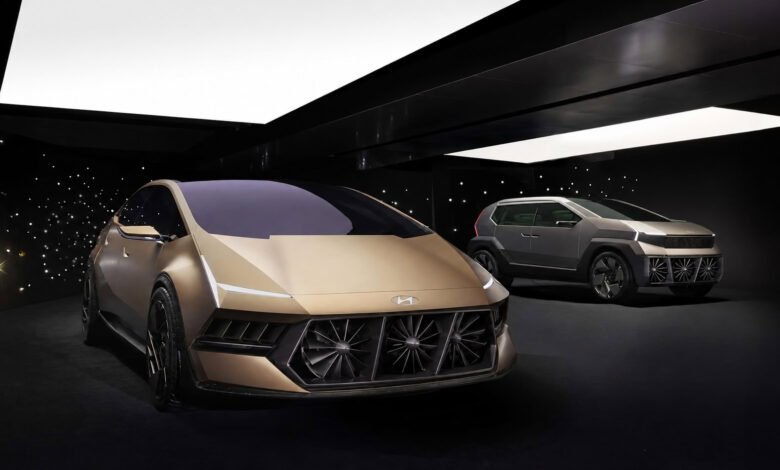
For years, internet forums and social media platforms have been flooded with a seemingly simple, tongue-in-cheek question: Why don’t electric vehicle manufacturers just mount a wind turbine on the roof to charge the battery while driving? To anyone with a basic grasp of physics, the punchline is obvious. Newton’s laws of motion dictate that the aerodynamic drag created by the turbine would require far more energy to overcome than the generator could ever hope to claw back. It is a textbook lesson in thermodynamic futility.
Yet, the engineering minds at Hyundai and Kia are not ready to dismiss the concept entirely. Instead of fighting the laws of physics, they have designed a clever workaround. A newly uncovered patent filing reveals a highly sophisticated, bumper-mounted wind turbine system designed to capture wasted kinetic energy and convert it into usable electricity—without ruining vehicle efficiency.
The Engineering Behind the Bumper-Mounted Turbine
The core innovation of this patent lies in its integration of active aerodynamics. Rather than placing a crude propeller in the airstream, the Korean automotive giants propose hiding a miniature turbine and generator assembly directly behind the front bumper grille.
To prevent the turbine from acting as an aerodynamic anchor at high speeds, the system uses a series of movable flaps. These flaps open and close dynamically based on vehicle speed and driving conditions:
- High-Speed Operation: When cruising on the highway, aerodynamic drag is the primary enemy of efficiency. At these speeds, the movable flaps close completely, sealing off the wind tunnel to optimize the vehicle’s drag coefficient and preserve driving range.
- Low-Speed City Driving: At lower speeds, aerodynamic drag is negligible compared to the energy required to overcome vehicle weight and tire rolling resistance. Here, the system calculates the incoming airflow and opens the flaps, allowing the turbine to harvest energy and charge the onboard electronics without negatively impacting driving dynamics.
Why This Tech Targets Hybrids and Gas Cars, Not EVs
Interestingly, the patent indicates that this technology is not primarily intended for pure battery-electric vehicles. Instead, its most revolutionary applications are found in hybrid and traditional gasoline-powered cars.
In a hybrid vehicle, the system can feed energy directly into the hybrid battery. Internal combustion engines are most efficient under specific loads and speeds. By using the bumper turbine to generate auxiliary power, the vehicle can keep the internal combustion engine operating in its sweet spot, or shut it down entirely to rely on electric-only driving for longer stretches. This optimization could push hybrid fuel economy to unprecedented heights.
For traditional gasoline vehicles, the turbine serves as a highly advanced alternative to the conventional alternator. A standard alternator places a constant parasitic load on the engine to keep the 12-volt battery charged and run the vehicle’s extensive electronics. By harvesting energy from the air during deceleration or when coasting down a hill, the bumper turbine can take over these duties, reducing mechanical drag on the engine and saving fuel.
Harnessing the Wind While Parked
Perhaps the most intriguing aspect of the patent is its capacity for stationary charging. If a driver parks their vehicle in an open area and points the front bumper into the wind, the active flaps can open automatically. The natural breeze then spins the internal turbine, generating a continuous trickle charge to top off the battery while the vehicle is completely stationary.
While the patent does not specify the exact wattage or efficiency figures of these micro-turbines—and small-scale generators are historically prone to efficiency losses—the sheer ingenuity of capturing otherwise wasted energy is a fascinating step forward.
Editorial Perspective: A Lifeline for the Internal Combustion Engine
This patent sends a clear message: Hyundai and Kia are not putting all of their eggs in the pure EV basket. By investing heavily in technologies that maximize the efficiency of hybrid and gasoline powertrains, the Korean automakers are ensuring that internal combustion options remain viable, clean, and highly efficient for years to come. For markets where long distances and charging infrastructure make EVs less practical, this clever wind-harvesting technology could offer a bridge to a more sustainable future—powered, quite literally, by the air around us.