Crypto Markets Enter Q3 in State of Fragile Stability After $8 Billion Deleveraging
Talos data reveals a market cleared of speculative froth but vulnerable to price swings.
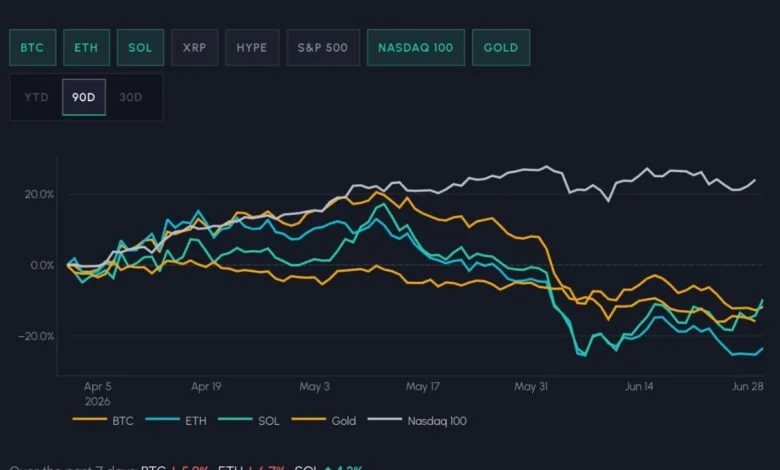
The cryptocurrency market has emerged from a volatile second quarter with a significantly cleaner balance sheet, though the removal of speculative froth has left trading environments notably more fragile. According to a market update from institutional data provider Talos, a massive wave of long liquidations totaling $8.35 billion across Bitcoin and Ether has effectively reset the market’s leverage profile heading into the second half of 2026.
This deleveraging process has created a paradox for institutional participants. While the market is technically more stable because the threat of a cascading margin call has diminished, its structural ability to absorb large trades has withered. Talos reported that Bitcoin’s 2% order-book depth—a critical measure of the capital required to move the price—collapsed from approximately $70 million in early May to between $35 million and $40 million by the end of June.
The decline in liquidity mirrors a broader retreat in trading activity. Spot exchange volume fell 28% quarter-over-quarter to $2.32 trillion. Such environments often lead to increased price slippage, a phenomenon where the lack of immediate buyers or sellers causes large orders to move the market price more aggressively than usual. This structural shift is a primary concern for international financial institutions monitoring the maturation of digital asset market structures.
Data from Talos shows that Bitcoin open interest, which tracks the total value of outstanding derivatives contracts, plummeted 32% from its quarterly peak to $33.5 billion. Ether saw an even steeper deleveraging, with open interest falling 40% to $16.2 billion. This reduction in leveraged money suggests that the recent price action has been driven more by spot selling and a contraction in stablecoin supply than by forced liquidations of derivative positions.
The cooling of institutional appetite was most visible in the U.S. spot Bitcoin exchange-traded fund (ETF) sector. June alone saw approximately $4.5 billion in outflows, contributing to a year-to-date total of $5.5 billion. On a single day, June 25, these funds recorded a net outflow of $696.3 million, signaling a sharp reversal from the aggressive accumulation seen earlier in the year.
Corporate demand also showed signs of exhaustion. The firm Strategy, a major corporate holder of the asset, significantly throttled its acquisition pace. According to company disclosures cited by Talos, Strategy purchased roughly 3,600 BTC in June, a fraction of the 25,000 BTC it bought in May and the 50,000 BTC acquired in April. The company ended the quarter holding 847,363 Bitcoin in its treasury, with an average purchase price of $64,103.
By Wednesday, Bitcoin was trading at $58,656. Earlier in the session, the asset touched $57,742, marking its lowest valuation since September 17, 2024. This price level sits well below the average entry point for major corporate holders like Strategy, placing a spotlight on the market’s diminished capacity to find support as speculative positions and institutional inflows both wane simultaneously.