

Colombia’s New Government Tests Trump’s Hemisphere Security Vision With Promise of Sovereignty Over Drug War Operations
Restrepo's remarks reveal tension between hemispheric security ambition and sovereignty as Colombia deploys thousands to combat drug-trafficking armed groups
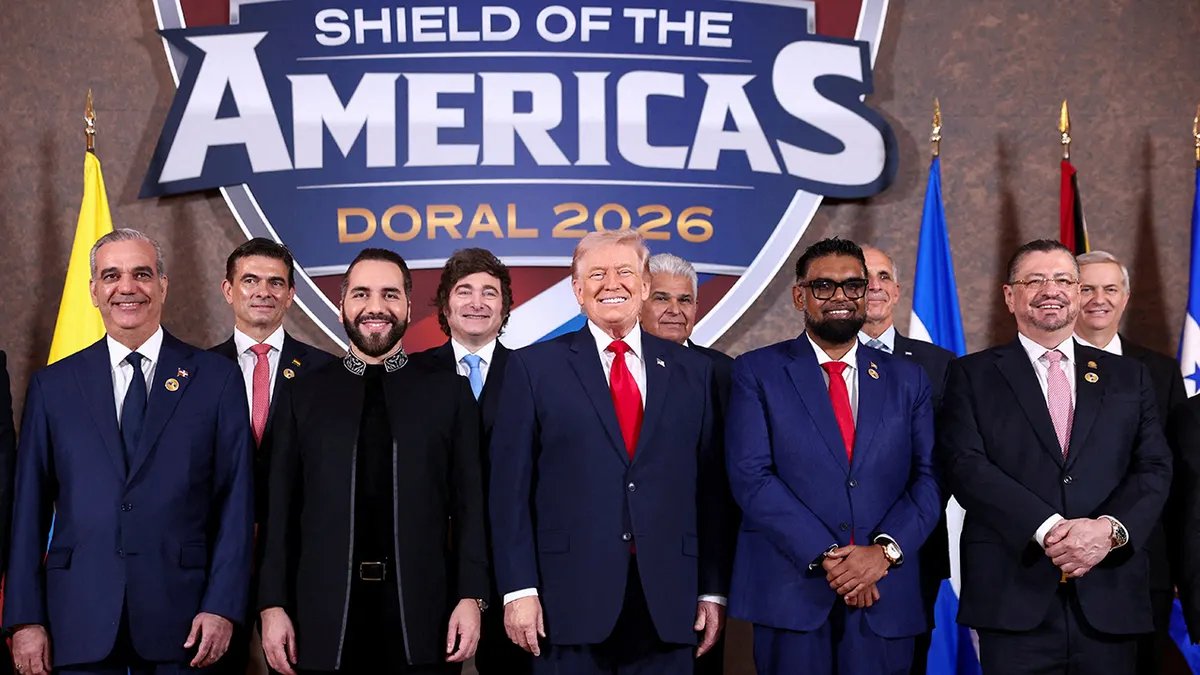
When Colombian Vice President José Manuel Restrepo stood alongside President Donald Trump in New York last week, he endorsed a sweeping security vision for the Western Hemisphere — but quietly drew a boundary that could reshape how Washington’s most ambitious regional initiative actually functions on the ground.
Restrepo’s remarks, made in an on-camera interview with Fox News Digital on the sidelines of the 81st United Nations General Assembly, signal both an alignment and a tension at the heart of the Trump administration’s “Shield of the Americas” framework. Colombia, a country where U.S. counter-narcotics support has flowed for more than two decades, is now signaling it wants the partnership on its own terms.
The Shield of the Americas summit, held in Doral, Florida, on March 7, 2026, brought together leaders from across the hemisphere — including Argentina’s Javier Milei, El Salvador’s Nayib Bukele, Chile’s Jose Antonio Kast, and Bolivia’s Rodrigo Paz — in what Trump described as the most significant security and economic gathering in the region’s modern history. The initiative frames the Western Hemisphere as a shared theater for confronting what the administration calls “narco-terrorism,” a term that has become central to U.S. policy under the Trump national security apparatus.

**A Security Partnership Built on Asymmetric Expectations**
The promise and the complication of the Shield framework became visible within days of the summit, as Colombia confronted a security crisis on its Caribbean coast. In late September 2026, President Abelardo De La Espriella deployed more than 500 soldiers and 600 police officers to the city of Santa Marta after the Autodefensas Conquistadoras de la Sierra Nevada (ACSN), a drug-trafficking armed group, launched an “armed strike” in retaliation for the killing of one of its senior operatives. The group’s response — roadblocks, business closures, and attacks on public infrastructure — exposed the fragility of state authority in parts of Colombia’s Caribbean region.
The deployment came weeks after Defense Secretary Pete Hegseth stated publicly that Colombia had authorized “joint military operations to destroy terrorists and terror networks” and that Washington had discussed possible strikes against the National Liberation Army (ELN) and remnants of the Revolutionary Armed Forces of Colombia (FARC). Hegseth’s remarks suggested a level of operational integration that would mark a significant departure from decades of U.S.-Colombia security cooperation, which historically operated under the model of Plan Colombia: Washington providing funding, intelligence, and equipment while Bogotá retained command authority.
But Restrepo appeared to narrow that interpretation. While acknowledging U.S. contributions in intelligence, technology, and advisory capacity, he emphasized that Colombian forces would conduct operations themselves. “The public forces of Colombia are those who are going to act in those places,” he said. Asked directly about “boots on the ground,” his answer was unmistakable: Colombia’s own forces would be deployed, not American ones.
**The Petro Legacy and the Rightward Pivot**
Colombia’s current security posture represents a sharp reversal from the policies of former President Gustavo Petro, whose “total peace” initiative sought negotiated solutions with armed groups including the ELN, the Segunda Marquetalia, and other factions. De La Espriella, who assumed office after a June electoral victory that mirrored a broader rightward shift across Latin America, moved to dismantle key elements of that approach upon taking office.
His administration reactivated arrest warrants against members of illegal armed groups and publicly accused the Petro government of fostering what Restrepo called “the idea of impunity.” According to Restrepo, approximately 30 percent of Colombia’s territory lacked effective state control when the new government began — a claim Fox News Digital has not independently verified, but one that aligns with assessments from security analysts who have long flagged governance gaps in rural Colombia.
The shift is not occurring in isolation. Since mid-2025, countries including Argentina, Chile, Ecuador, Bolivia, and Panama have elected leaders who have moved their governments rightward, driven by voter dissatisfaction with crime, economic stagnation, and perceived institutional weakness. De La Espriella’s June victory added Colombia to that cohort, creating a bloc of hemisphere-aligned governments that share ideological affinity with Trump’s approach to hemispheric security.
Restrepo framed this convergence as a historic opportunity. “There is a wave of freedom, a wave of democracy, a wave of free market,” he said. “If we want to keep and preserve democracy in the region, the Shield of the Americas is going to be the best opportunity to do it.”
**The Sovereignty Question at the Center of Hemisphere Security**
Restrepo’s insistence on Colombian operational control is not merely diplomatic posturing. It reflects a long-standing sensitivity in Bogotá about the optics of foreign military presence on Colombian soil — a sensitivity rooted in the country’s history, including the U.S. military’s presence during the Colombia-Peru War era and the controversial role of American advisors during decades of internal conflict.
The distinction matters practically as well as symbolically. Joint operations that involve U.S. forces in combat roles raise legal questions under both Colombian and American law. Under U.S. statutes, the president has broad authority to use military force against foreign terrorist organizations, but the deployment of American troops in host-nation combat operations typically requires host-government consent and, in some cases, congressional notification.
By maintaining that Colombian forces will lead operations, the De La Espriella government preserves both its political capital and its legal standing, even as it accepts American intelligence and technology support. The arrangement mirrors patterns seen in other U.S. counter-terrorism partnerships — from Syria to Yemen — where Washington provides the tools but local forces bear the operational risk.
**Diplomatic Maneuvers: Iran, the UN, and Terrorism Definitions**
The security realignment extends beyond the battlefield. Colombia’s Ministry of Foreign Affairs announced this week that the country is severing all diplomatic relations with Iran, citing alleged links between the Iranian government and international terrorist and narcoterrorist groups that threaten Colombian security. The move follows a broader trend of Latin American nations recalibrating their Middle East partnerships.
At the UN General Assembly, De La Espriella’s government used its platform to call for an international definition of terrorism — a goal the United Nations has pursued since adopting its global counterterrorism strategy in 2006, without success. Member states have for two decades failed to agree on a comprehensive convention, largely due to disagreements over what constitutes a “terrorist” act versus a legitimate liberation or resistance movement.
Restrepo argued that the United Nations itself needs reform, calling for greater efficiency and a more consistent application of human rights standards. “Human rights should apply to all, regardless of political considerations,” he said. “Ideology cannot decide to whom we are going to apply or not human rights.”
His comments arrive as UN Secretary-General António Guterres prepares to leave office at the end of 2026, potentially opening the door to institutional changes that Restrepo and other allies hope will produce a more action-oriented body.
**What the Shield Means Beyond Colombia**
The Shield of the Americas initiative has drawn both support and skepticism since its announcement. Supporters view it as a long-overcoming framework for coordinating hemispheric security in an era of rising cartel violence and state fragility. Critics worry it could replicate Cold War-era interventions that destabilized Latin American democracies, or that it could lead to an escalation of militarized responses that disproportionately affect civilian populations.
Colombia’s experience may serve as a test case for the entire initiative. If the country can demonstrate that American intelligence and technology partnerships — without direct U.S. combat deployment — can degrade armed groups and restore territorial control, it could provide a template for other Shield member states. If not, the model’s limitations could become apparent.
For now, the De La Espriella government is betting on the former outcome. With more than 1,100 security personnel deployed to Santa Marta, arrest warrants being reactivated against armed group members, and a diplomatic rift with Tehran deepening, Bogotá is signaling that it intends to back its words with action — on its own terms and on Colombian soil.



One Comment