Can Qantas Project Sunrise Really Shrink Seven Days of Jet Lag?
The flight has a number now. The question is what 22 hours does to the 238 people inside it — and Qantas has been testing the answer since 2019.
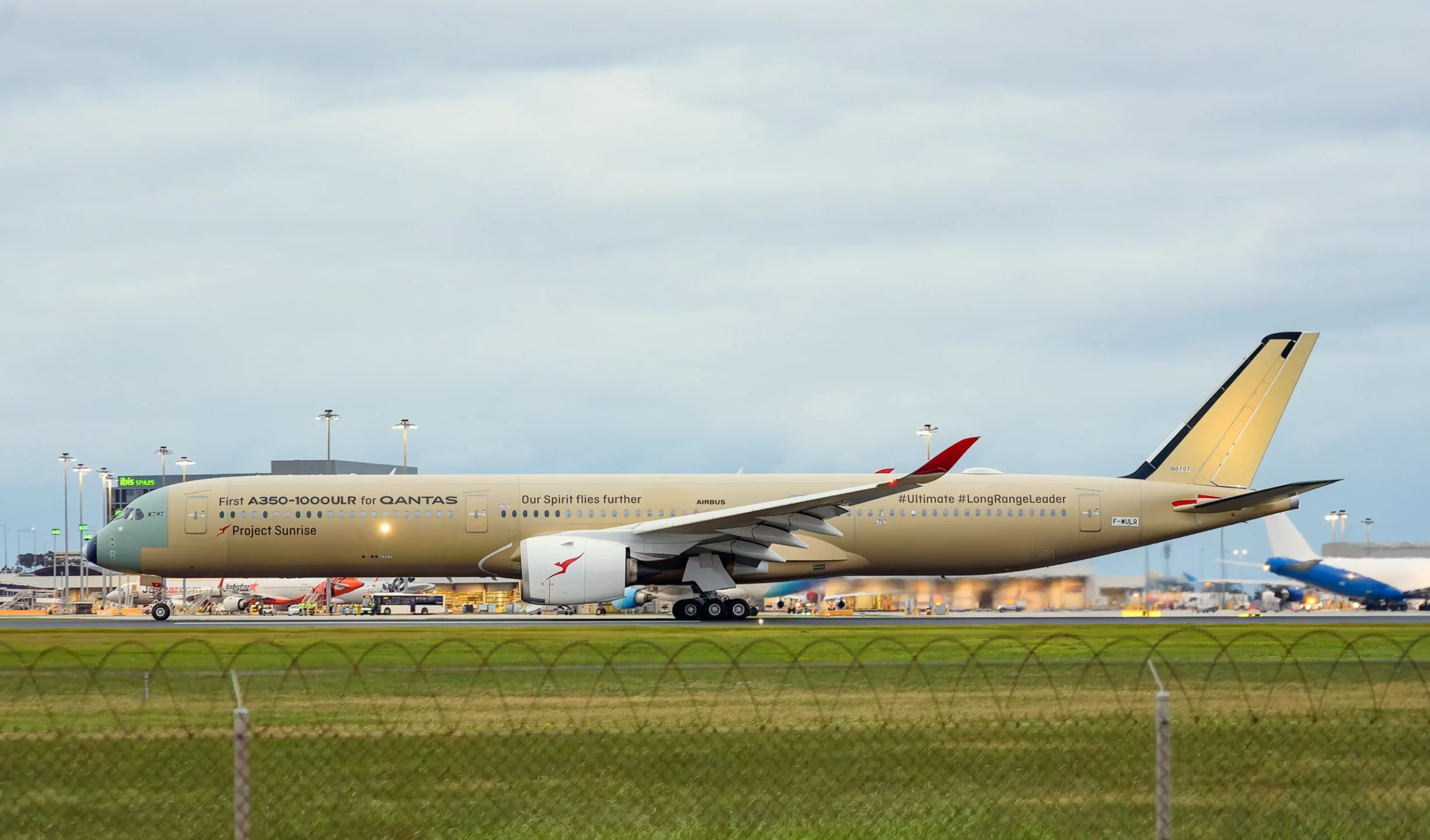
Qantas spent seven years finding out what 22 hours inside an aeroplane does to a human body, and this week it finally gave that flight a number. From October 2027, QF1 and QF2 will fly Sydney to London non-stop for the first time. Qantas Project Sunrise tickets go on sale in February 2027. The first of the twelve Airbus A350-1000ULRs built for it is still in its test program. The first delivery comes in April 2027.
The current Sydney to London service via Singapore, an Airbus A380, becomes QF5 and QF6 from 31 October 2027, and the seasonal Perth to Rome service now holding those numbers becomes QF105 and QF106. QF3 and QF4 are expected to follow for Sydney to New York when that service starts in mid-2028. Tickets go on sale from August 2027. The flights will leave Sydney in the afternoon and reach London early the next morning. The trip takes between 19 hours 25 minutes and 21 hours out, and 18 to 20 hours back, and the one-stop service via Singapore stays for passengers who want to break the journey. At about 17,000 kilometres, it becomes the longest commercial flight in the world, passing Singapore Airlines’ Singapore to New York service. In 1947 the same route took four days and seven stops: Darwin, Singapore, Calcutta, Karachi, Cairo, Castel Benito and Rome.
Peter Cistulli, professor of sleep medicine at the University of Sydney, calls a Sydney to London non-stop “a major life challenge” for the body. The flight crosses nine to eleven time zones, depending on the time of year, and the New York service will cross up to fourteen.


In 2019, Qantas flew the route three times before a single ticket existed, on re-purposed Boeing 787-9 delivery flights carrying only a few dozen people each so the aircraft were light enough to cover the distance. The first, QF7879 from New York to Sydney on 18 October 2019, took 19 hours 16 minutes. No commercial airline had flown non-stop between the two cities before. The second, from London to Sydney on 14 November, took 19 hours 19 minutes over 17,800 kilometres. It landed with fuel for about another hour and 45 minutes in the tanks. Captain Helen Trenerry flew it. The third, from New York in December, took 19 hours 31 minutes. Qantas had flown London to Sydney non-stop once before, in August 1989. A new Boeing 747-400 flew the delivery flight in just over 20 hours with 23 people aboard. The project takes its name from the wartime Double Sunrise flights, when Catalina flying boats stayed airborne between Perth and Ceylon for more than 24 hours. The longest lasted 31 hours 15 minutes. Those aboard saw two sunrises. The first A350 to be delivered is named Vega, after a star, as the Catalinas were.
Researchers from the University of Sydney’s Charles Perkins Centre monitored the passengers. Researchers from Monash University monitored the pilots, with the Cooperative Research Centre for Alertness, Safety and Productivity. The passengers wore devices tracking movement and light exposure, and followed a tailored sequence of meals, lighting, sleep and movement. They kept a daily log for a week before the flight, during it and for two weeks after. They also took a reaction-time test on an iPad modelled on whack-a-mole. The pilots wore electroencephalogram headsets. The headsets tracked brainwave patterns. They gave urine samples before, during and after the flights so researchers could track melatonin levels, and cameras in the cockpit recorded them for the whole flight. The third flight flew a standard service, so the researchers had a control to compare against. Alan Joyce, the Qantas chief executive at the time, said no airline had done this kind of dedicated research before. The results, he said, would shape the cabin design, the inflight service and the crew rosters.
Twenty-three volunteers flew on the optimised schedule. The comparison with the traditional one is the sharpest result Qantas has published. Those on the tailored schedule reported jet lag lasting about two days less. They slept better during the flight, and performed better on cognitive tests in the two days after landing. When their alertness was benchmarked against a standard business-class passenger, the optimised business-class volunteers scored 66 percent better. Passengers in an optimised economy setting did better than those on a traditional business-class schedule, by more than 30 percent. Cistulli’s stated goal is to cut jet lag on these flights “to a couple of days of inconvenience” from the seven days a traditional service pattern takes to adapt to.
Light is the strongest cue for the body clock. The cabin has twelve lighting scenes, including a sunrise that moves gradually from the front of the cabin to the rear over nine minutes. They were developed in more than 150 hours of trials in an A350 cabin mock-up at Airbus’s facility in Hamburg. Meals are timed to the destination, not the departure. The food before bed is bland, low-fat and high in protein. Chilli and chocolate are served where the schedule wants people awake. Movement is built into the flight. Sleep is protected for as long as 12 hours, which only a 22-hour flight allows. On the longest flights flying today, at 12 to 15 hours, a rest period that long would take up the whole journey. The optimal sleep duration is around seven and a half to eight hours. Six hours, even interrupted, helps, Cistulli says.
Across almost 500 passengers on Qantas international flights longer than nine hours, 54 percent used ear plugs or noise-cancelling headsets to sleep, and 38 percent drank alcohol to aid their sleep. Ten percent used sleeping tablets. Sixty percent napped. Only 5 percent got up to exercise. Less than half, 47 percent, made a conscious effort to go out into the sunshine on arrival. The researchers call that one of the most important strategies for syncing the body clock. Dr Yu Sun Bin, a sleep researcher on the Charles Perkins Centre team, said most people actively try to reduce their jet lag and are not doing what is most effective: “Drinking more than a few glasses of alcohol will make jetlag worse. It might make us fall asleep faster but beyond a certain point, it also disrupts the quality of sleep and causes dehydration.”
The A350-1000ULR carries 238 seats, the lowest density of any A350 in the world. Six enclosed first suites come with an 80-inch bed, a separate reclining armchair and lighting that can be programmed to support the passenger’s circadian rhythm. Fifty-two business suites have sliding doors and flexible dining timed to scientifically optimised windows. Forty premium economy seats offer the most generous pitch Qantas sells. And 140 economy seats include 42 sold as Economy Plus at a 34-inch pitch at the front of the cabin. Between premium economy and economy sits the Wellbeing Zone, the first purpose-built inflight wellbeing space on any airline. It has stretch handles, a guided on-screen movement program, a hydration station and premium refreshments. No alcohol is served there. It won the passenger comfort category of the 2024 Crystal Cabin Awards.
radicalposition, commenting on Qantas’s Instagram announcement, has flown the route for forty years: “Many a late night departure from Singapore to London on Qantas going back forty years. Feel very nostalgic right now.” Another, themindfulflyer, has flown it many times: “QF1 and QF2 will always be the A380 from Sing to Lon return to me 🥰 flown it so many times and loved every flight. Will be sad to see the stopover go but I guess non stop is more efficient.” The excitement runs the other way too. “Sydney to London nonstop on QF1 and QF2 from October 2027 is historic Kangaroo Route energy, what a milestone for Qantas and Australia! ❤️🇦🇺” wrote tobiechip, and its_tan_xx put the booking impulse in four words: “get me on that flight 😭”. Nobody in the twelve comments visible without logging in mentions the 22 hours, the jet lag or the price. The airline’s chief executive, Vanessa Hudson, calls the service “a new dawn of travel” and the most significant step in the airline’s 105-year history. The endurance question is the one the airline spent seven years researching, and it is the one nobody on the thread is asking.
Hudson has said fares will run about 20 percent higher than one-stop alternatives. It is the level Qantas already charges on Perth to London, which the airline describes as its best commercially performing route. Qantas expects the twelve aircraft to add about A$400 million a year to its earnings once all of them are in service. Its own research from May 2026 found intent to book non-stop ultra-long-haul flying had risen from 58 to 70 percent since February, reaching 80 percent among premium travellers. Since 2018 more than 1.7 million passengers have flown its non-stop long-haul services from Perth to London, Rome and Paris, Melbourne to Dallas and Auckland to New York. Those routes record the highest customer-satisfaction scores on its international network.
Cistulli is blunt about the gap at the centre of the whole project: “We don’t have any data on a 22-hour flight.” The results have not yet been published in a peer-reviewed journal, and the volunteer group was 23 people. The blood-clot risk on a long flight is small, about half a percent. The modelling suggests it stays under one percent at 22 hours. No one has measured it, because no 22-hour flight has flown with passengers yet. Certification is still ahead of the aircraft. The first A350-1000ULR made its maiden flight on 2 June 2026. A second aircraft is moving through its eight-week testing and certification program, and the first delivery is expected in April 2027 after a delay from late 2026. More than 360 pilots and 1,200 cabin crew still have to be trained. The regulator’s approval for pilot duty periods of up to 23 hours is a separate step from the aircraft’s own certification.
In July 2026 the first aircraft flew non-stop from Toulouse to Melbourne in 19 hours over almost 17,000 kilometres. The return leg, a few days later, flew for 24 hours and 24 minutes over about 23,100 kilometres. Airbus said the distance was reported as a new record for a commercial airliner. 3.6 million people followed the flight on Flightradar24.