

Amazon Workers Turn to SNAP as Corporate Profits Soar
Corporate profits rise while workers turn to federal aid
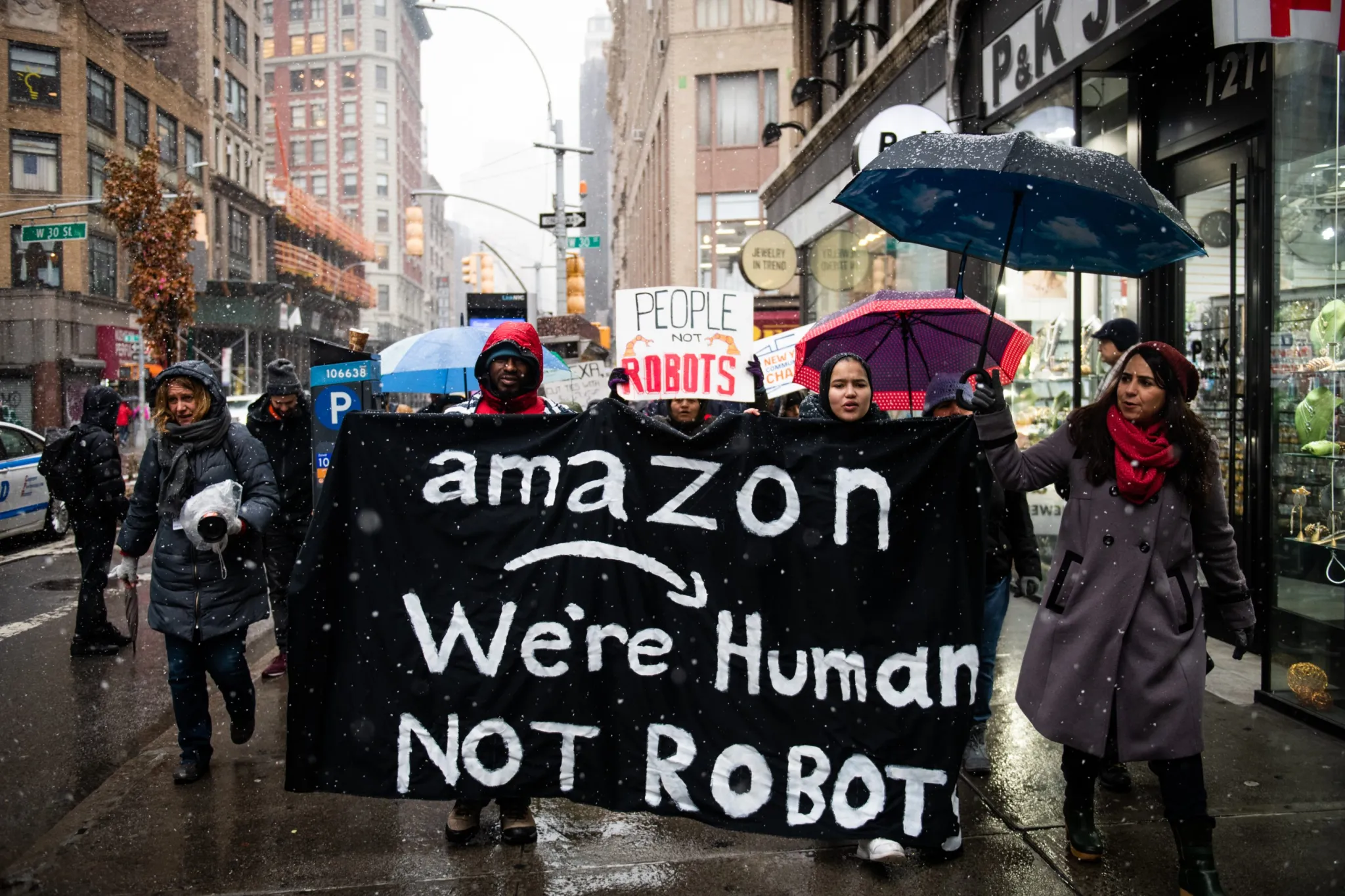
WASHINGTON — Thousands of full-time employees at some of the nation’s largest and most profitable corporations are relying on federal safety-net programs, according to a Government Accountability Office (GAO) report analyzing workforce data across 11 sampled states. Kathryn Larin, the GAO’s director for education, workforce, and income security issues, said the findings challenge traditional assumptions about public assistance recipients: today’s beneficiaries are overwhelmingly active participants in the workforce, with the majority working full-time hours.
The GAO found that Amazon, the country’s largest company by revenue, had 12,346 employees enrolled in the Supplemental Nutrition Assistance Program (SNAP) and 11,338 relying on Medicaid across the sampled states. The number of Amazon workers requiring federal aid was nearly triple the figure recorded in 2020, when the GAO conducted a similar assessment.
Federal SNAP guidelines generally cap gross monthly income at 130% of the Federal Poverty Level. That limit is roughly $1,580 per month for a single individual and about $2,693 for a family of three. Full-time employment at major corporations can therefore still leave workers without enough income to cover basic living expenses.


Amazon’s financial fortunes surged over the same period. Its annual profits rose from $11.6 billion to $77.7 billion, while its 2025 revenue increased 12% year-over-year, climbing from $638 billion to a record $717 billion.
Amazon spokesperson Rachael Lighty disputed the GAO’s framing, saying the report’s conclusions are “wrong” and that focusing on raw numbers rather than percentages presents a misleading picture of the company’s compensation structure. “When you look at the actual facts, you see that Amazon pay is among the best in the industry, regular full-time employees have access to health care from their first day—at only $5 per week with $5 copays for employee-only coverage—and 74% of our regular full-time employees are enrolled in an Amazon health insurance plan, well above the 65% private-sector take-up rate for full-time workers,” Lighty said in a statement. “We challenge other large retailers to provide the same Day 1 comprehensive healthcare benefits that we do.”
Amazon did not respond to subsequent requests for comment regarding the GAO data. The report also identified similar upward trends in safety-net enrollment among employees at Walmart, FedEx, and various rideshare and delivery platforms.
Larin described the workers identified in the report as families that are “really barely able to make ends meet” despite working a lot. “What this analysis really points to is the large number of people who have very low incomes and continue to have very low income,” Larin said. “I mean, these are families that are really barely able to make ends meet, and yet they are working, and they are working a lot.”
The pressure on workers comes as the labor share of income has fallen to its lowest recorded level since the Bureau of Labor Statistics (BLS) began tracking the statistic in 1947. The BLS, the federal agency that has tracked domestic labor market activity since 1884, reports that working Americans now receive 52.8% of the nation’s economic output. The measure covers the portion of national GDP paid in wages, salaries, and benefits.
Diane Swonk, chief economist and managing director at KPMG, said the disparity reflects structural vulnerabilities in the U.S. economy. KPMG’s analysis found that corporate profits as a share of U.S. GDP nearly doubled between 1982 and the present, rising from 8% to 15.85%. During the same period, total employee compensation as a share of GDP fell from 66.6% to 61.9%.
The difference is also visible in financial markets and pay. Since 2000, the S&P 500 index has soared 600%, while inflation-adjusted wages for American workers have risen only 12.5%. Economists refer to the divergence between productivity and compensation as the “Great Decoupling.” For nearly three decades after World War II, productivity and hourly compensation grew together; since the mid-1970s, productivity has grown significantly faster than real wages.
“A friend refers to it as the ‘revolution chart,’ which [is] disturbing but telling,” Swonk wrote in a social media post, referring to the visual representation of the diverging lines. “Inequality fuels social and economic instability.”
Anna Stansbury, an assistant professor of work and organization studies at the MIT Sloan School of Management, points to declining organized labor as one factor behind the erosion of the labor share. Union membership accounted for 20.1% of U.S. workers in 1983 but had fallen to 10.0% by 2025. American union density reached roughly 35% of the private-sector workforce in the mid-1950s, giving workers significant leverage to negotiate for higher wages and benefits.
Stansbury also identifies the widespread “fissuring” of the workplace, a term for the systematic dismantling of the traditional employer-employee relationship. Large employers increasingly contract out non-core operations to third-party subcontractors, staffing agencies, or independent gig workers. Bank of America, for example, historically would have directly employed custodial staff and provided the same company benefits and wage structures available to other employees. Corporations today typically outsource those roles to specialized maintenance firms.
By shifting work to subcontractors and gig workers, primary employers eliminate obligations to provide healthcare, retirement benefits, or equity while shielding themselves from direct liability for labor law violations. The strategy allows companies to claim increased operational efficiency while depressing overall labor costs.
The federal minimum wage has also remained unchanged at $7.25 per hour since July 24, 2009. That is the longest period without an adjustment since the minimum wage was established in 1938.
Technological advances have added another pressure on labor’s share of income. Brent Neiman, an economics professor at the University of Chicago, argues that artificial intelligence is poised to accelerate wage stagnation by automating tasks previously performed by salaried staff. “Anyone who has used ChatGPT can see how much work now done by people could soon be done by technology,” Neiman wrote in a recent op-ed.
A July white paper by Apollo Chief Economist Torsten Slok and economist Sania Edlich examined 321 occupations between 2015 and 2025. The researchers found that roles with high exposure to AI integration experienced a 6.7% decline in real wage growth after 2023, the year following the public release of generative AI tools like ChatGPT. The wage compression occurred without a corresponding drop in overall employment levels, with employers capturing the financial benefits of AI-driven productivity gains rather than sharing them with workers.
Economists have not settled whether the current low in the labor share represents a permanent structural shift or a temporary phase of the economic cycle. Stansbury notes that sharp spikes in inflation typically depress real wages in the short term. If inflation stabilizes and wage growth recovers in a tight labor market, the labor share of income could rebound, making the current downturn cyclical.
If wage growth remains flat despite cooling inflation and low unemployment, however, it will signal a fundamental, long-term reorganization of the American economy. “If those two things happen and the labor share continues to fall,” Stansbury said, “then it would suggest that there’s actually been a secular shift, a secular acceleration in the downward trend.”









