Amazon Data Center Fight in Pennsylvania Halts Eminent Domain
Regulators halted eminent domain seizures for a 1,300-acre campus after residents exposed Amazon's hidden role and challenged zoning approvals.
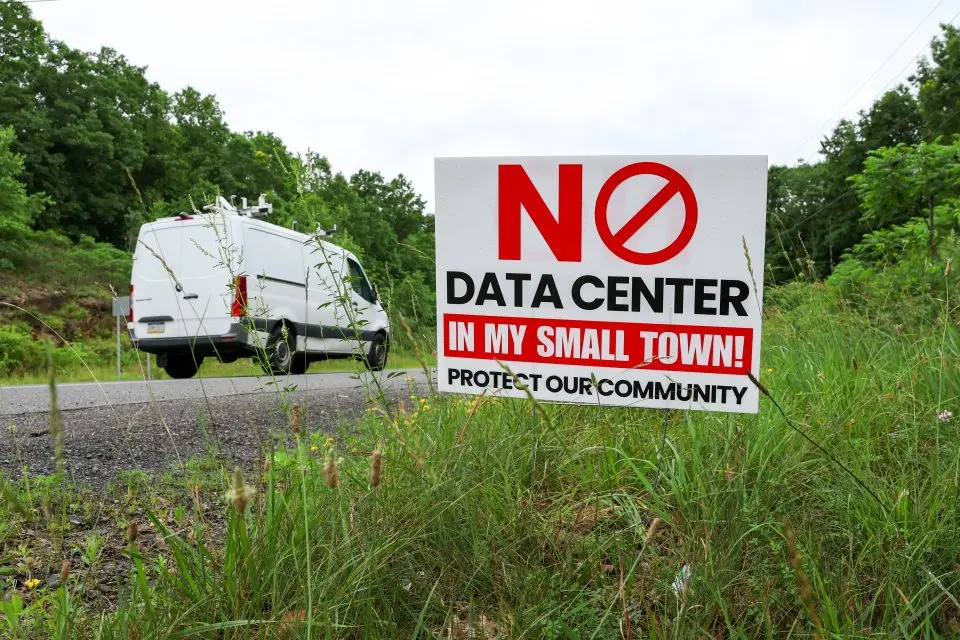
A Pennsylvania judge has blocked a utility company from seizing private land to power a proposed 1,300-acre data center campus, delivering a major legal victory to residents fighting one of the most aggressive artificial intelligence infrastructure projects in the Northeast.
Luzerne County administrative law judges halted proceedings last month for an 11.2-mile high-voltage transmission line planned by PPL Electric Utilities. The regulators determined it was premature to authorize utility extensions for Project Hazelnut while the underlying development remains unapproved and mired in litigation. The ruling protects 28 properties in Sugarloaf Township that faced eminent domain seizure to accommodate the power corridor.
The judicial intervention arrives as the broader U.S. data center boom encounters unprecedented friction. During the first quarter of 2026, at least 75 data center projects representing more than $130 billion in combined investment were delayed or canceled nationwide. Active opposition groups across 49 states surged from 396 at the end of 2025 to 833 by March, according to a June report by Data Center Watch. Gallup polling consistently shows roughly 70% of Americans oppose data center construction in their communities.


Project Hazelnut, pitched by developer NorthPoint Development as a $165 million investment encompassing 15 buildings at the foot of the Pocono Mountains, attempted to bypass local resistance through direct financial incentives. In June, eligible households in the 4,500-property Hazle Township received letters offering $10,000 payouts contingent on community acceptance of the campus. Residents largely rejected the offer, viewing it as an attempt to purchase consent for a project whose ultimate tenant remained hidden.
The secrecy surrounding the facility’s end-user unraveled after residents filed right-to-know requests. Records released in January revealed correspondence between Amazon and the Pennsylvania Department of Community and Economic Development showing state officials attempting to disclose Amazon’s involvement while the tech giant demanded covert treatment, citing broad contractual issues. Amazon subsequently acknowledged evaluating multiple sites across the commonwealth and holding discussions with NorthPoint, but stated no definitive agreement exists.
Amazon Web Services CEO Matt Garman addressed the transparency deficit directly on Friday, announcing the company will no longer enter into nondisclosure agreements with government agencies regarding data center projects. The policy shift responds to a growing national backlash against hyperscalers using shell developers and municipal NDAs to acquire land and secure permits without public scrutiny.
Pennsylvania’s political leadership initially accelerated these developments before reversing course. Gov. Josh Shapiro announced Project Hazelnut in November 2024 as the inaugural test of an executive order fast-tracking AI infrastructure permitting. By July 2025, he promoted a separate $20 billion Amazon AI buildout in the state, the largest capital investment in Pennsylvania history. However, Shapiro signed a new executive order in August eliminating the fast-track process and shifting environmental review authority back to local Department of Environmental Protection offices.
Shapiro recently told CBS News Philadelphia that developers were “wreaking havoc on the communities” despite lacking secured power access or committed technology tenants, characterizing much of the activity as speculative land grabs rather than viable construction plans.
Local courts have reinforced this skepticism. In May, a Luzerne County judge denied an appeal for Project Hazelnut, ruling the project lacked required zoning approval because data centers were not defined in the local ordinance and the initial process failed to provide adequate public input. Hundreds of acres had already been cleared prior to the ruling, prompting neighbors to report significant wildlife displacement and raising alarms about construction near existing Superfund sites where earthmoving could breach hazardous waste containment barriers.
The grassroots resistance is organized under the Alliance to Stop the Line, which has filed approximately 20 formal protests with the Public Utilities Commission challenging PPL’s transmission plans over property value destruction, noise pollution, and electromagnetic field exposure. Resident Erika Cook, an insurance agent facing eminent domain for her own property, described the movement as a network of pro se litigants securing incremental victories against well-funded developers.
Despite the recent legal wins, the threat of geographic displacement remains acute. While Hazle Township successfully challenged the zoning and transmission components, NorthPoint is actively exploring a 1,400-acre data center development in neighboring Banks Township, signaling that defeated projects frequently migrate to adjacent municipalities with less organized opposition.