JMU’s Coaching Factory Fuels Rise From FCS Power to American Conference Contender
Three consecutive head coaches now leading Power 4 programs as Dukes join American Athletic Conference
HARRISONBURG, Va. — James Madison University accepted an invitation to join the American Athletic Conference on Monday, completing a four-year climb from the FCS ranks that has been propelled by an unprecedented coaching pipeline and a player-driven culture that has survived six head coaching changes without a losing season since 2002.
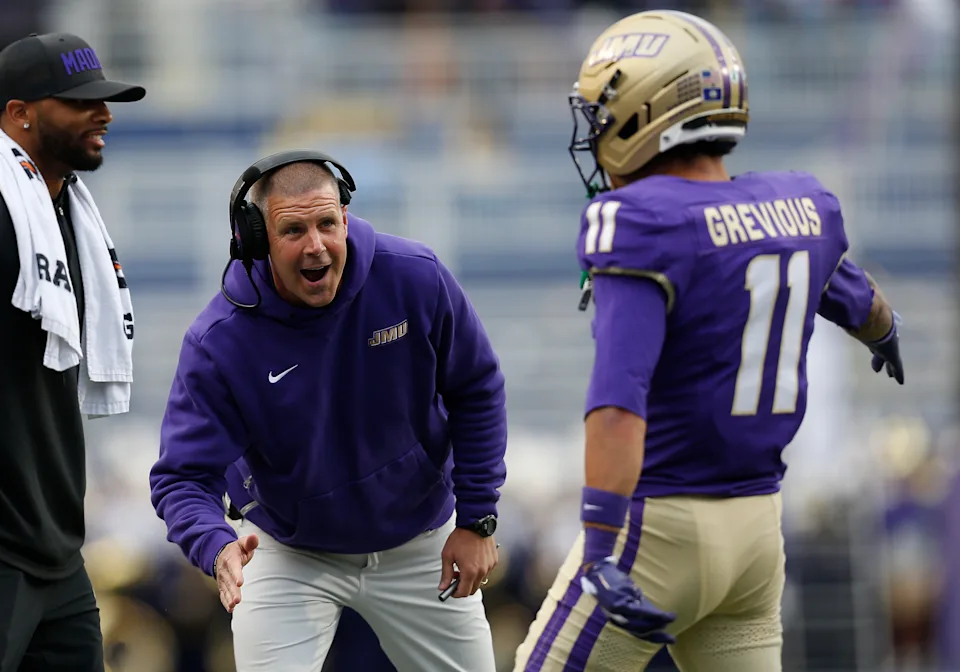
The Dukes (6-0) enter Saturday’s game against Georgia State receiving votes in the AP Top 25 that would place them No. 31 nationally — eight spots behind Group of 5 playoff leader Boise State — while their last two head coaches, Curt Cignetti at Indiana and Bob Chesney at UCLA, are guiding undefeated Big Ten programs. Current coach Billy Napier, hired after a 22-23 record in three-plus seasons at Florida, has won his first six games and surrendered offensive play-calling to coordinator Cam Aiken, a former Clemson and Ole Miss assistant.
“I have a lot to prove,” Napier said. “I’m highly motivated as a result of the things that have happened in the past.”

The American move carries a $28 million price tag — $5 million for the Sun Belt exit fee and $23 million for the American entrance fee — funded entirely by donors and school-affiliated corporate sponsors. The shift positions JMU for the new 12-team College Football Playoff structure that guarantees one Group of 5 berth, but also places the program in a conference where schools like Memphis and South Florida are preparing to approach the $21 million athlete revenue-sharing cap expected under the NCAA’s proposed settlement.
JMU currently spends an estimated $5-7 million combined on football and men’s basketball through name, image and likeness collectives. Athletic director Matt Roan acknowledged the program “may no longer be the best resourced in its new conference” and will need to reach $10 million or more annually to remain competitive.
“We’re going to need money to maintain,” said Cliff Wood, a longtime donor and former CarMax executive who operates the school’s collective. “Same as moving from FCS to FBS. In order for us to be successful, people have to put their money where their mouth is.”
The university subsidizes approximately 75% of its $78 million athletic budget, with $55 million coming from mandatory student fees — a model that has drawn scrutiny nationally but sustained JMU’s growth. A planned multi-billion dollar campus redevelopment includes a rebuilt east side of Bridgeforth Stadium with a new football operations center.
The program’s foundation traces to a 2006 Title IX compliance decision that eliminated 10 sports, concentrating resources on the remaining 18 programs. Scholarships increased to NCAA maximums, recruiting restrictions were lifted, and staff salaries rose. Former athletic director Jeff Bourne grew annual fundraising from $110,000 to over $3 million during his tenure.
“We had so many sports that we weren’t funding any of them the right way,” said Charlie King, the retired vice president who oversaw athletics. “It turned the whole athletic program.”
The football program’s modern identity crystallized under Mickey Matthews, who survived a 2003 student-led “Fire Mickey” campaign to win the 2004 FCS national championship. The 2010 upset of Virginia Tech — only the second FCS victory over a ranked FBS opponent, following Appalachian State’s 2007 win at Michigan — announced JMU nationally. Mike Houston added a second FCS title in 2016, and each subsequent coach built on the infrastructure: Everett Withers established the Alpha Dogs donor group, Houston created a recruiting machine, Cignetti won 52 games in five seasons, and Chesney guided the program’s first FBS playoff appearance.
Yet players describe a culture that transcends coaching changes. Fifth-year senior Jayden Mines, part of a core group that passes down the “JMU Way,” described a summer team-building exercise where groups of 10 players hiked into the mountains sharing a single gallon of water while holding a rope.
“That was pain,” Mines said. “As soon as players get here, you flush where you came from or what you’re used to. We’ve had a whole lot of transfers the last few years. You’ve got to take guys under your wing and teach them the JMU Way.”
Transfer Amar Thomas confirmed the culture shock: “They’ve never played this hard for the man next to them.”
Napier sensed it immediately. During an early interaction with a fifth-year senior, the player delivered a blunt message: “No matter who’s in the head coach’s office up there, we win.”
“There is a player-led culture and a drive and standard that will not be compromised,” Napier said. “They teach that to the new players who come in. I feel the same sense of urgency as these players have taught me.”
The Dukes rank 10th nationally in scoring offense (41.8 points per game), feature the 10th-most productive running back in former North Carolina transfer George Pettaway, and possess the nation’s leading return specialist in Michael Scott (565 yards, two punt return touchdowns). Napier’s January recruiting blitz — 64 official visits in 19 days yielding 63 new players — overhauled a roster that had lost significant talent to the transfer portal.
JMU’s athletic ascent began in 1972 when Challace McMillin recruited 60 men to form the first football team at Madison College, which had been an all-women’s institution until 1966. Half quit before the first practice. Three years later, the team finished undefeated. The school became James Madison University in 1977.
Now, as Cignetti’s No. 5 Indiana hosts No. 4 Ohio State and Chesney’s No. 12 UCLA hosts Wisconsin on Saturday, the program that didn’t exist 52 years ago has produced three consecutive Power 4 head coaches — a pipeline unprecedented for a school that completed its FBS transition only in 2022.