AI Inference Costs Are Collapsing Faster Than Battery or DNA Sequencing Prices, Epoch AI Data Shows
The 50% quarterly drop in reasoning expenses outpaces historical tech deflation curves, forcing enterprise buyers to rethink premium API strategies.
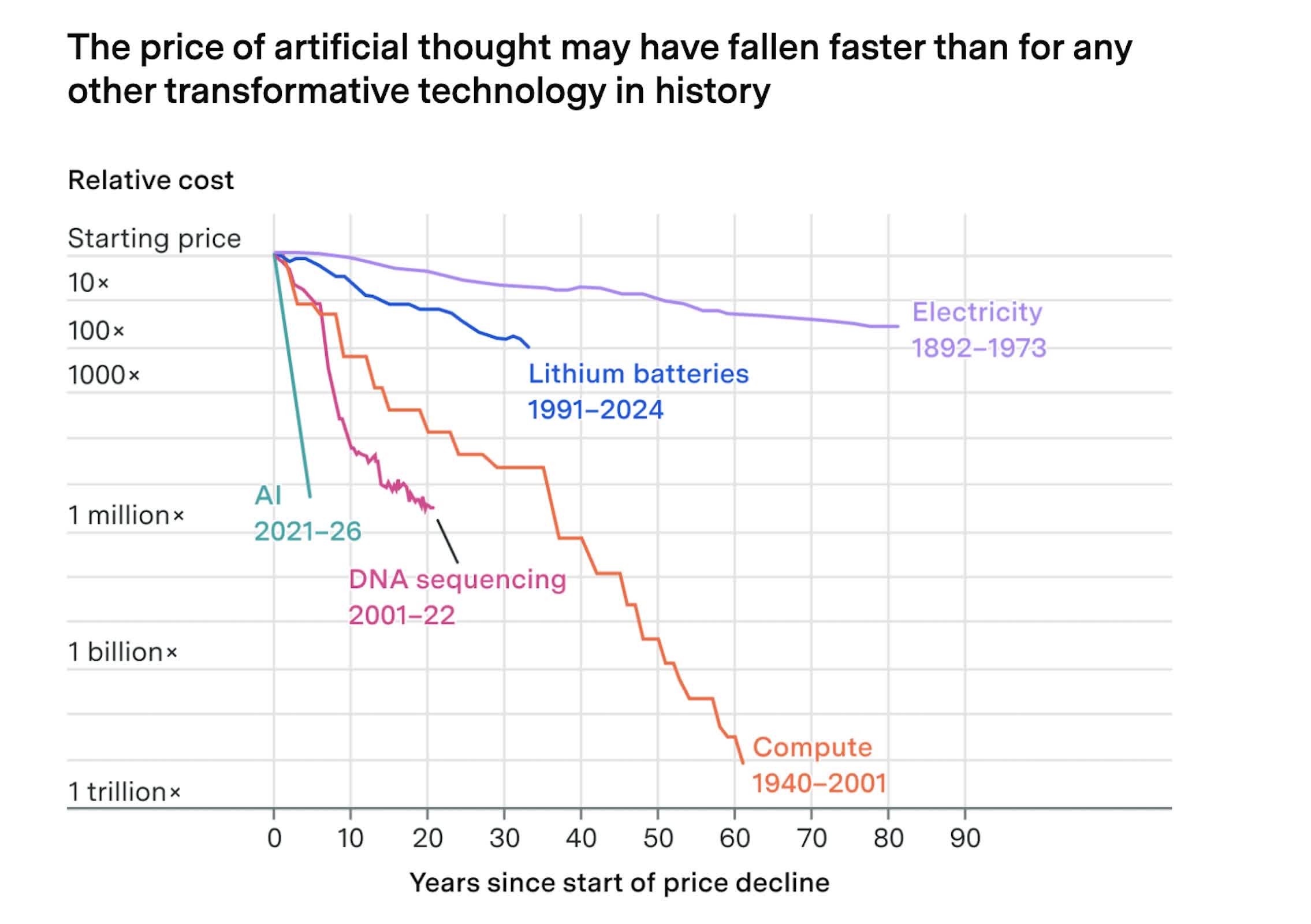
The cost of achieving graduate-level artificial intelligence performance is now halving roughly every three months, a pace of deflation that outstrips the historical price collapses in lithium-ion batteries, DNA sequencing and traditional computing hardware. For enterprise buyers and software developers, the rapid erosion of inference pricing threatens to upend current business models built around expensive frontier models.
Research firm Epoch AI tracked the expense required to run AI systems capable of scoring at least 81.25% on GPQA Diamond, a multiple-choice benchmark testing scientific reasoning at the postgraduate level. The analysis isolates the economics of capability rather than tracking average API prices across all tasks. Under this metric, costs have declined by nearly 50% per quarter, compounding to an approximate thirteenfold reduction annually.
The speed of this decline has no modern parallel in foundational technologies. Between 1991 and 2024, lithium-ion battery prices fell by a factor of 100. DNA sequencing costs underwent a similar multi-decade compression following the completion of the Human Genome Project in 2003. General computing costs dropped by hundreds of billions of times over six decades starting in 1940. By Epoch AI’s measurements, the current AI cost curve is moving four times faster than the historical trajectory of genomic sequencing and eighteen times faster than battery chemistry improvements.


OpenAI’s own model releases illustrate the magnitude of the shift. GPT o3, launched in January 2025, answered GPQA Diamond questions correctly 75% of the time at a compute cost of $0.30 per query. Approximately eighteen months later, GPT-5.6 Luna reportedly delivered identical accuracy for $0.0004 per question. That represents a 750-fold reduction in the unit economics of high-level scientific reasoning.
Such drastic drops stem from more than just algorithmic breakthroughs. The broader AI industry has aggressively pursued architectural efficiencies, most notably through Mixture of Experts (MoE) designs and speculative decoding, which allow models to activate only a fraction of their total parameters during any given inference step. Combined with custom silicon like tensor processing units and aggressive quantization techniques that reduce the precision required for calculations, providers have fundamentally altered the energy and compute required per token.
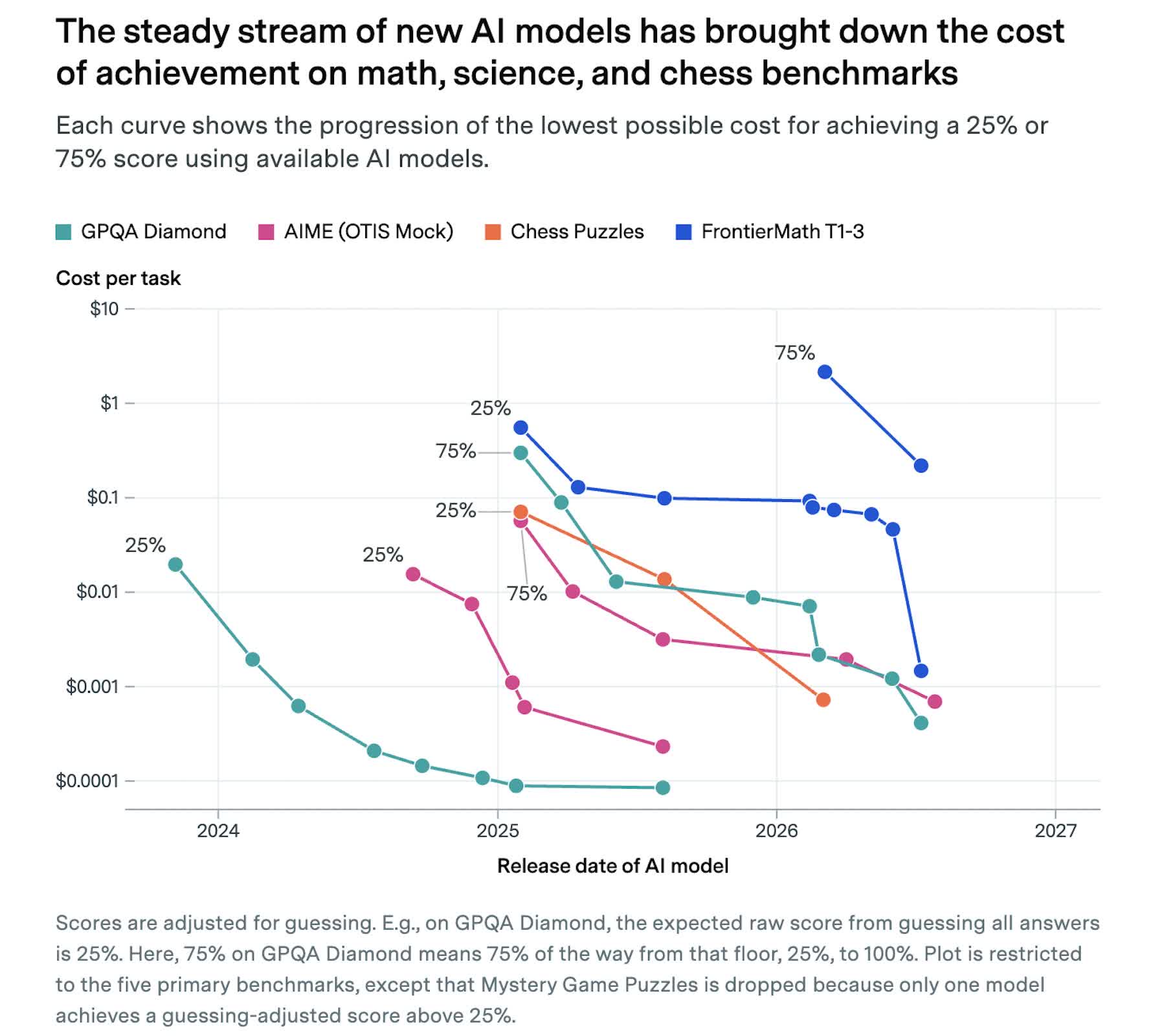
The deflationary trend, however, is neither uniform nor guaranteed to continue at its current velocity. Epoch AI’s data reveals significant variance depending on the cognitive task being measured. While scientific reasoning costs have plummeted steadily, other domains show erratic trajectories. Performance economics on Frontier Math benchmarks remained largely stagnant between 2025 and mid-2026 before experiencing a sudden, sharp decline. Chess puzzle evaluations followed yet another distinct pattern, indicating that no single universal cost curve governs all forms of machine reasoning.
There are also signs that the steepest phase of the drop may be passing. Across the five benchmarks analyzed, quarterly cost reductions initially averaged 66%. Two years into the measurement period, that rate decelerated to 32% per quarter. Physical constraints are likely contributing to the slowdown. Running frontier models still demands massive data-center footprints, specialized cooling infrastructure and substantial electricity. As global demand for power and advanced semiconductors intensifies, providers face hard floors on how cheaply they can operate physical hardware.
Methodological risks further complicate the picture. Epoch AI flagged the persistent danger of “benchmaxxing,” where developers optimize architectures specifically to score well on public leaderboards without delivering proportional gains in unstructured, real-world enterprise workflows. When the researchers introduced randomized elements to prevent this type of optimization, cost reductions appeared less dramatic than on unprotected benchmarks, suggesting that targeted gaming inflates some of the headline efficiency numbers.
Historical comparisons also carry caveats. The AI dataset begins in 2023, with earlier figures extrapolated from research trends. By contrast, the comparative computing data ends in 2001 and electricity metrics stop in 1973, meaning the historical baselines do not account for recent developments in cloud computing or renewable energy scaling.
For corporate procurement teams, the economic reality of these curves forces immediate strategic shifts. Companies routing high-volume workloads through premium APIs face mounting pressure to migrate to cheaper, highly capable alternatives or deploy open-weight models on internal infrastructure. The shrinking gap between flagship and budget tiers means paying top dollar for marginal accuracy gains is becoming increasingly difficult to justify to chief financial officers.
Yet pure unit economics rarely dictate enterprise vendor selection in isolation. Switching foundational models requires rigorous regression testing, updates to retrieval-augmented generation pipelines, new security audits and compliance reviews under frameworks like SOC 2 or HIPAA. Deep integrations into existing software stacks create friction that insulates incumbent providers from immediate displacement solely based on price.
As of late 2026, major hyperscalers including Microsoft Azure, Amazon Web Services and Google Cloud continue to expand dedicated AI inference capacity, betting that surging volume will offset shrinking per-token margins even as the underlying cost of machine reasoning approaches fractions of a cent.