Rapid Shutdown Tops BIPV Fire Safety as DC Voltage Risk Peaks
Experts from Asia and Europe prioritized rapid shutdown at 19.62% after statistical models confirmed DC current as the leading ignition source.
Building owners and solar installers integrating photovoltaic panels directly into exterior walls face a compounding electrical hazard that standard construction fire codes have not yet fully addressed. A new risk assessment framework identifies direct current voltage magnitude as the primary ignition trigger for building-integrated photovoltaic (BIPV) façades, pushing rapid shutdown systems to the top of the mitigation priority list.
Unlike rooftop arrays, BIPV modules replace conventional cladding materials. They sit flush against insulation and structural framing, leaving almost no ventilation gap to dissipate heat or contain an electrical arc. When a fault occurs in these high-voltage DC circuits, the resulting fire spreads through the building envelope far faster than traditional structural blazes, complicating suppression efforts for first responders who must navigate live electrical currents on vertical surfaces.
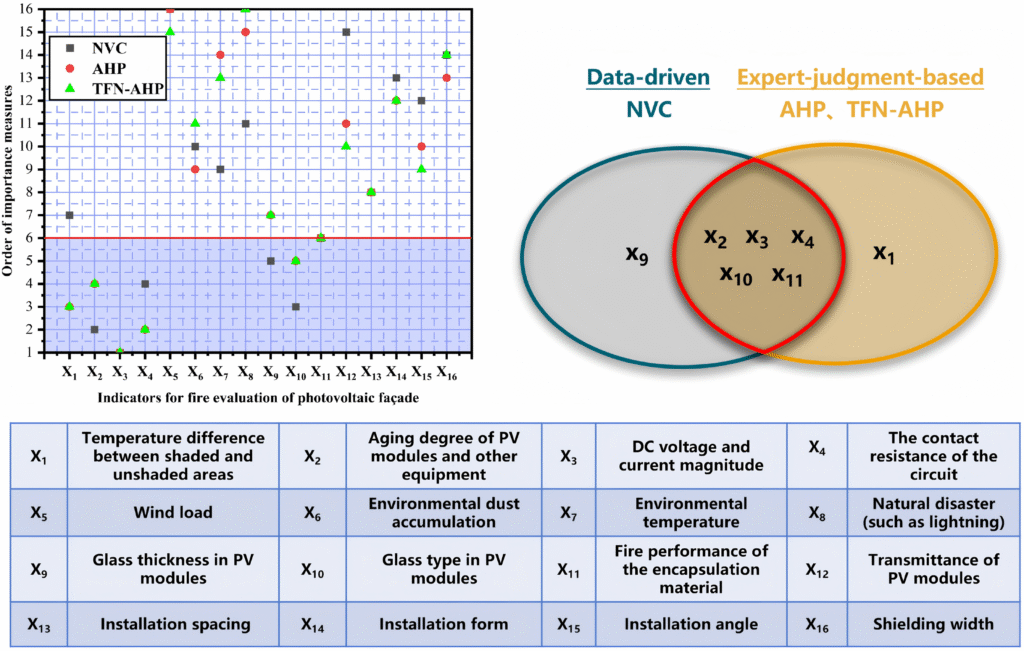
Researchers led by the University of Science and Technology of China quantified this vulnerability by testing 16 distinct risk indicators against both statistical models and expert evaluations. Corresponding author Yu Wang told pv magazine that while previous studies investigated the fire behavior of PV materials and modules, systematic fire risk assessment and resilience optimization for BIPV façades remain limited. The team used normalized variance contribution (NVC) analysis alongside the analytic hierarchy process (AHP), drawing on input from nine specialists across Asia and Europe, including fire service leaders and senior engineers.

DC voltage and current levels consistently ranked as the number one ignition driver across every valid scenario tested, with rank correlations exceeding 0.99 during data perturbation tests. Equipment aging, circuit contact resistance, module glass type, and encapsulation fire performance followed immediately behind. Wang noted that the most surprising finding was that the data-driven NVC analysis and expert-based AHP and triangular fuzzy number (TFN)-AHP assessments consistently identified five dominant risk factors despite differences in their overall rankings.

Translating those six dominant hazards into engineering requirements, the panel evaluated 15 safety measures. Rapid shutdown capability captured 19.62% of the total priority weight among individual interventions. Broader ignition prevention and fire-spread suppression strategies accounted for a combined 60.83% of the experts’ weighted priorities, according to the researchers.
The findings arrive as architects increasingly specify BIPV systems to meet stringent net-zero energy mandates for commercial real estate. Municipal fire departments in major U.S. cities have reported growing challenges with solar-equipped structures, particularly regarding safe firefighting distances and electric shock prevention when water contacts energized DC lines embedded in walls.
Other high-priority countermeasures identified in the study include electroluminescence inspection, drone-based infrared scanning, machine learning-based detection, and strict adherence to encapsulant flammability ratings. The framework also emphasized optimizing module layout and spacing to limit surrounding fire loads.
The research, which included scientists from Italy’s University of Trieste, was published in Applied Thermal Engineering under the title “Framework for fire risk assessment and resilience optimization of building-integrated photovoltaic façades.”