Why a Chinese AI Startup Replaced SAP Salespeople With Food Delivery Riders to Digitize Factories
After a failed analytics startup, founder Zhou Yuxiang built a profitable cloud platform by recruiting gig workers who knew how to navigate China's unmapped industrial parks.
Black Lake Technologies has deployed former Meituan and Ele.me food delivery couriers to sell artificial intelligence software to China’s estimated 4 million small-scale manufacturers, abandoning the traditional enterprise sales playbook that dominates Western technology markets. The Shanghai-based startup determined that couriers accustomed to navigating unmarked industrial parks, bypassing guard dogs, and locating workshop bosses through back entrances possessed street-level access that veteran salespeople from SAP and Siemens lacked.
The pivot reflects a broader structural reality in global manufacturing technology: the systems designed for Fortune 500 supply chains are fundamentally incompatible with the fragmented, family-run workshops that produce a significant share of the world’s physical goods. While multinational corporations spent decades integrating enterprise resource planning software into their operations, millions of smaller factories operated entirely on paper ledgers, whiteboards, and verbal instructions. Black Lake founder Zhou Yuxiang discovered this gap firsthand during a failed 2015 attempt to build an analytics platform modeled after Palantir. The venture, MadaData, collapsed because the target factories simply generated no usable digital data to analyze.



To solve the technical deficit among his new courier-recruited sales force, Zhou instituted a five-day training program requiring 14-hour daily shifts, mandatory exams, and the closure of at least one contract via telephone before graduation. Roughly half of the participants survive the process. The resulting team sells a cloud-based factory management system capable of tracking orders, scheduling materials, and measuring output. More recently, the software incorporates AI agents designed to autonomously read incoming purchase orders, generate pricing quotes, and schedule production runs without human intervention. The company reports it has been profitable since 2025, with annual revenue growth exceeding 60%.
Zhou, a Dartmouth College graduate and former investment banker, restarted the company after spending time working directly on a plastic-injection molding line producing cosmetics packaging for a European brand. Timing the intervals between production batches revealed that only one hour of a typical six-hour changeover involved actual productive work. The remaining five hours were consumed by information silos and subjective decision-making by floor supervisors—inefficiencies invisible to executives relying on aggregated spreadsheets but obvious to anyone standing next to the machinery.
This granular operational reality separates China’s current industrial AI push from the software-driven automation waves that transformed Western manufacturing over the past four decades. The International Federation of Robotics recorded 354,000 industrial robot installations in China in 2025, accounting for 59% of the global total. Open-weight models developed by Alibaba, DeepSeek, Z.ai, and Moonshot AI now deliver near-frontier performance at significantly lower costs than closed Western alternatives, accelerating adoption among mid-tier manufacturers.
Yet capital constraints remain severe. U.S. export controls continue to restrict access to advanced AI processors, forcing Chinese developers to optimize around less powerful hardware. The funding disparity is equally stark: OpenAI secured $122 billion in a single round this year, and Anthropic raised $65 billion, figures that dwarf the entire venture capital pool available to Chinese industrial startups. Zhou views time, rather than capital or compute, as the primary bottleneck, noting that his engineering teams operate under extreme schedules to maintain pace with competitors.
The most persistent obstacle is foundational digitization. Zhou explicitly rejects the narrative that China can leapfrog traditional software infrastructure directly into AI-driven operations, drawing a sharp distinction between the country’s successful jump from cash to mobile payments and the requirements of industrial production. Financial transactions rely on standardized protocols; manufacturing requires capturing highly specific, variable physical processes unique to each facility. Without baseline digitization, AI models lack the proprietary training data necessary to function reliably on a shop floor.
Black Lake’s latest initiative attempts to bridge this data desert while testing whether AI can alter business models rather than merely accelerate existing ones. The company spent two years incubating PopZao, a platform accessible via web browser and WeChat mini program, designed to connect independent creators directly with manufacturing capacity. AI agents translate conceptual designs into 3D simulations and convert those simulations into machine-readable industrial data routed to partner factories.
The model targets the creator economy dynamics exemplified by the 2025 viral surge of Labubu, the Pop Mart toy character that drove a 185% revenue increase for the retailer. PopZao allows entities outside the traditional intellectual property hierarchy to commission physical merchandise. In one early deployment, a Buddhist temple submitted photographs of its stone lions through the platform. Black Lake’s system generated designs and manufactured a batch of 500 units within 30 days. The inventory sold out in a week, prompting the temple to begin submitting images of local trees and animals for subsequent production runs.
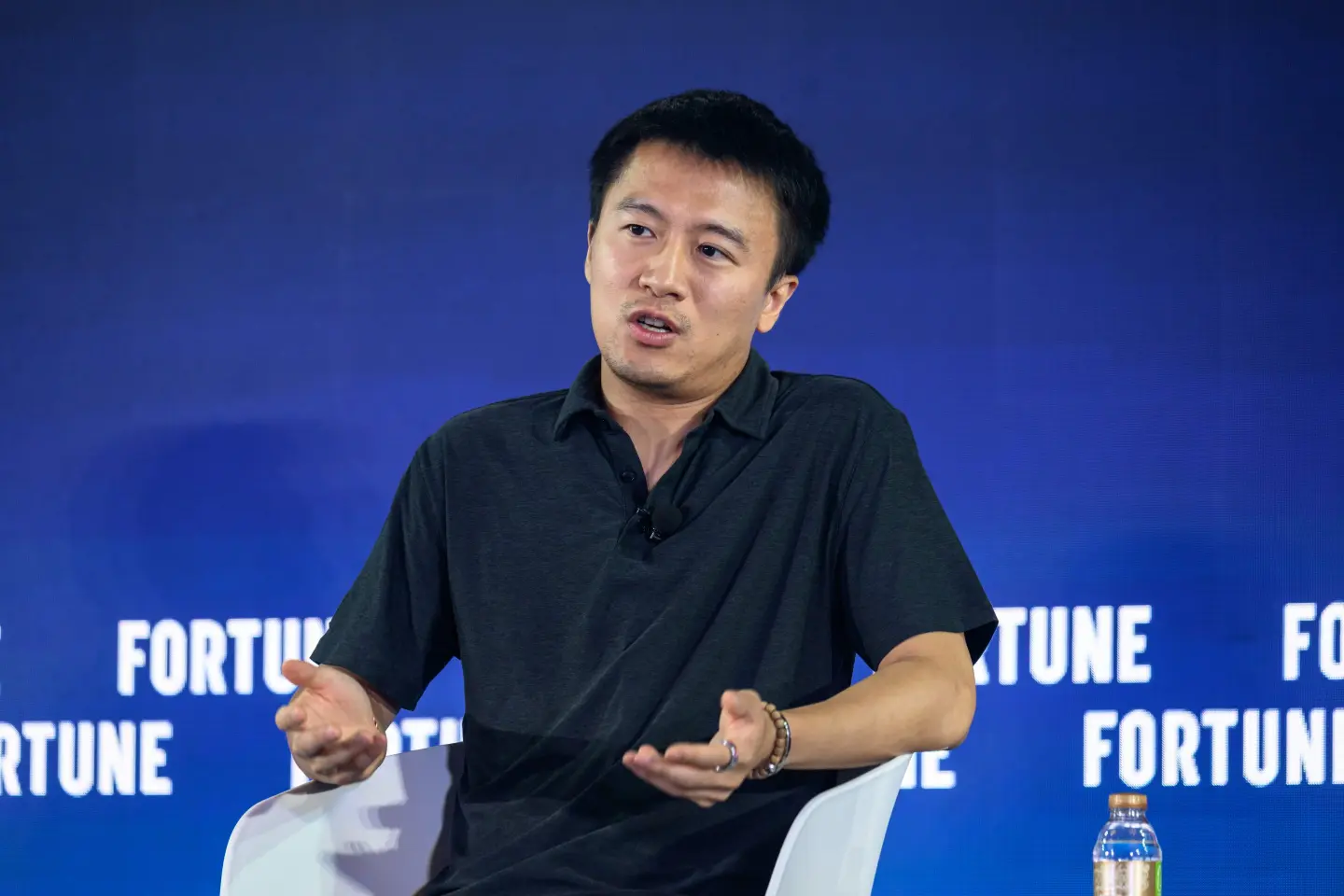
Zhou maintains that such applications represent task replacement rather than industry restructuring. Speaking at the Fortune Leaders Forum in Macau on Sept. 8, he argued that artificial intelligence has yet to experience a transformative inflection point comparable to the emergence of internet search engines, asserting that genuine disruption will only materialize when AI fundamentally reorganizes how entire sectors operate rather than automating discrete workflows. Black Lake continues to deploy autonomous agents across its client base while accumulating the proprietary factory-floor datasets required to test that threshold.