
Ford’s 2026 Ranger Sticks With Its Turbo Four as Rivals Pile On
Ford's 2026 Ranger stays with its 2.3L turbo four, but offers V6 options for those who need more power.

The 2026 Ford Ranger enters the North American mid-size pickup truck market anchored by its core 2.3-liter EcoBoost turbocharged four-cylinder engine. That powerplant produces 270 horsepower and 310 lb-ft of torque, mated exclusively to a 10-speed SelectShift automatic transmission. The powertrain configuration is engineered to deliver low-end and mid-range torque, contrasting with higher-revving naturally aspirated engines historically common to the mid-size truck class.
In the North American market, the truck is offered predominantly in a four-door SuperCrew configuration paired with a five-foot cargo bed. Maximum payload capacity reaches up to 1,805 pounds, depending on the drivetrain and trim level selected. Ford’s decision to maintain the 2.3-liter engine as the primary powertrain across the lower and mid-tier Ranger lineups underscores a broader automotive trend toward forced-induction four-cylinder engines.
The high-performance Ranger Raptor utilizes a 3.0-liter EcoBoost twin-turbo V6 delivering 405 horsepower and 430 lb-ft of torque, paired with long-travel suspension and Fox live-valve shocks. At the top of the performance hierarchy, that Raptor engine targets buyers seeking extreme off-road capability. Models fitted with the available 2.7-liter twin-turbocharged EcoBoost V6 generate 315 horsepower and 400 lb-ft of torque, aimed at customers looking for increased towing and highway passing power without stepping up to a full-size F-150.
Assembly for North American markets takes place at Ford’s Michigan Assembly Plant in Wayne, Michigan. The current Ranger is built on Ford’s updated T6.2 body-on-frame platform, a chassis architecture shared in part with the sixth-generation Ford Bronco. The platform represents the second generation of the mid-size Ranger sold in North America since Ford reintroduced the nameplate for the 2019 model year. That launch ended an eight-year domestic hiatus for the badge following the retirement of the prior compact Ranger platform in late 2011.
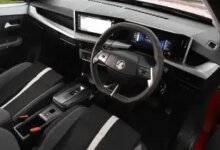
Standard and available driver-assistance features fall under the Ford Co-Pilot360 umbrella, incorporating Pre-Collision Assist with Automatic Emergency Braking, Lane-Keeping Assist, and Blind Spot Information System (BLIS) calibrated to cover trailer blind spots. Inside the cabin, the truck incorporates Ford’s SYNC 4A infotainment architecture, controlled through a standard 10.1-inch or an optional 12.0-inch portrait-oriented center touchscreen. The display interface integrates wireless Apple CarPlay and Android Auto compatibility, alongside digital instrument displays measuring 8.0 inches on standard trims and 12.4 inches on premium variants.
The direct-injected, twin-scroll turbocharged engine is positioned against a field of redesigned rivals in an increasingly competitive segment. The 2026 Ranger retains a maximum towing capacity of up to 7,500 pounds when equipped with the optional trailer tow package and integrated trailer brake controller. The truck incorporates functional utility features such as available integrated rear-bumper side steps, an available 400-watt in-bed power inverter, and Pro Trailer Backup Assist.
Ford expands the 2026 Ranger lineup with additional multi-cylinder EcoBoost configurations on higher trims. Competing models such as the Toyota Tacoma have similarly shifted toward 2.4-liter turbocharged four-cylinder engines, while General Motors utilizes a 2.7-liter turbocharged four-cylinder across the Chevrolet Colorado and GMC Canyon lineups. The Ranger’s engine configuration competes directly with these forced-induction offerings while standing apart from naturally aspirated entries in the class, including the 3.8-liter V6 Nissan Frontier and the 3.6-liter V6 Jeep Gladiator. The 2026 Ranger operates in a mid-size pickup market that has undergone a widespread mechanical transition. DETROIT — Ford’s decision underscores the automaker’s commitment to the turbocharged four-cylinder as the segment standard.