Crusoe Ends $1.25 Billion Boom Supersonic Turbine Deal, Dropping 29 Generators
The order was expected to provide up to 1.2 gigawatts of power to Crusoe campuses and help fund Boom’s supersonic airliner program.
Crusoe Energy Systems has ended its agreement to buy 29 stationary natural gas turbines from Boom Supersonic, both Denver-based companies confirmed, canceling a deal valued at $1.25 billion. The generators were intended to supply up to 1.2 gigawatts of electricity to off-grid computing campuses, and Crusoe’s withdrawal leaves Boom without the launch customer for its new energy division.
Crusoe spokesperson Andrew Schmitt said the company was keeping its options open as it expands. “We build AI factories from the power up, and we’re bringing new campuses online across the country, powered by innovative energy sources,” Schmitt said. “As our portfolio grows, we stay flexible, choosing the energy solutions that are right for each site as its needs evolve – including turbines, along with wind, solar, batteries and the grid.”
Founded in 2018 by Cully Cavness and Chase Lochmiller, Crusoe first built modular data centers using natural gas that would otherwise be flared at oil drilling sites, a process known as Digital Flare Mitigation. The company initially focused on Bitcoin mining before pivoting toward hosting high-performance computing (HPC) and artificial intelligence workloads. It recently secured $3.9 billion in new capital for expansion, including a multi-gigawatt data center campus in Abilene, Texas.


The Abilene campus, developed with Lancium, is designed to provide computing power to OpenAI. Its first 200-megawatt phase is backed by a $3.4 billion joint venture with Blue Owl Capital and Primary Digital Infrastructure. Crusoe’s retreat from turbines comes as the project and the wider AI sector drive demand for large, continuous power supplies.
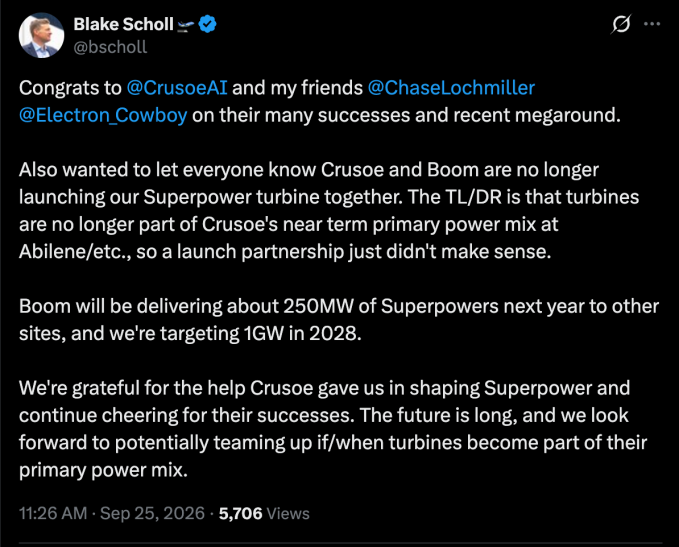
Boom Chief Executive Officer Blake Scholl announced the termination on X, describing it as a change in Crusoe’s near-term infrastructure plans.

“The TL/DR is that turbines are no longer part of Crusoe’s near term primary power mix at Abilene/etc., so a launch partnership just didn’t make sense,” Scholl wrote. He said Boom still expects to deliver approximately 250 megawatts of its Superpower generators to other customers next year and is targeting 1 gigawatt of deployed capacity by 2028.
The original agreement called for Crusoe to buy Boom’s 42-megawatt Superpower turbines, with deliveries scheduled to begin in 2027. The land-based generators are adapted from Boom’s proprietary Symphony turbofan engine and share roughly 80% of its components. Boom launched the stationary turbine business last year and raised $300 million to commercialize the Superpower variant, aiming to use sales of gas-fired generators to the AI sector to generate near-term cash flow for the development and flight-testing of its airliner.
The search for data center power has led technology companies and infrastructure developers to pursue direct, continuous “baseload” supplies, increasingly bypassing traditional utility grids. Microsoft signed a 20-year power purchase agreement with Constellation Energy to revive a unit of the Three Mile Island nuclear plant in Pennsylvania. Amazon Web Services (AWS) acquired a 960-megawatt nuclear-powered data center campus from Talen Energy for $650 million, while Google signed an agreement with Kairos Power to deploy a fleet of small modular nuclear reactors (SMRs) for its data centers. Industry analysts say developers are prioritizing immediate, proven and rapidly deployable grid connections and power generation assets over pre-commercial energy technologies with multi-year lead times.
For Boom, the turbine business was intended as an unorthodox financial engine for its multi-billion-dollar effort to build a commercial supersonic airliner. The company is developing the Overture, designed to fly at Mach 1.7 on sustainable aviation fuel (SAF), while the design, testing and certification of a new commercial airliner can require several billion dollars.
Major aerospace engine manufacturers Rolls-Royce, General Electric and Pratt & Whitney declined to design a custom propulsion system for the Overture. Boom then partnered with Florida Turbine Technologies, a subsidiary of defense contractor Kratos, to develop its own engine, Symphony. Boom officials said they are pursuing other customers in their pipeline to meet near-term delivery targets.