169 Pledges to Save the Villa Vie Odyssey — and a Court Queue That Puts Them Last
The ship is now a legal object in a queue. The residents who paid for it twice stand behind the sheriff, the crew, the lender and the fuel supplier.
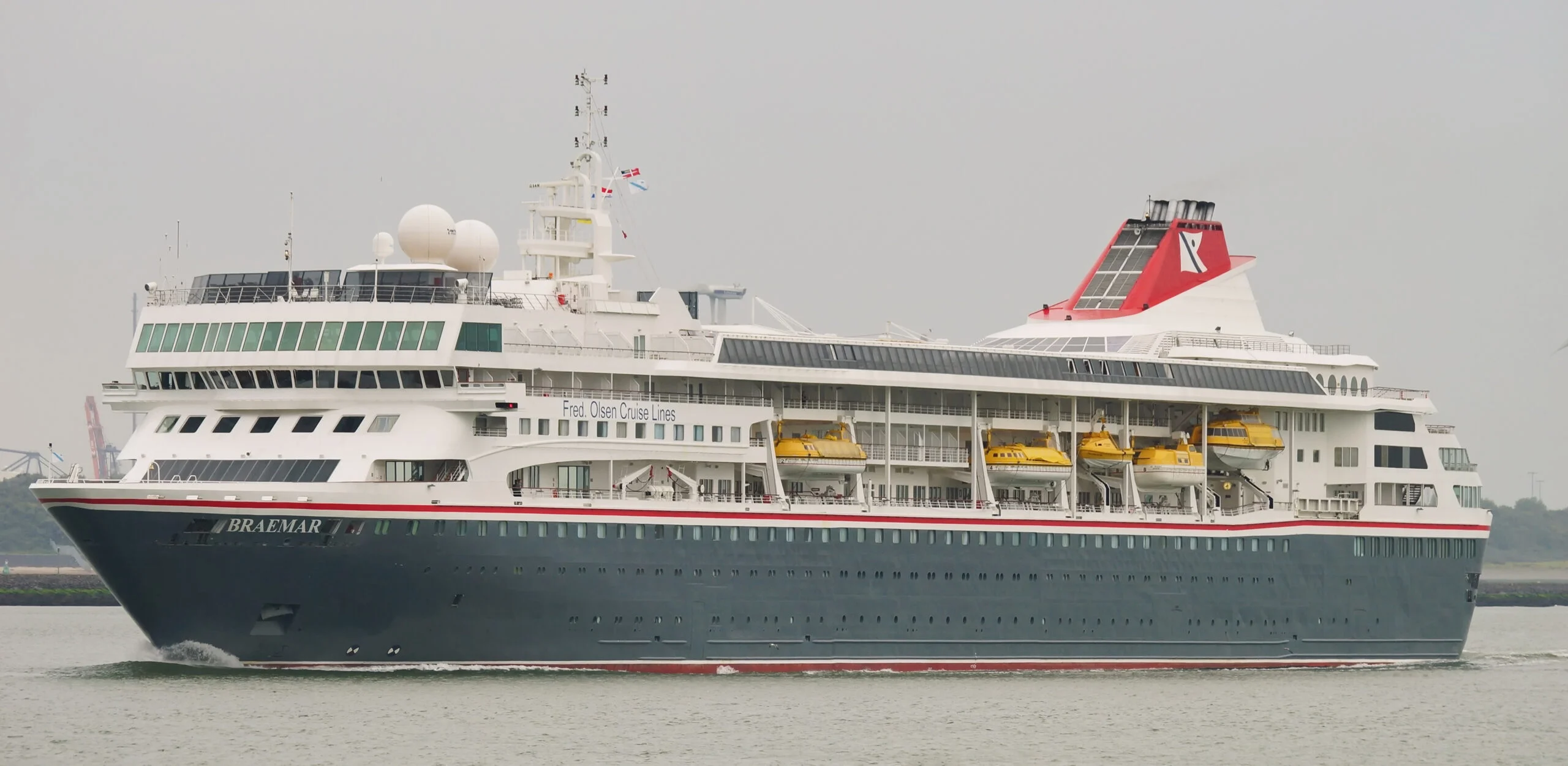
The Singapore Courts’ vessel register records the arrest of the Villa Vie Odyssey at 10:34 a.m. on Sunday, at Changi General Purpose Anchorage, on an application by the law firm Helmsman LLC. About 50 officers and crew were aboard. No residents were. The tracker showed her stationary just offshore, east of Changi Air Base, with none of the roughly 200 people who had called her home aboard. Court records reviewed by CBS News name Helmsman as the arresting solicitor but not its client; a source familiar with the matter told CBS the action was likely brought by a fuel supplier, and that Villa Vie owes a supplier in the region about $500,000.
An arrest does not mean criminal charges. In Singapore it means the ship is held as security for a claim, and the machinery around her changes at once. The Maritime and Port Authority, the Immigration and Checkpoints Authority and the Police Coast Guard must be notified. The arresting party appoints a security guard from the court’s panel and a vessel watch service, and the Sheriff’s Office gets daily updates on the ship’s location from the day of the arrest until she is released. The Maritime and Port Authority said the crew were in good condition and that the ship’s creditors were making arrangements for their daily needs and welfare. The Odyssey arrived in Singapore on Sunday morning after sailing from Sihanoukville, where she had departed at 00:25 on Wednesday 4 November under the control of her lender, after Villa Vie missed payments.
The residents have already tried to buy her back once. Sagar Capital, a group backed by residents, spent two months negotiating, gathered 169 pledges and collected no money, and quit on 31 October. Its letter to residents, reviewed by Business Insider and confirmed by three residents, gave five reasons. There was no agreement with the lender. The group had found more debt than it expected: “We were given access to Villa Vie’s records only last Saturday. Our review found substantially more debt than we had anticipated.” A takeover carried legal exposure. A Chapter 11 case would cost about $3 million for its first 60 days. And there was no monthly fee that would both cover operating costs and stay affordable. “We could not in good conscience ask anyone to put their savings at risk on a plan that might not succeed,” the letter said. Paul Montoya, a member of the ship’s seven-person Resident Council who helped secure the pledges, described the bid to Business Insider as a “Hail Mary.”

A second effort is still active, CBS News reported on 8 November, led by another group hoping to buy the ship at auction. It would not involve Villa Vie’s founder and executive chairman, Mike Petterson. Whitney Olson, 47, a retired Montana car-dealership owner who spent more than $1.5 million on two cabins, an ownership interest and additional contributions to the business, told the New York Times she intends to monitor the auction and explore buying the vessel at a reduced price. “It was so special. I’m not ready to be done,” she said. She had considered putting in another $2 million in April, but wanted a comprehensive financial audit and assurances that her investment would be protected if the company entered bankruptcy proceedings. She said Petterson declined to provide the information she requested. “He was more interested in taking the money from the residents at these exorbitant interest rates than giving me what any investor would ask for.”
Petterson told CBS he had believed he had an operational partner to rescue the ship, but that did not pan out, which led to the vessel being taken by its lender. The partner was Oneil Khosa, the former chief executive of Margaritaville at Sea, and the deal fell through earlier this month. “I’m not going to be the front face person of a company any time soon,” he told CBS. He says he could still get the ship back and is continuing to look for investors to take it over for good, and that another option would be to raise the funds to file for Chapter 11 bankruptcy and sell the company.
In April, Villa Vie asked them for emergency loans to cover fuel, offering up to 24 per cent in return, and residents raised more than $2 million. An agreement obtained by CBS News describes the loan as “Unsecured” without “Collateral or Guarantees.” Craig and Cindy Voight, who boarded in Belfast in October 2024, said they spent more than $300,000 on their cabin and monthly dues, in addition to $100,000 in the fuel loan programme, and plan legal action over it. “So we thought, alright, we’re going to get 18% interest,” Craig Voight said. “First payment’s supposed to start a month later. So between then and now they owe us over $113,000. They’ve never paid one penny.” Petterson acknowledged in a statement that some residents could take legal action over the fuel loans, saying, “I take their concerns seriously.” He said the financing was arranged through the parent company, Residential Cruise Holdings, “because existing financing restrictions prevented Villa Vie Residences from borrowing directly.”
The lender is the Norwegian firm Ness, Risan & Partners AS — NRP Maritime Asset Management — named as the lender in a message Villa Vie sent residents on 1 November, and the firm whose funds provided a term loan for the acquisition and the Belfast refit on 26 April 2024. That loan is the mortgage on the ship, and it ranks ahead of the fuel supplier and the residents. Petterson told Business Insider that residents owned roughly 88 per cent of Villa Vie, with the rest held by the founders, the management team and himself, and told CBS that the company “was entirely capitalized by the residents themselves. There is no stakeholder outside of the residents.” Both can be true at once: the residents own the company, and the company does not own the ship free and clear.
What the residents were told about the company’s finances is itself disputed. Benjamin Schatz, a Harvard-educated lawyer who travelled aboard, told the New York Times that “founders knew surprisingly little about the state of the finances,” and that few passengers understood money from cabin sales was being spent immediately to keep the ship operating. Petterson maintained that financial updates had been provided to founders every few months. Mary Ann Demsar, a 67-year-old retired teacher from Ontario, put the pricing question plainly to the Daily Mail: “Unfortunately, it was not expensive enough. It did seem too good to be true that it could cover its costs, and we kind of felt that way.”
If the owner does not secure the release of the vessel, the plaintiff may apply for an order that the sheriff sell her by judicial sale, the Singapore Courts’ own guidance says, and the proceeds are used to satisfy the expenses of the sheriff and other dues, then the claims of the plaintiff and other relevant parties. The established order, set out in Singapore case law, starts with the sheriff’s expenses and the costs of the party that produced the fund. Then come maritime liens — salvage, damage done by a ship, and seaman’s and master’s wages — then possessory liens, then mortgages, then statutory liens. The crew’s wages are a maritime lien, which puts them near the front. The crew had been behind on pay in September — residents collected cash outside a restaurant at mealtimes and handed out $100 to every crew member one stripe and below, and officers were finally paid for September on 30 October. The fuel supplier’s claim for unpaid bunkers is a statutory lien, which puts it below the mortgage. The residents’ cabin purchases and fuel loans are unsecured, which puts them outside the list altogether.
A Singapore court has already decided this exact fight. In 2017, in the case of the Posidon and the Pegasus, World Fuel Services, which had supplied bunkers it was never paid for, asked the court to rank its claim ahead of the mortgagee, Piraeus Bank. The court refused. The established order “should be followed and not be readily departed from,” it said, and a departure needs a powerful reason or truly exceptional circumstances. Three factors would have to line up for a fuel supplier to jump a mortgage: the mortgagee knew the borrower was insolvent, was fully aware in advance of the nature and extent of the expenditure, and benefited from it. The court found none of them made out. The supplier that likely had the Odyssey arrested, owed about $500,000, faces the same test in the same court.
Villa Vie paid a reported $13 million for the ship, then the Braemar, in 2023, with another $12 million initially allocated to refurbishment and recertification. Montoya said residents are now relying on “even more of a long shot,” such as a “benevolent soul” stepping in. Cheryl Ethrington, a resident who had planned to pledge toward the buyout, said: “I haven’t completely given up hope that someone will pick up the baton and run with it. If not, life goes on.” The sheriff’s commission alone is 5 per cent of the first S$1,000 of the sale price and 2.5 per cent of the balance — hundreds of thousands of dollars on a sale anywhere near the purchase price, before any creditor is paid. A judicial sale can be effected as quickly as three months from the arrest, if bids meet the reserve price set by the court. The residents who hope to buy her at auction would be buying their home a third time: once as a cabin, once as a fuel loan, and now as a ship, at a price set by the court, against a lender who already holds the mortgage.
On 9 July 2025 the Odyssey failed her first inspection under the US Centers for Disease Control and Prevention’s Vessel Sanitation Program, scoring 81 against a pass mark of 86, with 44 violations. Inspectors found chlorine in the drinking water as low as 0.1 parts per million, against a minimum of 2.0, and trays of cheesecake and caramel mousse stored at 57 degrees Fahrenheit when they should have been kept at 41. About 30 pieces of equipment across the galleys and pantries were listed as out of order. She was the only cruise ship to fail a CDC inspection in 2025, and as of August that year she had not submitted her corrective report. The inspection was more than a year before the shutdown, and it does not establish the ship’s condition now, but it is on the record, and it is part of what the ship is.
About 98 of the former residents were still in Cambodia on 4 November, according to the Tourism Ministry, in Sihanoukville, Kampot, Kep, Siem Reap and Phnom Penh. The ministry said it welcomed them to keep exploring the country, with a coordination team available to assist them during their stay. Others had returned home or travelled elsewhere in the region.
Joel Greiff, 57, paid $350,000 for a cabin, moved aboard in October after selling his condominium and drawing on his retirement savings early, and spent 26 days on the ship. He told CBS he had come to terms with the possibility that he might never recover the money. He pays about $200 a month for a room in Kampot.