Walmart drone delivery expands to Denver, Seattle by 2027
The 2027 rollout tests autonomous aerial logistics against high-altitude terrain and Pacific Northwest weather patterns.
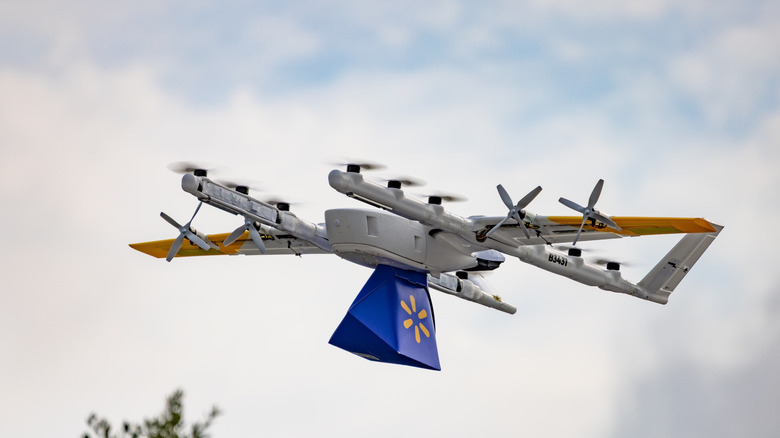
Walmart and Alphabet subsidiary Wing will launch drone deliveries in the Denver and Seattle metropolitan areas in 2027, extending an aerial logistics network that already spans five U.S. markets and targets coverage from more than 270 stores nationwide.
The expansion pushes the partnership into regions defined by challenging geography and weather. Denver’s high altitude reduces rotorcraft lift efficiency, while Seattle’s persistent rain and wind require navigation systems far more resilient than those tested in the Sun Belt cities where the service currently operates. Wing’s fleet is engineered to cruise at speeds up to 60 mph with payloads capped at five pounds — a weight limit designed for urgent household staples, over-the-counter medications, and small electronics rather than full grocery carts.
Consumers in Atlanta, Charlotte, Dallas–Fort Worth, Houston, and Orlando can already select drone delivery through the Walmart app or website when their orders qualify. Wing also maintains its own standalone application for direct ordering. The five-pound payload ceiling aligns with Federal Aviation Administration Part 107 regulations governing small unmanned aircraft, which restrict commercial drone weight and mandate operations within approved flight corridors. Unlike traditional ground couriers, Wing’s aircraft lower packages via tether to designated drop zones, eliminating the need for landing infrastructure in residential yards.

Fourteen additional destinations are slated for activation before the Denver and Seattle rollout, including Miami, Philadelphia, Los Angeles, and the San Francisco Bay Area. That schedule positions Walmart to compete directly with Amazon, which has operated its Prime Air drone service in College Station, Texas, and parts of Arizona since 2022. Amazon recently secured FAA approval to fly beyond visual line of sight, a regulatory milestone that allows drones to travel farther without a dedicated human observer on the ground.
The race for low-altitude airspace intensified earlier this week when DoorDash detailed plans for DoorDash Air. That platform will debut in northern California fulfilling orders for restaurant partners including Chipotle and Popeyes. While Walmart and Wing focus heavily on retail goods, DoorDash is targeting the prepared food sector, where delivery speed directly impacts product quality.
Alphabet incubated Wing internally before spinning it into an independent subsidiary, leveraging mapping data and autonomous navigation technology originally developed for self-driving initiatives. For Walmart, integrating aerial transport addresses last-mile delivery costs, which industry analyses consistently identify as the most expensive segment of the supply chain. Ground-based gig economy drivers remain central to Walmart’s fulfillment strategy, but automated air routes offer predictable transit times unaffected by urban traffic congestion.
Regulatory clearance remains the primary variable governing the pace of expansion. The FAA requires operators to secure specific waivers for flights over populated areas and Beyond Visual Line of Sight. Wing currently holds approvals covering suburban operations in Texas and North Carolina, and securing equivalent authorizations for dense coastal metros like Seattle and San Francisco will dictate whether the 2027 timeline holds.
Walmart confirmed that site selection for the next phase of store-based launchpads is underway across the targeted fourteen markets.