Patrick McGrath Expands Into Furniture, Candles After Hamptons Hit
The Studio McGrath founder prepares a Biedermeier furniture line and moves his gallery to Noho after renovating Mario Buatta's former Upper East Side residence.
A decade after leaving retail visual merchandising to launch his own practice, interior designer Patrick McGrath is accelerating beyond residential commissions into product design, gallery exhibitions, and a high-profile real estate acquisition that places him in the direct lineage of one of American decorating’s most famous maximalists.
McGrath and his partner, architect Reinaldo Leandro — co-founder of the firm Ashe Leandro — are currently renovating a prewar apartment on Manhattan’s Upper East Side previously owned by Mario Buatta. Known as the “Prince of Chintz,” Buatta defined a heavily layered, pattern-saturated aesthetic for decades before his death in 2018. McGrath, whose work leans toward restrained juxtapositions of museum-quality antiques and contemporary art, represents a deliberate stylistic departure from the apartment’s former occupant. The renovation signals a broader industry shift among younger New York designers who are moving away from the maximalist revival of the late 2010s toward tighter, more historically literate curation.
That curatorial approach is what salvaged a 1970s shingle-style house in Southampton, New York, from demolition. A thirtysomething art collector, who had hired McGrath years earlier to design his Soho apartment, purchased the property in the village’s Estate Section with plans to raze it. Leandro was already selected as the replacement architect. Instead, McGrath spent 18 months overhauling the interiors, replacing floral Hamptons tropes with a framework capable of supporting works by Rashid Johnson, Vik Muniz, and Nate Lowman. The intervention convinced the owner to keep the structure.


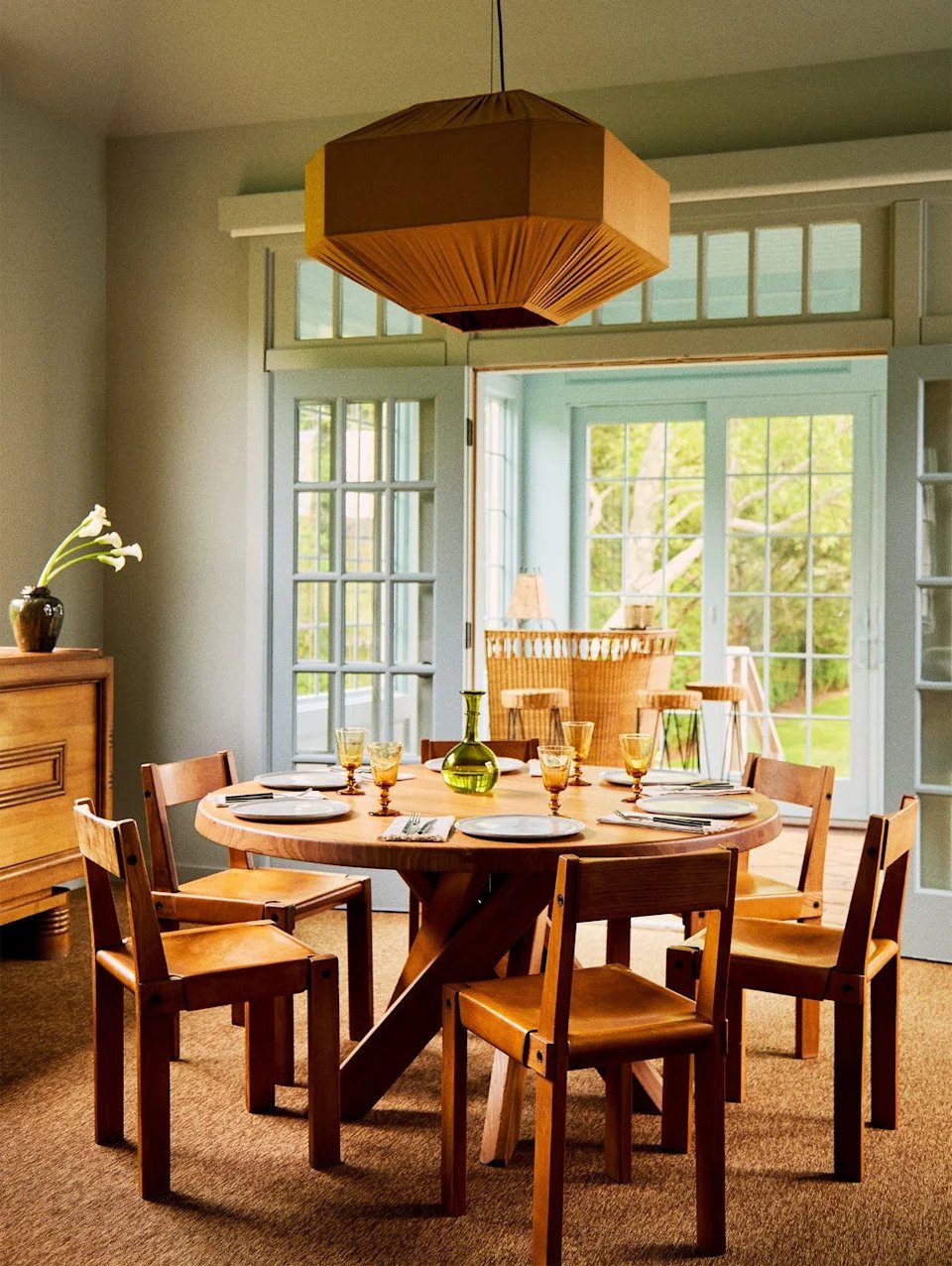
The Southampton project required bridging midcentury European design with contemporary American art — a combination that demands precise scale and material contrast to avoid looking like a showroom. McGrath anchored the living room with twin bespoke sofas upholstered in a silk, cotton, and raffia blend, surrounding them with a Pierre Jeanneret armchair, a Jean Prouvé daybed, and a 1930s French cabinet featuring straw marquetry. In the primary bedroom, an Andy Warhol Brillo Box sits on a low-mounted Vitsoe shelf beneath a Robert Longo drawing, flanked by 1930s R.C. Coquery lounge chairs and a Marcel Breuer bentwood table. The dining room pairs a 1960s Pierre Chapo table with a Charles Dudouyt sideboard from the 1940s under a Ruemmler pendant light. Structural changes included replacing the fireplace, updating kitchens and baths, installing varied carpet textures, and adding a gym and cold plunge.
McGrath’s ability to source across centuries stems from his early career trajectory. After moving from the Boston suburbs to New York in 2005 to attend NYU, he assisted designer Frank de Biasi, developing a specialization in 18th- and 19th-century furniture. By 2014, he was working for Elle Decor A-List designer Michael Bargo, managing ready-to-wear and accessory displays at Giorgio Armani boutiques nationwide. He launched Studio McGrath in 2015, initially funding the practice through word-of-mouth projects for first-time homeowners while still employed in fashion retail.
Today, the business operates across multiple revenue streams. Last year, McGrath opened a showroom and gallery in downtown Manhattan to reach buyers outside his immediate referral network. His second exhibition there reunited him with Bargo for “Icons: Antiquities, Jean Prouvé and Bruce Weber,” which paired archival photography with midcentury French design. Clients such as Aerin Lauder now source directly from the space; Lauder recently acquired a 19th-century French nursing chair and ottoman from his inventory.
This month, the gallery relocates to a larger Noho space, debuting with an exhibition themed around the Seven Deadly Sins. Simultaneously, McGrath is expanding into consumer products. A six-piece furniture collection inspired by 19th-century Biedermeier design — a Central European movement known for clean lines and unadorned wood grain that predates modernism — is scheduled for release next year. For the current holiday season, he partnered with Francisco Costa, the former Calvin Klein creative director whose brand Costa Brazil focuses on sustainably sourced luxury wellness products, to produce a candle line conceptually rooted in Robert Frost’s 1920 poem “Fire and Ice.”
The Noho gallery opens later this month, followed by the Biedermeier furniture rollout in 2027.