GM Bets $866M on Software to Survive China’s EV Speed War
A new central computing unit and AI-driven engineering aim to cut development cycles from five years to under three.
General Motors is attempting to compress its vehicle development cycle by half, targeting the two-to-three-year timelines that have allowed Chinese automakers to flood global markets with inexpensive electric vehicles. The Detroit company outlined this accelerated strategy Wednesday at its annual GM Forward event in New York, revealing a manufacturing and engineering overhaul driven by enterprise artificial intelligence.
The financial scale of the transition is already visible in GM’s filings. The automaker’s capitalized software amortization expense reached $866 million in 2025, according to the company. That figure represents only the portion of costs spread out over multiple years, indicating total immediate spending on software and electrical architecture runs significantly higher as traditional manufacturers try to close the gap with competitors who treat cars primarily as computing hardware.
Volkswagen Group’s struggles illustrate the financial danger of these transitions. After failing to deliver reliable in-house software through its Cariad unit, Volkswagen agreed to a $5.8 billion joint venture with Rivian to salvage its digital infrastructure. GM has chosen to build internally, a path that requires absorbing massive upfront engineering costs without a partner to share the burden.


To execute the faster cadence, GM engineers used AI tools to run 300,000 virtual simulations of a new lithium-manganese-rich battery pack before constructing a single physical prototype. According to the company, this process moved the concept from design to an approved program in one month. Traditional automotive development cycles typically require four to five years to bring a new vehicle from initial sketches to production lines.
The pressure to accelerate stems directly from Chinese factories capable of producing far more vehicles than domestic consumers can absorb. Backed by government subsidies and lower labor costs, those excess units have pushed into Europe and South America. Tesla CEO Elon Musk warned during a 2024 earnings call that without trade barriers, Chinese automakers “will pretty much demolish most other companies in the world.”
Image Credits:GM /
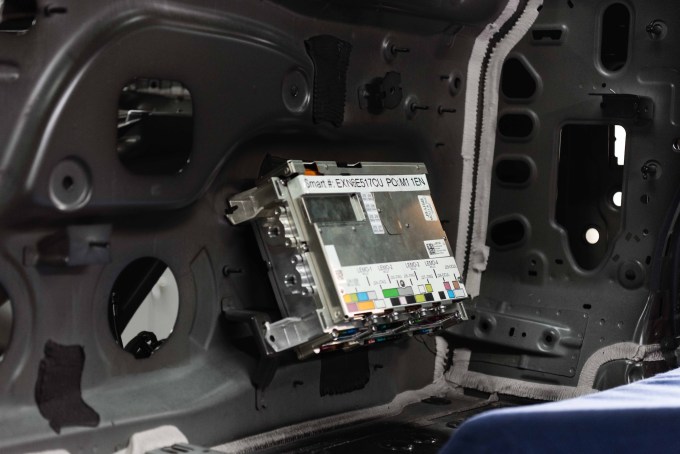
Speed alone will not work without a fundamental change in how the vehicles are wired. Legacy electronics architectures scatter dozens of smaller computer chips throughout a chassis, creating heavy wiring harnesses and fragmented data networks that slow down software updates. GM’s fourth-generation EV platform replaces this distributed setup with a Central Compute Unit (CCU) that is 40 times more powerful than its existing systems, the company announced. Eliminating edge processors cuts wiring weight by 30%.
This centralized architecture will debut in the Cadillac Escalade IQ in 2028. While designed for electric vehicles, GM confirmed the CCU will also be integrated into future internal combustion models. The consolidation handles propulsion, chassis controls, perception, and active safety on a single processing hub.
Centralizing the compute power is a prerequisite for the hands-free, eyes-off highway driving feature GM plans to roll out alongside the Escalade IQ in 2028. Unlike current driver-assistance systems that require operators to remain ready to take control, the new feature removes the need for driver intervention on highways.
GM previously abandoned Apple CarPlay across nearly all its EVs in favor of a Google-based infotainment system to maintain tighter control over the software environment inside the cabin. Sterling Anderson, executive vice president of global product and chief product officer at GM, told TechCrunch the company views vehicles as spaces meant to “understand context, reduce friction, and give people back moments that would otherwise be consumed by the demands of the road.”