Ford and the Ad Council Launch National Campaign to Steer Gen Z Toward Skilled Trades as AI Anxiety Rises
Survey data reveals a stark gap between teenagers open to trade careers and those actually planning to pursue them, prompting a new corporate-backed advertising push.
A coalition led by Ford Motor Co. and the Ad Council is mobilizing a national advertising campaign designed to redirect American teenagers toward skilled trades, targeting a generational bias toward four-year universities that industry leaders say has created a critical labor shortage. The initiative, announced Wednesday at the Ford Pro Accelerate event in Detroit, enlists Home Depot, Dycom Industries, The Wallace Foundation and comedian Nate Bargatze to rebrand plumbing, electrical work, welding and automotive repair as high-earning entrepreneurial paths rather than fallback options.
The push arrives as young workers face mounting uncertainty about white-collar employment. Data released by the Federal Reserve Bank of New York placed unemployment among recent college graduates at 5.7% in June, significantly higher than the 4.1% rate for the broader workforce. Simultaneously, research published in August by Stanford University economists found that employment for workers ages 22 to 25 in occupations highly exposed to artificial intelligence sits roughly 19% below historical trends compared to less-exposed fields. That gap widened from 15% the previous year, driven primarily by slower hiring of new graduates rather than mass layoffs.
Economists remain divided on whether generative AI tools are the primary driver of this shift. Harvard economist David Deming has pointed to the structural changes brought by remote work, while Apollo Global Management’s Torsten Slok noted that the graduate unemployment gap began widening approximately six months before the public release of ChatGPT in late 2022. A separate analysis by Ramp and Revelio Labs found that entry-level headcount at companies investing heavily in AI actually grew 12% over two years. Regardless of the cause, corporate America is increasingly worried about the other side of the ledger: the physical economy.


Ford CEO Jim Farley, speaking at Michigan Central, argued that decades of cultural messaging positioning a university degree as the sole route to the American dream have left the country paying a steep price. The Alliance for America’s Skilled Trades—a consortium Farley helped establish alongside BlackRock, Google and Carhartt—released an estimate projecting that employers must fill approximately 1.7 million skilled-trades openings annually through 2035 to maintain basic infrastructure and commercial operations.
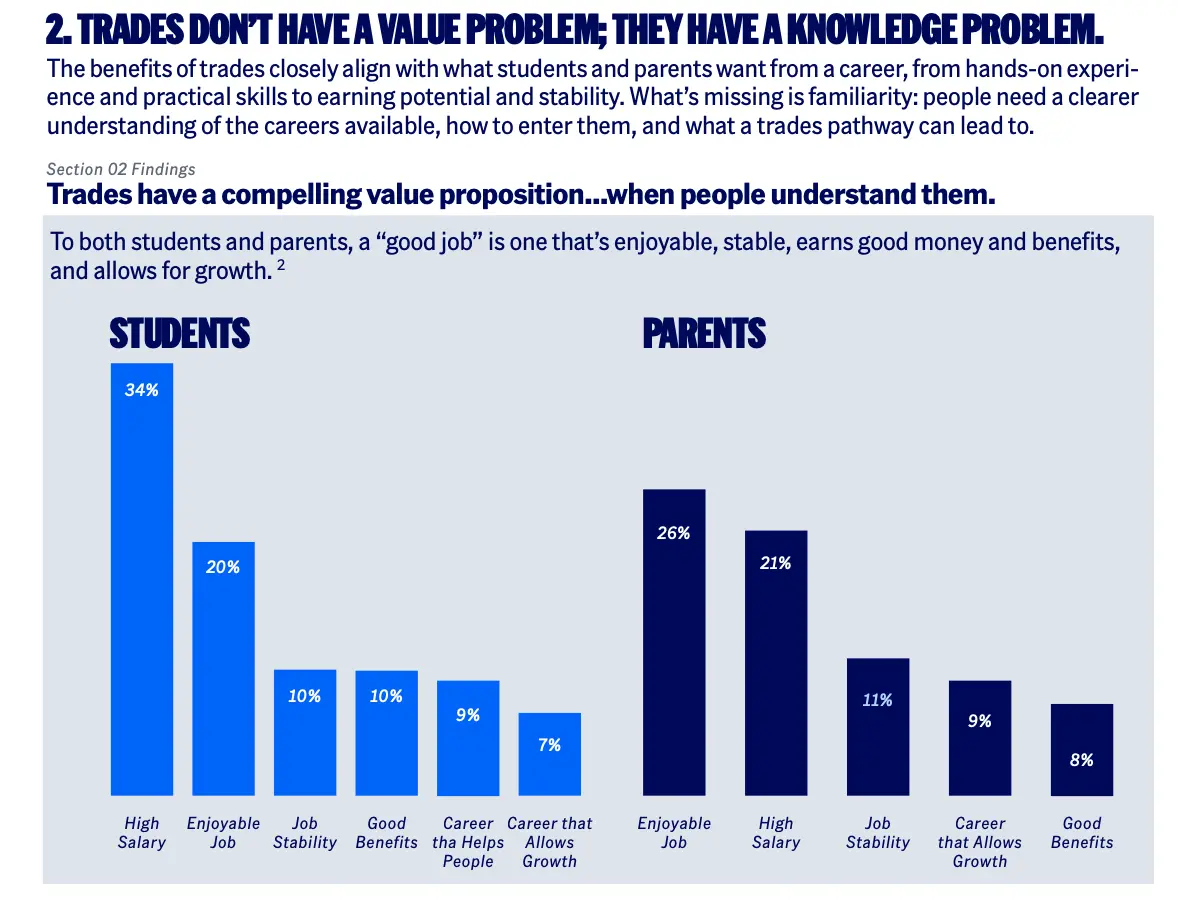
To quantify the cultural barrier, Ford and the Ad Council Research Institute surveyed 5,712 people between June and July, including 3,009 high school students, 2,501 parents and 202 school counselors. The findings revealed a stark disconnect between perception and intent. While 56% of respondents identified college as the most familiar post-high school path and 42% said it was the route their families expected, only 9% of teenagers were actively considering the trades. More revealing was the gap between openness and action: 38% of students and 48% of parents considered trade careers viable, yet only 11% of students and 12% of parents actually planned to pursue them.
Michelle Hillman, chief campaign and program officer for the Ad Council, said the forthcoming campaign will run across donated media time and space, mirroring the nonprofit’s historic public service model. Mark Truby, Ford’s chief communications officer, explicitly compared the ambition to the Ad Council’s mid-20th-century Smokey Bear wildfire prevention effort, seeking to embed trade careers into the cultural consciousness with similar permanence. Hillman noted the campaign will lead with outcomes that survey respondents prioritized: financial security (cited by 59%), personal fulfillment (44%), earning potential (42%) and stability (39%).
The stigma surrounding manual labor remains deeply entrenched. According to the coalition’s research, 61% of teens acknowledge existing stereotypes about tradespeople. Only 33% of students said they would feel respected pursuing a trade career, compared to 50% for health care and 46% for technology. Institutional guidance reinforces this divide: 88% of school counselors recommend universities, while just 54% suggest trade schools. Parents, cited by 76% of teens as their primary influence, often default to the university script. Gender disparities further complicate recruitment, with boys twice as likely as girls to plan for a trade career, at 14% versus 7%.
Home Depot has attempted to chip away at these perceptions for years. Chief marketing officer Molly Battin highlighted the company’s Path to Pro initiative, launched in 2018 with $50 million in funding. Last week, the retailer committed an additional $13 million to Skills Explorer, a program targeting children ages 11 to 17 in partnership with Boys & Girls Clubs and Scouting America. Battin characterized the gap between considering and planning for a trade as the most telling metric in the research, emphasizing that the industry does not lack value but suffers from a severe knowledge deficit among young people and their families.
Corporate backers are also leaning heavily into entrepreneurship to attract ambitious teenagers. Truby pointed to the demographic profile of families involved in youth sports leagues, noting that many built substantial businesses starting from a foundational trade skill. This mirrors broader economic data suggesting that owners of closely held, trade-based businesses frequently accumulate significant wealth outside traditional corporate ladders. Dycom President and CEO Dan Peyovich reinforced this framing, stating that economic growth fundamentally relies on a workforce capable of building and sustaining physical infrastructure, requiring a shift in how trade careers are presented to the next generation.
Jillian Marquez, a senior fabricator at Roush Automotive who spoke alongside Bargatze at the Detroit event, offered a direct counter-narrative to the college-first expectation. Marquez, who left university after less than two months, emphasized that mindset outweighs physical stereotypes, pushing back against assumptions that trade work is restricted by gender or body type.
Jean Desravines, president of The Wallace Foundation, which focuses on youth development, education and the arts, framed the coalition’s work as an equity issue, arguing that long-term community stability requires young people to access well-paying jobs that do not mandate a four-year degree. The Ad Council is currently in the fact-finding phase of the campaign, mapping out media placements and creative strategies ahead of a broader rollout.