Hyundai Subsidiaries Complete Pilot Cross-Border Treasury Transfer Using Tether’s USDT
The $20,000 transaction on the Avalanche blockchain settled in seven minutes, highlighting stablecoins as an emerging tool for corporate treasury.
Hyundai Motor’s US and Mexican subsidiaries have completed a pilot cross-border treasury transfer using Tether’s USDT stablecoin, settling a $20,000 payment in approximately seven minutes on the Avalanche blockchain.
According to Tether, Hyundai Motor America converted the funds into USDT, transferred the stablecoin to Hyundai Motor Mexico, and then converted it back into US dollars. The entire transfer and verification process took about seven minutes. This represents a significant reduction in transaction times compared to traditional cross-border bank transfers, which typically require three to four hours or more to complete.
The pilot program utilized Axiym’s settlement infrastructure. Hyundai Card designed the remittance structure and oversaw the regulatory, compliance, accounting, and operational requirements necessary to support the proof of concept.
Integrating Stablecoins into Corporate Treasury
The pilot was designed to evaluate whether stablecoin-based settlement could be integrated into existing corporate treasury operations without changing established governance, compliance, or accounting processes. Following the completion of this initial test, the participating companies plan to expand testing to additional payment corridors and local currency settlements as they evaluate broader enterprise treasury workflows.
Corporate treasury has increasingly become a key focus for stablecoin companies, with firms rolling out products designed to support cross-border payments, liquidity management, and intercompany settlement.
In April, treasury management software provider Kyriba partnered with Circle to integrate the USDC stablecoin into its enterprise treasury platform. The collaboration allows treasury teams to manage stablecoin balances alongside cash positions, settle eligible cross-border and intercompany payments in near-real time, and access liquidity outside traditional banking hours using existing treasury workflows and approval controls.
Rising Enterprise Demand
Data indicates growing corporate interest in digital asset settlement. A Bitso Business report published this month found that stablecoin transaction volumes processed on its platform increased 81% year-over-year in the first half of 2026. This growth was driven by demand for real-time settlement, treasury management, and cross-border liquidity solutions. More than 60% of new business clients onboarded during the period were financial institutions, including banks and licensed payment providers.
Business surveys also point to growing enterprise adoption. A June Paybis report found that 22.5% of surveyed businesses already use stablecoins for international payments or plan to within the next 12 months. Citing McKinsey research, the report said business-to-business transactions accounted for roughly 60% of the estimated $390 billion in global stablecoin payment volume in 2025.
The enterprise push comes as the stablecoin market continues to expand. Total stablecoin market capitalization has climbed to about $312.3 billion, up roughly 21.5% from $257.1 billion a year earlier, according to DefiLlama, with Tether’s USDT remaining the largest stablecoin by market value.
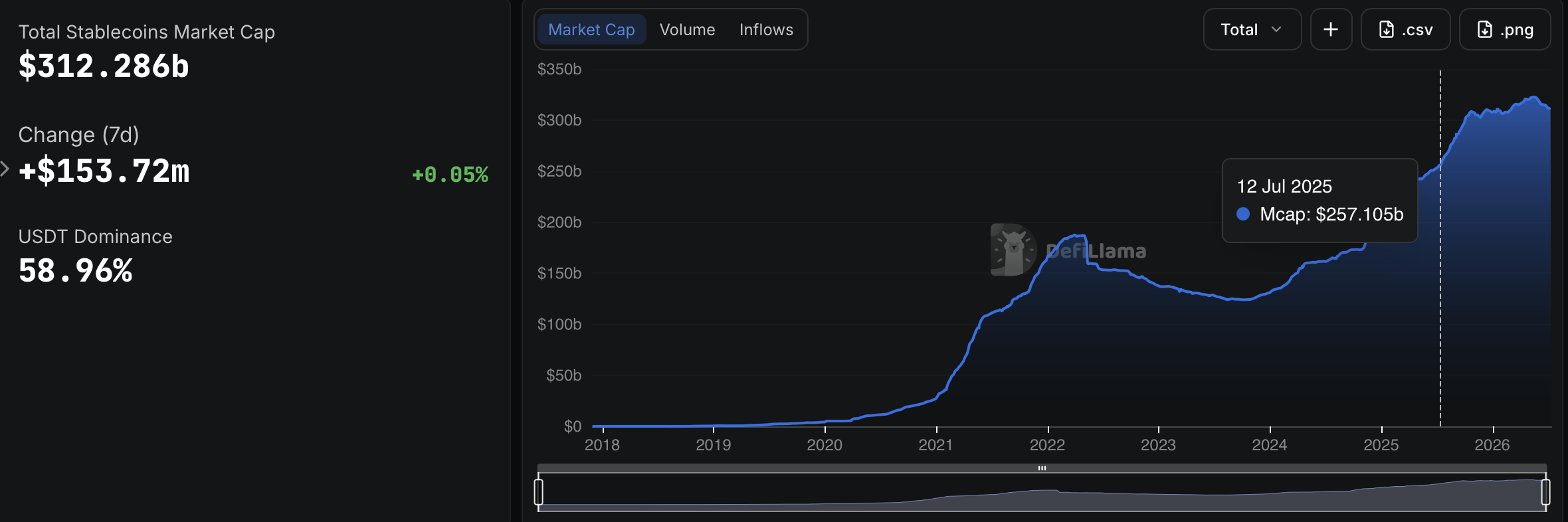
Source: Defillama
Technical Overview: Stablecoins and Corporate Liquidity
To understand the significance of the Hyundai pilot, it is helpful to look at how stablecoins function in enterprise environments. Stablecoins are digital currencies pegged to a reserve asset, most commonly a fiat currency like the US dollar. Unlike traditional cryptocurrencies, which experience high price volatility, stablecoins are designed to maintain a stable value, making them viable for corporate accounting and treasury operations.
The choice of the Avalanche blockchain for this pilot is technically significant. Avalanche is a decentralized smart contract platform known for its high transaction throughput and rapid sub-second finality. By processing transactions on a public blockchain, enterprises can bypass the traditional SWIFT network and intermediary correspondent banks, which often introduce delays, operational overhead, and higher transaction fees. This allows multinational corporations to achieve near-instantaneous settlement across international borders, optimizing liquidity management and working capital.